
Torbay Civic Society
William Pengelly1812–1894
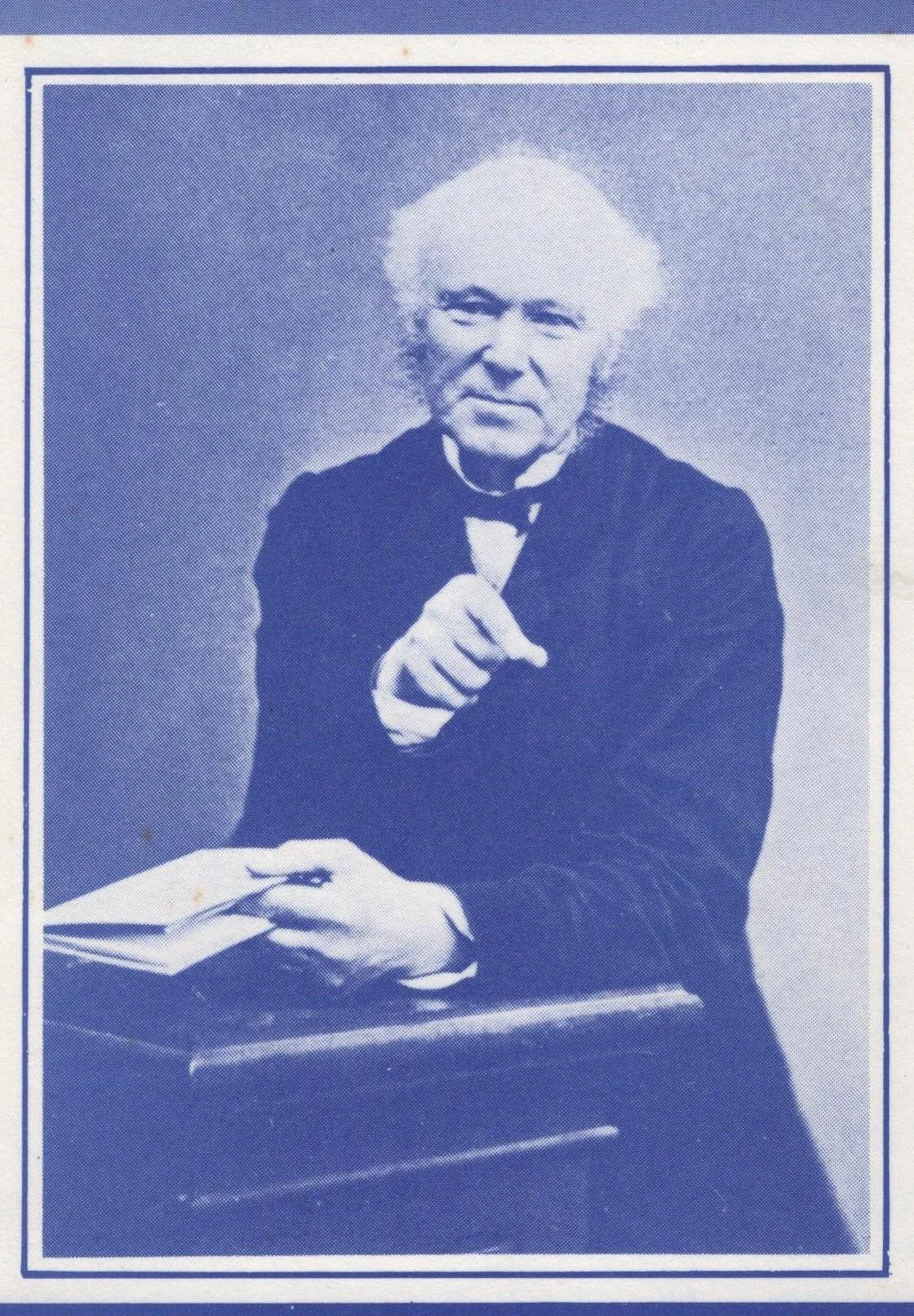
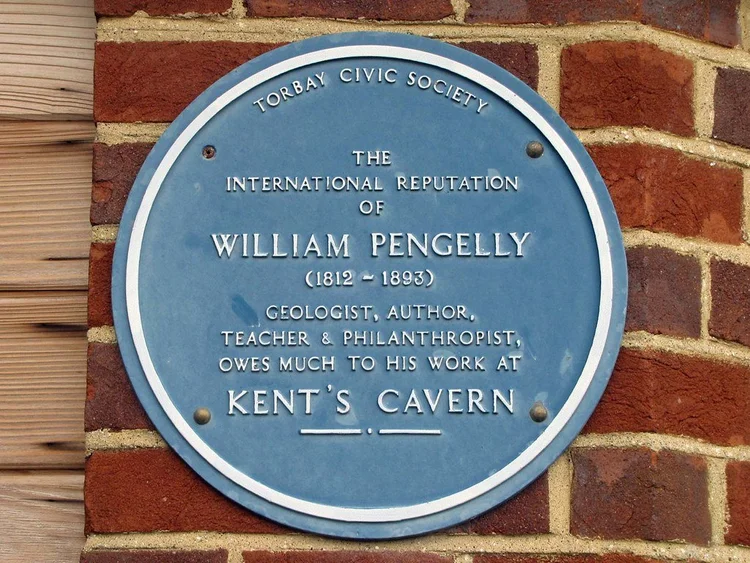
William Pengelly was a self-educated Cornishman from Looe who left school at the age of twelve. He came to Torquay as a penniless young man to make his way in the world, and within less than 30 years he had been elected a Fellow of the Royal Society. He was an eminent Victorian in the best sense of the word — highly successful, public spirited and greatly loved.
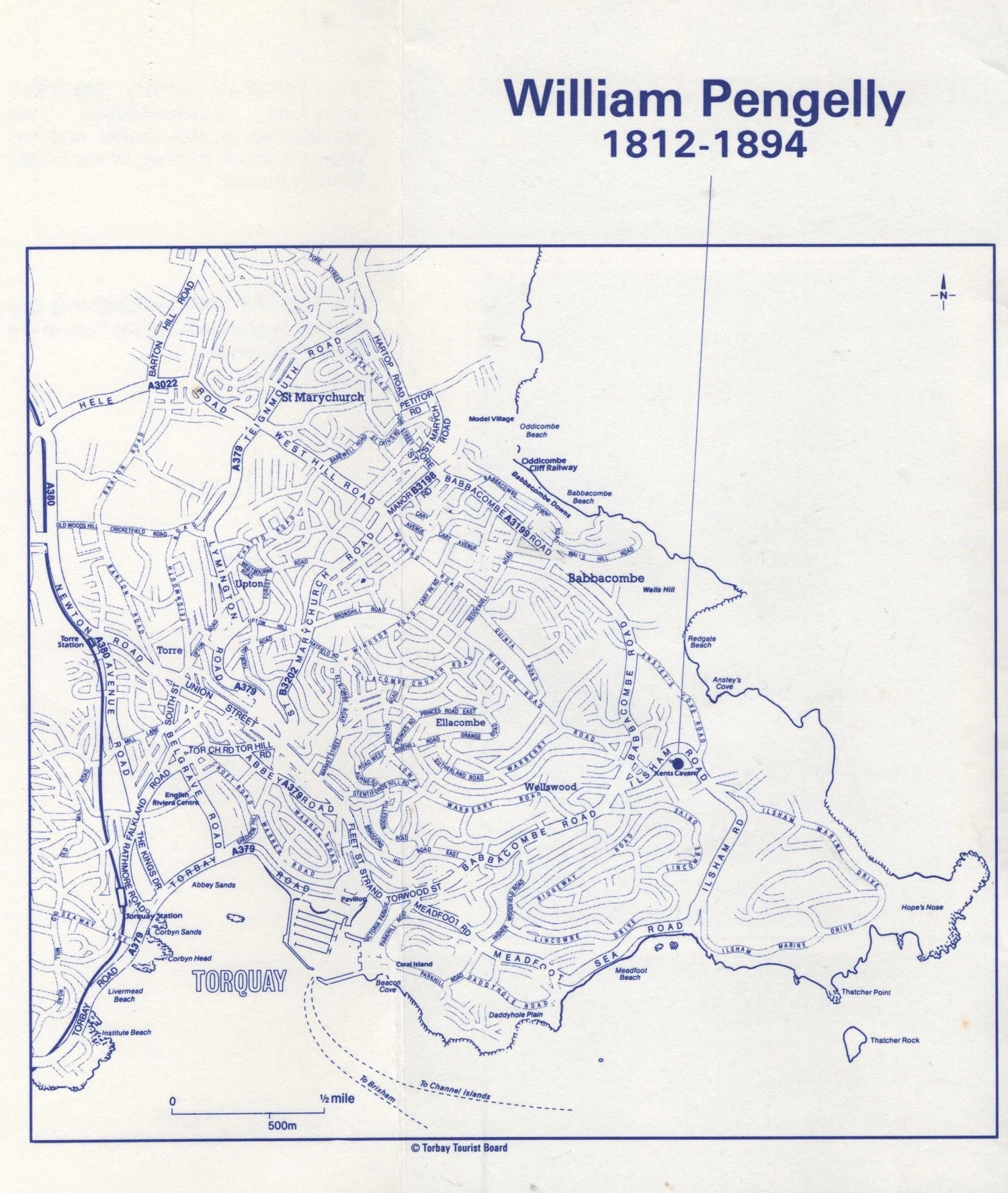
The Pengelly Hall at the Torquay Museum, which was built in the year of his death, commemorates his contribution to the life of the town as a teacher, a champion of popular education, and a living exponent of the new scientific interest in the physical world. Kent’s Cavern also commemorates Pengelly. It was the main workplace where he gained his international reputation, and which became a landmark in the uncovering of the story of mankind.
Although without private means, all the work for which he is still remembered both locally and nationally he did in the service of his fellow men, without payment or financial reward.
His formal education ended at the age of twelve. He spent four years working on the deck of his father’s small coastal vessel, but when his mother lost her other son he left the sea, became a pupil teacher in the local school and set out on a long and arduous task of self-education. He would think nothing of walking from Looe to Plymouth and back in search of a book he needed.
In the 1830s the new town of Torquay was a magnet to the countryside around, and Pengelly made his way there in much the same spirit that Dick Whittington made for London. But Pengelly didn’t have to turn again. Before very long he had a school of his own, and in the evening he walked down into Temperance Street and gave free classes to illiterate working men.
Within a year or two, the rich and the influential were beating a path to his door. Sir Arthur Quiller-Couch said he was the most inspiriting lecturer he had ever met. Members of the Dutch and Russian royal families were among his many private pupils.
As his reputation grew, so did his circle of friends, both in Torquay and outside. One of them, Edward Vivian, nephew of Lord Vivian, was to be his lifelong collaborator and lies in a grave next to his in Torquay Cemetery. With Vivian and others he founded in 1844 the Torquay Natural History Society which became the local base for his labours, and provided the focus of his scientific work.
1846 was a very important year for him. His private pupils had become so numerous he could afford to free himself from the burden of a school. Whereupon, with the backing of the Torquay Natural History Society, he made a start on what was to be his major work — research into the deposits of bones and fossils in the nearby caves. Some 34 years later, when he was 68, he lay down his hammer with the certain knowledge that his task had been accomplished. It was to make an important contribution to the thinking of his time.
Most Christians in the middle of the 19th century believed man existed as the result of a single act of creation. In BC 4004 according to Bishop Ussher, any challenge to the literal truth of the Bible was widely seen as threatening the whole basis of the Christian religion.
Science seemed to offer such a challenge, and for two reasons, Charles Darwin in The Origin of Species, was to portray the creation of man as a long, evolutionary process, extending back many hundreds of thousands of years. The geologists, and William Pengelly was one of them, were to confirm the Darwinian theory with the solid evidence of rocks, stones and fossils.
Pengelly began what was to be the major part of his life’s work in Kent’s Cavern in the year 1846, with the backing of the Torquay Natural History Society. Twenty years earlier a Roman Catholic priest, Father MacEnery, had unearthed in the cavern, or Kent’s Hole as it was called then, the remains of many primitive animals and many early men. But his findings had been ignored or plainly not believed. Pengelly repeated MacEnery’s work on a more thorough and systematic basis, but without gaining much more attention than MacEnery had done.
After the first foray into Kent’s Cavern, Pengelly’s fame and reputation as a geologist and a research worker spread in the scientific community beyond the boundaries of Torquay. When in 1858 a cavern was discovered at Windmill Hill in Brixham, Sir Charles Lyell and Thomas Henry Huxley gave him their full backing, and he was entrusted with its excavation.
He was now working on a project that was completely his own. From the start he insisted on the precise, measured, fully recorded approach to the excavations that was his hallmark — something new then but now standard practice. Sealed under a stalagmite floor he found both the remains of extinct animals and man-made tools. The results were conclusive, at least for the scientific world, and his growing reputation as a geologist was further enhanced. In 1863 he was elected a Fellow of the Royal Society, and in the following years he was to receive many further honours, including the Lyell Medal of the Geological Society.
Two years later he began the third leg of his work. He went back to Kent’s Cavern and applied the same techniques to all the chambers in the complex. Almost every day for 15 years he visited the cavern, and very frequently he would spend at least five hours washing, cleaning, labelling and recording the finds. When the task was completed there were 3,948 boxes containing something like 50,000 bones. They included the bones of lions, hyaena, cave bear and grizzly bear, woolly rhinoceros, horse, bison, stag and reindeer. What was perhaps more important, he found several hundred human artefacts, mostly made of flint. These still form the best sequence of stone tools found in any cave site in Britain. The earliest of them could possibly date back as much as 300,000 years.
Pengelly’s work at Kent’s Cavern established his long term reputation in the study of palaeontology and archaeology. Students and research workers continue to study the remains he discovered and repeatedly uncover new important details. This modern research would scarcely be possible, were it not for the meticulous care with which Pengelly recorded his discoveries, which was far in advance of anything before, and indeed of much that came later.
William Pengelly was in religious belief a member of the Society of Friends and in political belief he was a Liberal. He was acquainted with many of the leading scientists of the age, and many of them he included among his friends. He was a man of remarkable ability with a great breadth of knowledge, and although he left no major publication he published over a hundred papers on a wide range of subjects. His major work was in caves, and particularly Kent’s Cavern.
His best epitaph he wrote himself. He recited it with a gentle suggestion of self-mockery to an appreciative audience at the British Association meeting in Exeter.
Epitaph
Here rests his head on balls of album graecum;
A youth who loved Cave-earth and stalagmite;
If fossil bones they held, he’d keenly seek ‘em;
Exhume and name them with supreme delight.
His hammer, chisels, compass lie beside him;
His friends have o’er him piled this heap of stones.
Alas! alas! poor fellow! woe betide him
If, in the other world, there are no bones.
Research: Frank Cawson
About this series
This leaflet, and the plaque, is one of a series commemorating notable people, buildings and events in the history of Torbay, prepared by the Torbay Civic Society.