
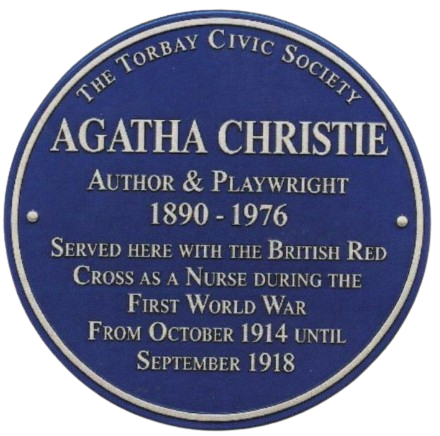
Agatha Christie
Wartime nursing and pharmaceutical training in Torquay, 1914 to 1918.
From Voluntary Aid Detachment nurse to dispensing assistant. The four years that gave the creator of Hercule Poirot a working knowledge of poisons.
Agatha Christie's service during the First World War was one of the most formative periods of her early life. Long before she became internationally famous as the creator of Hercule Poirot and Miss Marple, the young Agatha had acquired first aid experience and volunteered for wartime medical work in Torquay. Her years as a Voluntary Aid Detachment nurse and later as a dispensing assistant brought her into close contact with wounded servicemen, hospital routines, medicines and poisons. The experience gave her practical knowledge that would later become a distinctive feature of her detective fiction.
Preparing for wartime service
Agatha had prepared for voluntary medical work before or around the outbreak of war, although the precise chronology is not entirely clear. She undertook a St John Ambulance first aid course and obtained a First Aid certificate. She also gained practical experience by understudying nurses on district work and at Torbay Hospital. In her later recollections she admitted how inexperienced she initially was, but this preparation meant that when wartime nursing was required, she was ready to volunteer.
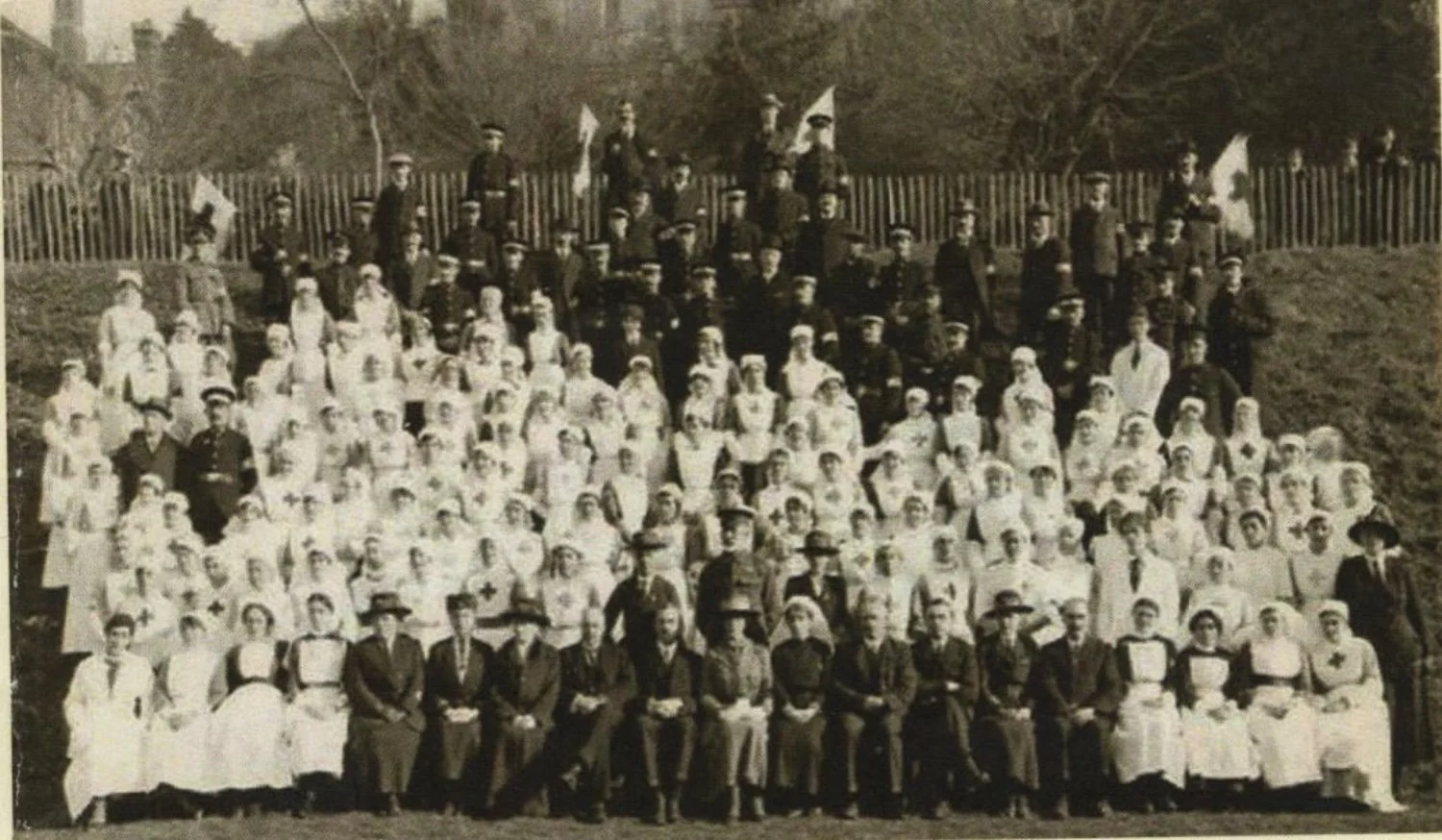
After Britain entered the war in August 1914, voluntary hospitals and auxiliary medical facilities were rapidly organised. In Torquay, Agatha joined the VAD and began nursing in October 1914. She became part of the large civilian volunteer effort supporting professional medical staff and caring for servicemen wounded or taken ill during the conflict.

A VAD nurse in Torquay
VAD nursing was practical and demanding. Volunteers assisted trained nurses with the everyday care of patients: making beds, cleaning wards, serving meals, helping patients wash and dress, preparing dressings and carrying out the routine work needed to keep a wartime hospital functioning. For a young woman from a comparatively sheltered background, it was an abrupt introduction to illness, injury, responsibility and disciplined hospital life.
Her nursing was associated with the wartime hospital facilities established in Torquay, including those at the Town Hall. Some later accounts differ over exact locations and dates, and Christie herself was not always precise when recalling events many years afterwards. What is clear is that she began VAD nursing in October 1914 and that a severe attack of influenza interrupted her nursing work in 1915.

From nursing to the dispensary
After recovering, Agatha moved into another branch of wartime medical service. Encouraged by her friend Eileen Morris, she joined the dispensary team later in 1915. The change proved important. Nursing had introduced her to the care of patients; dispensary work introduced her to the preparation, measurement and controlled use of medicines.
Christie described herself as a dispensing assistant and at times as the third dispenser. Although the older term apothecary was still in use, her work was essentially pharmaceutical. Under supervision she learnt to prepare prescriptions accurately, measure ingredients and understand the properties of drugs. Precision was vital, since substances that could heal in the correct quantity might be dangerous or fatal if wrongly prepared or administered.
Pharmaceutical training and poisons
The dispensary became a place of serious study as well as wartime service. Agatha undertook formal pharmaceutical training and studied for examinations associated with the Society of Apothecaries. Her work required knowledge of drug names, preparations, dosages and toxic substances. She became familiar with compounds whose effects depended on very small differences in quantity and developed a lasting interest in poisoning.
This knowledge later gave her crime writing unusual authority. Christie did not use poisons simply because they sounded dramatic. She understood how medicines were stored and dispensed, how dosage affected the body, how symptoms could resemble natural illness and how apparently ordinary preparations might become lethal. Poison consequently became one of the most characteristic methods of murder in her fiction.
The Mysterious Affair at Styles
It was while working as a dispensing assistant during the war that Agatha began the detective novel that became The Mysterious Affair at Styles. She had already written poems, stories and attempted novels, but without comparable success. Her new manuscript drew naturally upon a world she now knew: wartime England, convalescing officers, VAD service, Belgian refugees and, above all, the use of poisons.
The Mysterious Affair at Styles is the novel that introduced Hercule Poirot to the world. Published in 1920, it follows Poirot as he solves the murder of a woman at the home of Emily Inglethorp, a Belgian refugee who helped him settle in England. The novel is notable for its detailed illustrations, including maps of the house and the murder scene. Poirot's method of solving crimes by understanding the minds and motivations of suspects, rather than relying solely on physical clues, revolutionised the mystery genre and remains a hallmark of Christie's work.
It is tempting to identify exact real life models for Christie's characters and incidents, but such claims should be treated cautiously. Her wartime experiences undoubtedly supplied knowledge, atmosphere and possible inspiration. Proving that any particular person or local event directly became a fictional character or episode is much more difficult.
Service to 1918 and its lasting influence
Agatha continued pharmaceutical work through the remaining war years, completing a period of wartime service that extended to 1918. The change in her experience was remarkable. In 1914 she had entered voluntary nursing with limited practical knowledge. By the end of the war she had worked in hospital conditions, cared for servicemen, trained in dispensing and acquired specialist knowledge of medicines and poisons.
Those years became an important foundation for her later literary career. The discipline of nursing, close observation of people under stress and the exactness demanded in a dispensary all found echoes in her fiction. Her pharmaceutical knowledge was especially enduring: throughout dozens of novels and stories she repeatedly used poisons in ingenious but medically informed ways.
Christie's wartime contribution should therefore be remembered in its own right, not merely as a prelude to literary fame. She was one of many women who gave their time and energy to voluntary medical service during the First World War. In her case, however, wartime nursing and pharmaceutical training also created an extraordinary bridge between practical service and twentieth century literature.
A note on the historical record
Some details of Christie's wartime service remain disputed or are described differently by biographers and local historians, particularly the precise dates and locations of her nursing and dispensary duties. Her autobiography, written many years later, can also be vague on chronology. It is therefore sensible to distinguish the well established outline of her VAD and pharmaceutical service from later speculation about the exact people, places and events that may have influenced individual works of fiction.
Acknowledgements
Historical photographs and Agatha Christie service record: British Red Cross. Text adapted from various sources by Rob Drew on behalf of Torbay Civic Society. Plaque sponsored by Torbay Civic Society.