
Torbay Civic Society
The Bijou TheatrePaignton
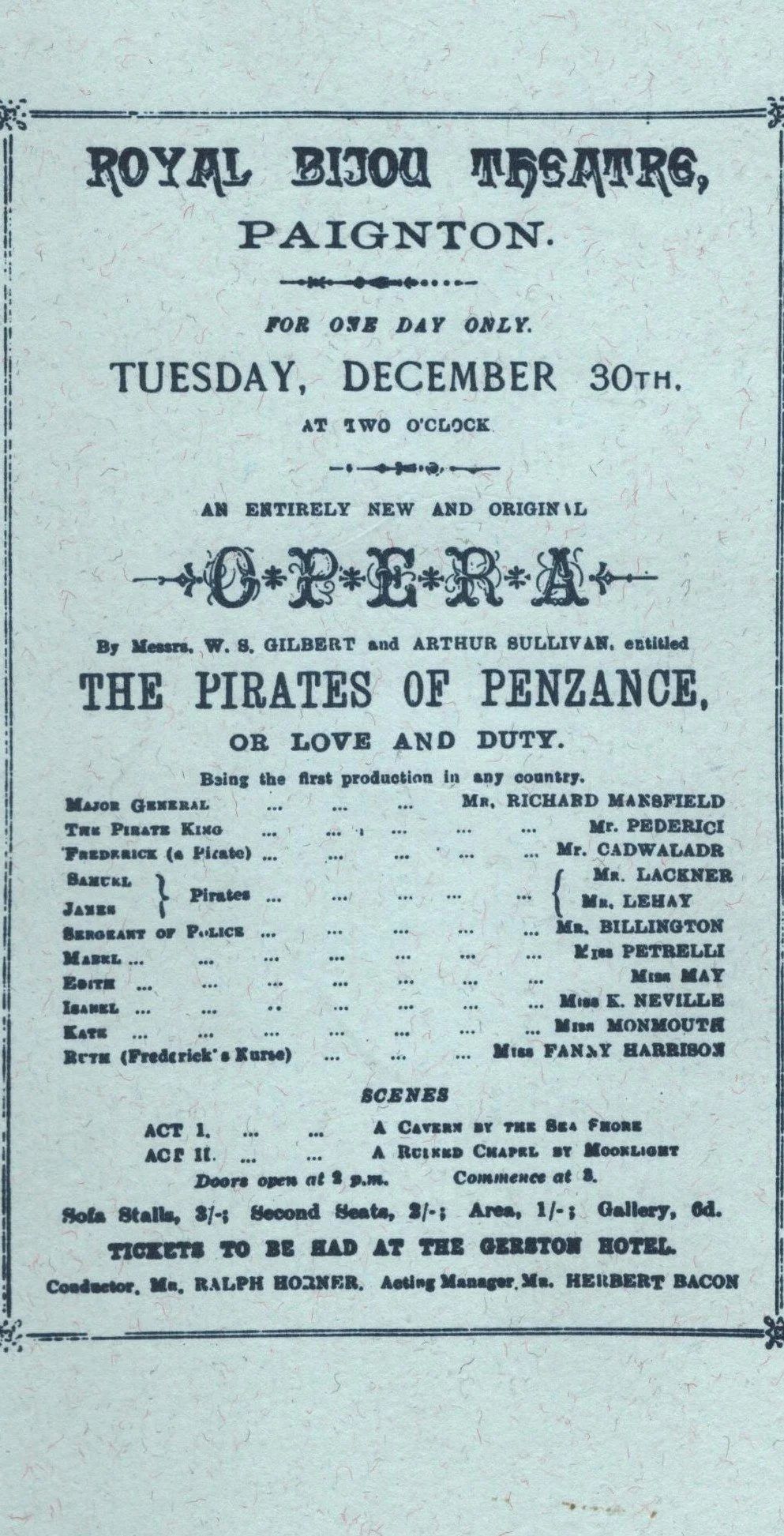
‘Bijou’ comes from the Breton word for a jewelled ring. It was a prophetically appropriate name for a theatre that was extremely small, that lasted a lifetime and that was prized above everything else as a token of a very special event. Such a theatre was the Bijou Theatre in Paignton.
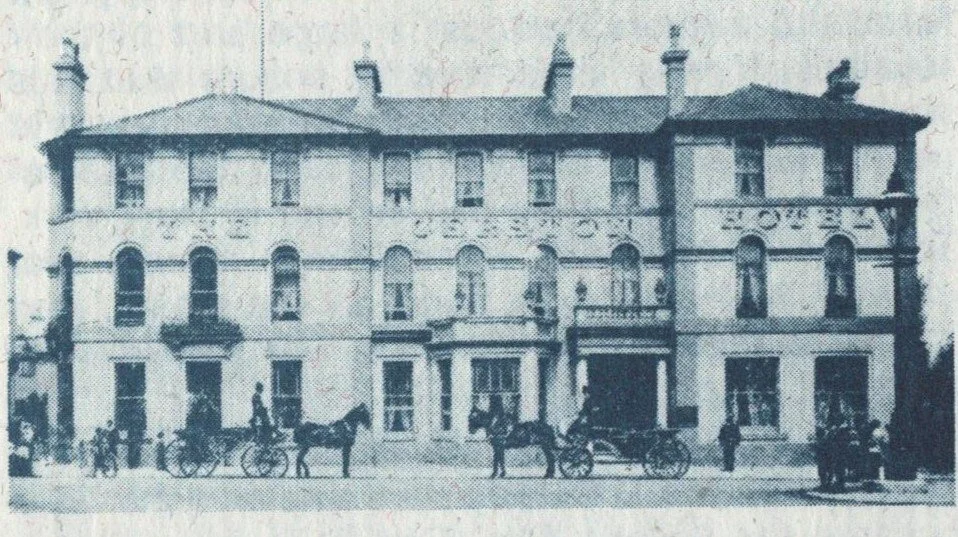
Paignton was no exception to the rule that when the railway comes to a town an hotel is built by the station. The Gerston Hotel was opened in 1871, two years after the railway arrived in the town, and some years after The Grand, which had been built beside Torquay Station and The Clarence, beside Torre.
But Arthur Hyde Dendy, who built The Gerston, did not envisage it merely as an ordinary station hotel. The Gerston was planned to be the focus around which the town would have a brilliant new social life. Paignton was now connected by its new shining metalled track with the whole of the outside world. Hence the publicity for the new hotel proclaimed: “The Gerston Saloon, billiard and supper rooms magnificently fitted up and brilliantly lighted”. It was equipped in the style of a private drawing room. It was hung with oil paintings of a kind that had never been seen in Paignton before, at least ouside a private house, and a set of the best quality sofas lined the walls in splendid ostentation.
The first function was a ball, and this was held under the patronage of Mrs. Henry Studdy of Waddeton Court, an untitled lady, it must be admitted, but these were early days. Ladies and Gentlemen wishing to attend the ball had first to obtain vouchers from her as a proof of their social acceptability. Only then were they allowed to purchase tickets. The lucky ones danced to a band of no less than 15 musicians from 9.30 until midnight, and when the clock struck twelve each gentleman took a lady on his arm, the doors were opened and they paraded into supper.
Ten days later the Saloon was graced by an occasion no less splendid, but of rather a different kind. As a result of this function the Saloon was known from then on as ‘The Gerston Saloon and Bijou Theatre’. Four gentlemen, assisted by three professional actors from London, staged a triple bill which consisted of a comic drama entitled Delicate Ground, or Paris 1793, a farce, The Area Belle and a burlesque drama, The Port Admiral.
At this first performance the sofas were arranged in rows to form the stalls, the tickets for which cost 3/-(15p) and 2/-(10p), while the less opulent could sit at the back or they could promenade, which was the fashionable word for standing up, at a cost of 1/-(5p). We hear that flys and horse omnibuses were hired to bring patrons from as far away as Torquay. But there could not have been all that many of them, for the Bijou never seated more than 70, even when a gallery was built some years later to house the overflow.
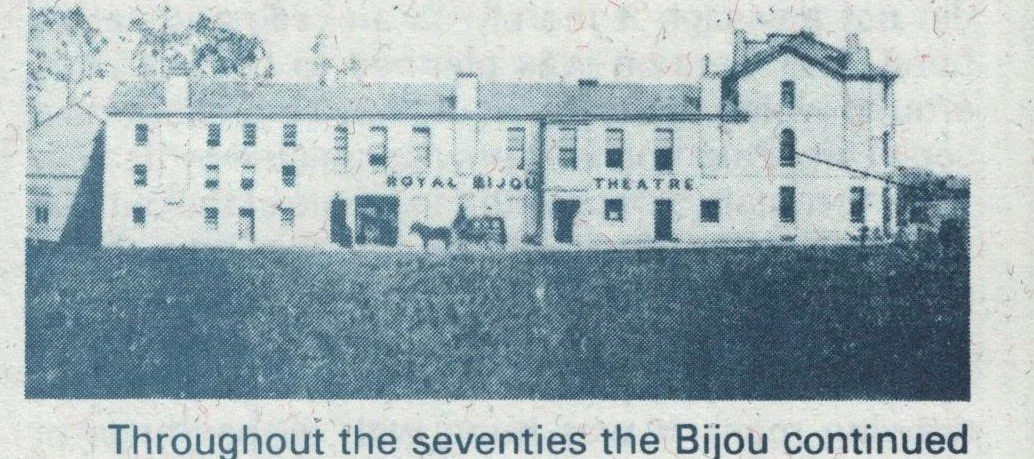
Throughout the seventies the Bijou continued to be used both as a Ballroom and a Theatre. The Easter Ball in 1872 achieved even greater social acclaim than ever, being held under the patronage of no less a personage than the Dowager Viscountess of Masserene and Ferrard, and she was assisted by Lady Seale of Dartmouth. The cost was 12/-(60p) a head (10/-(50p) for a lady) and this included refreshments during the evening and a champagne supper. The special train for Newton Abbot, with connections to Plymouth, did not steam out of Paignton until 3.10 on the following morning.
Not very long afterwards the words Royal Bijou Theatre were painted along the side of the hotel in letters almost two feet high. What was the reason for this grand appelation, albeit an appelation without the authority of Buckingham Palace? Tradition has it that the inspiration for this majestic claim was a visit paid to the theatre by Prince Edward and Prince George (later King George V) when they were cadets at Dartmouth.
But a theatrical occasion of even greater significance came in 1879.
A new work of W.S. Gilbert and Arthur Sullivan, the Pirates of Penzance, was due to have its first night in New York on 31st December, the last day of that year. Almost at the eleventh hour the authors were informed that they would forfeit their copyright unless a performance could be staged in England before that date. Their previous work, H.M.S. Pinafore, had also had its premiere in New York, and for this reason they now learned, such were the vagaries of the American copyright laws, the authors had lost a large part of their royalties. It was imperative to ensure that this should not happen again. But time was short and neither Gilbert nor Sullivan had been apprised of the situation until they had arrived in New York. To make matters even more difficult a great deal of work had still to be done on the Opera, and it is even reported that Sullivan was still working on the score on Christmas Day.
Helen Cowper Black was at that time the secretary to the D’Oyly Carte Company (she later became the second Mrs. Carte). To her fell the unenviable task of getting the Pirates of Penzance performed on an English stage before the 31st December. Never can a performance have been arranged in such haste, and with so little notice. It was done for the lawyers, without a cast, without rehearsals, without costumes and without a completed score.
But Miss Black had one stroke of luck. A D’Oyly Carte Company was putting on a performance the week after Christmas. It was H.M.S. Pinafore — but that didn’t matter.
What did matter was that the performance was at Torquay and there was the Bijou Theatre in Paignton.
Handbills were rushed out announcing “an entirely new and original Opera”, “the first production in any country”. The Town Crier was employed to proclaim the extraordinary news. On 30th December the town of Paignton would see the first ever production of a new Gilbert and Sullivan opera. It was just one day before the opening in New York.
The audience numbered no more than 50 — the public may have sensed that legal requirements rather than dramatic excellence would characterise the occasion. They may have wondered whether 3/- for a seat on the sofa, even in the front row, was not perhaps too much to pay for a performance in which none of the cast had proper costumes, and a spotted handkerchief was thought to be sufficient to indicate that a man dressed in the uniform of an English sailor was none other than a pirate.
No doubt when a production by amateurs was staged to mark the 50th anniversary of this event, the performance was rather more polished. A performance on the 70th anniversary was marked by a plaque.
For the last 30 years the old traditions of the Bijou Theatre have been kept alive by Miss Greta Huggins and her friends. The venue was moved to a converted stable block which held a maximum of 60. From a repertoire that ranged from Shakespeare to Chekhov and Agatha Christie they filled the theatre for a week, three times a year.
But now even the stable has gone, and by the time of the 100th Gilbert and Sullivan anniversary, a performance of the Pirates took place on the stage of the Palace Avenue Theatre. It is here to this day that the New Bijou Theatre Company keeps alive a tradition which is now more than a century old.
Research: Joyce Packe
About this series
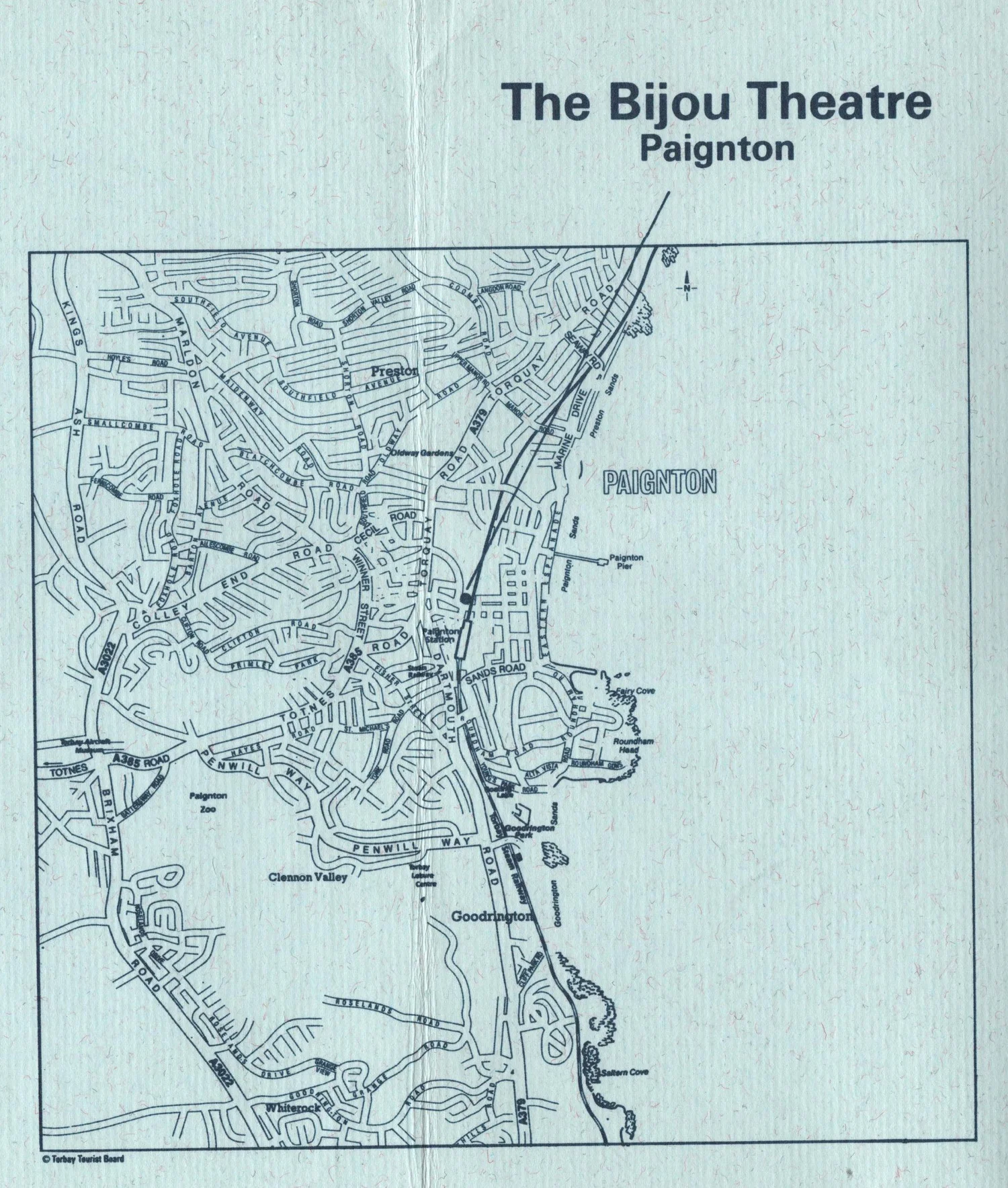
This leaflet, and the plaque, is one of a series commemorating notable people, buildings and events in the history of Torbay, prepared by the Torbay Civic Society. The plaque marks the site of the Bijou Theatre, on the corner of the last building in Hyde Road, opposite Paignton railway station.