
Torbay Civic Society
Hesketh CrescentTorquay
In 1844 when the railway from London reached Newton Abbot, the building of houses in Torquay increased apace. It needed little foresight to see that when the railway eventually reached the town itself, as happened three years later, something would have to be done to prepare for an influx on an altogether different scale.
The population of Torquay at this time was little more than 10,000. The main buildings, which were rented by the rich visitors for the winter, consisted of a hundred or so large villas, two hotels, a Bath spa, some magnificent churches and three splendid terraces. The fourth, and by far the grandest, had been more than half completed by the time the railway arrived.
Like the previous terraces, it was built by the Harvey brothers in the elegant new style of John Nash, a style that provided the perfect backdrop for the elegant goings on of a Britain that had become wealthier and more fashionable.
These four terraces today, overshadowed as it may be by car parks and sheltered housing, are a lasting reminder of a former age. They are a reminder of the elegance and ostentation that graced the town when it was a fashionable watering resort of the crowned heads and nobility of much of Western Europe.
The first to be built was known simply as Higher Terrace. In those days there was little else in the town except the Harbour, above which it stands so prominently to this day. When first built it was the only sizeable building in the town.
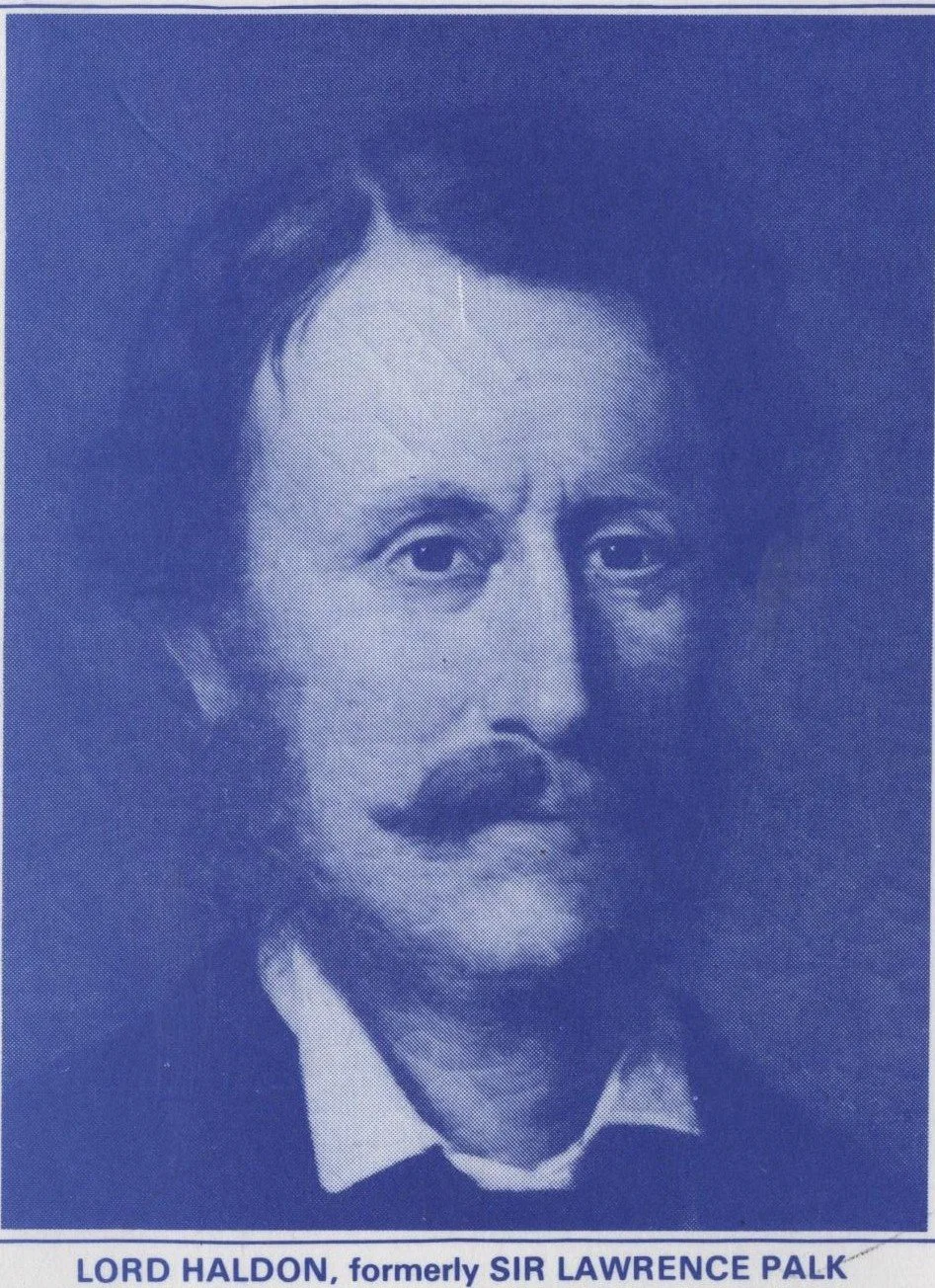
Lawrence Vaughan Palk, the Lord of the Manor, was associated with the next two of the terraces. The one that runs along the west side of the Harbour, he called Vaughan Terrace, after the maiden name of his wife. While Lisburne Terrace, which curves magnificently up a hill about half a mile along Torwood Street, he named after his father-in-law, the Earl of Lisburne.
It was perhaps the awareness that the coming of the railway was to transform things altogether that inspired the best and latest of Torquay’s Georgian terraces. By this time Sir Lawrence Vaughan Palk had long ceased to be the dutiful husband and son-in-law and was an absentee landlord almost on his deathbed after a life of dissipation in London and France. Wine, women and gambling monopolised his interests and consumed his fortune.
Eventually his agents in Devon were faced with a bill if the Baronet was to escape imprisonment for debt. He was hastily and very furtively despatched to France after some of the money had been found by selling a large stretch of land between Newton Abbot and Torquay. The land was bought by the railway developers. The fact that the agents of the absentee baronet had to raise money so desperately helped more than a little to speed up the arrival of the railway and the coming of age of Torquay.
And it speeded up the building of the fourth terrace, in which the Baronet’s son, who was later to become Lord Haldon, took a leading part. Where the father had been shiftless the son was ambitious, where the father had wasted his fortune, the son was full of plans to restore it. That is if there was anything left by the time he entered into the succession. He did what he could to hasten that day by trying to have his father declared insane.
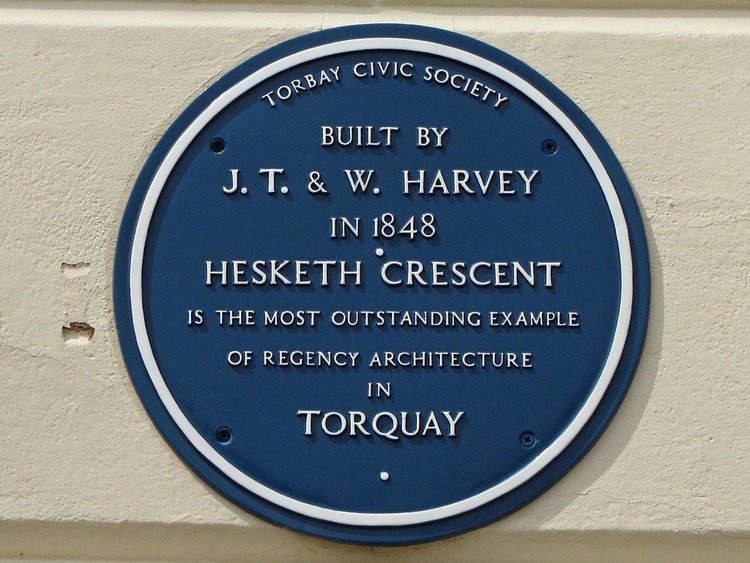
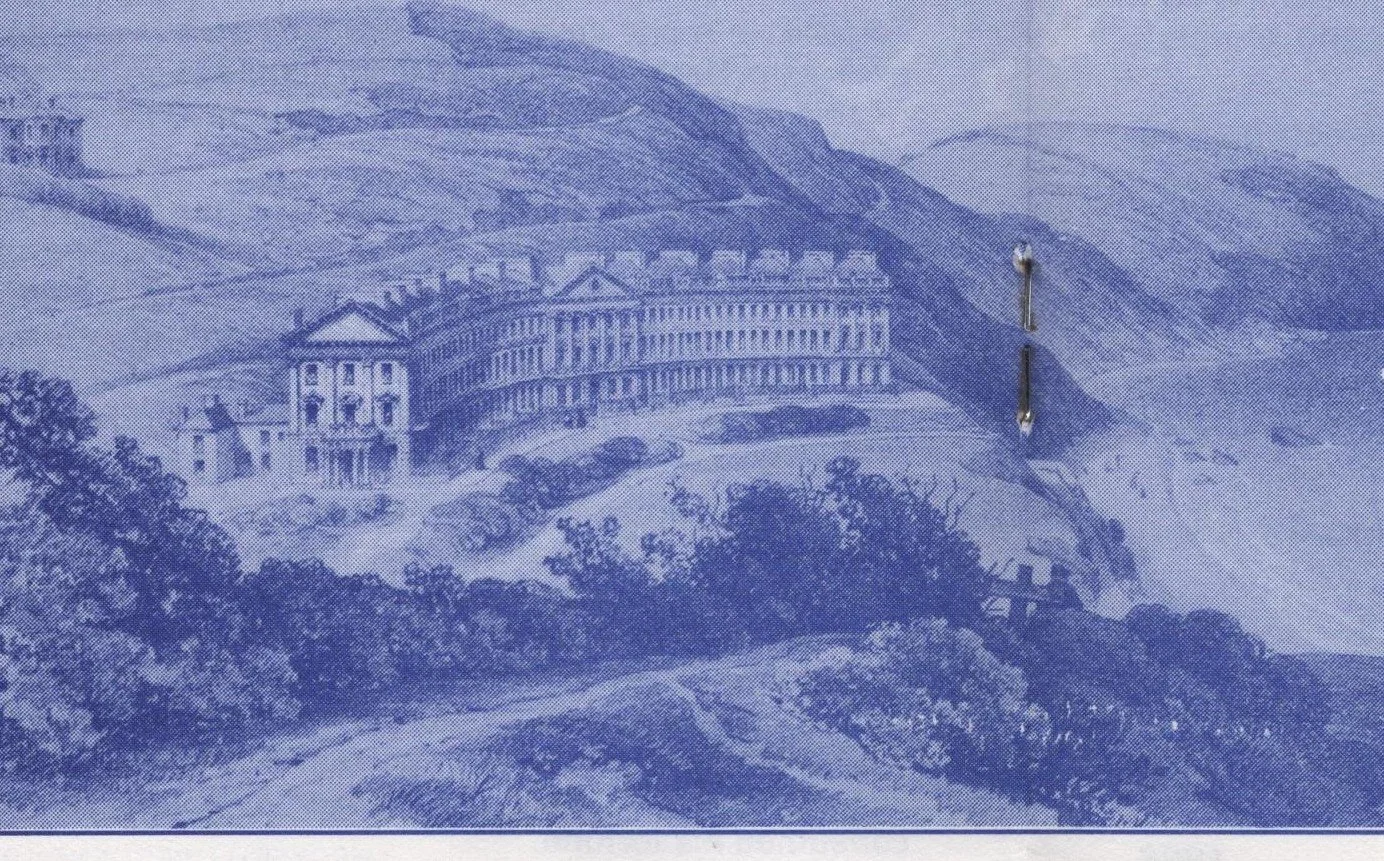
The builders were the Harvey brothers, and what they built remains without doubt the most elegant building in the town, described by a contemporary “as one of the finest crescents in the West of England.... the Regency ideals of London and Brighton reached their highest standard....”
It has 47 windows on the first and second floors while the central house, with five windows, has more ornamentation. The two end houses show elegant side pediments. The influence of Nash is very apparent; the proportions are perfect and the quality of the ornamental stone and ironwork places the building in a class of its own.
Just before the building was due to open some startling intelligence reached his son. In the absence of his father he had been occupying the great family mansion, now demolished, which his father had built on Haldon Hill, between Dawlish and Exeter.
The news was to the effect that his father, disabled and terminally ill had expressed the wish to return to his Estates and take up residence in the family home. The letters between father and son flew back and forth. The father enquired after the condition of the plate and crockery, and the son positively insisted that if the father returned it was to be without his French mistress.
Eventually the father came back and took up residence in Haldon House, while his son, by a most fortuitous piece of timing, was able to move into the new terrace. Here he lived for some considerable time with his wife and family. He had married into the Heskeths, who had an estate near Southport in Lancashire. Lady Hesketh was a frequent visitor.
In keeping with precedent it was soon renamed Hesketh Crescent, and became for a while a most sought after address.
In Victorian Torquay the visitors did not come for a fortnight in the summer or for a bargain break in the off-season, as they do now. They came as a family, with servants and coachmen, and more often than not they stayed for the season, which stretched from October to April or May. Sometimes they bought one of the large villas, with an acre or two of ground and room for six or seven servants apart from the coachman and groom, and returned to it a year after year. Sometimes they rented the whole large house furnished. Others preferred to rent unfurnished and to bring their furniture and luggage and sometimes even their carriage in a van attached to the train.
While they were here they passed the time going for rides in their carriages, promenading and entertaining one another to soirées, dinner parties and dances. There was much painting and drawing and making of music and playing charades. The focus of all this activity was the private villas themselves. What attracted them was the mildness of the winters, the health-giving properties of the air and the unspoilt beauty of the scenery.
For such a visitor Hesketh Crescent was admirably suited. There were initially eight very large terrace houses, with servants’ quarters on the top floor, four situated on either side of the central house. This was known as Osborne House. It was for those whose demands were less extensive and whose stay was perhaps shorter.
Why it was called Osborne House is not clear. Perhaps it was named after the residence of Queen Victoria on the Isle of Wight. Within a few years two more terrace houses and an end block had been added to each side of the Osborne Hotel, as it had become.
The Hesketh Crescent had its share of distinguished visitors. Perhaps the most famous was Charles Darwin, who stayed here for two months in 1861, when he was revising The Origin of Species and working on the botany of orchids.
Another visitor was Isambard Kingdon Brunel, in the early days of his association with Torquay, when he and his wife shared a house with his sister and brother-in-law, the Horsleys.
For many winters the end house was occupied by the Baroness Burdett Coutts, before she moved to Ehrenburg House, the site of the present English Riviera Centre.
In the 1900’s John Galsworthy the playwright stayed there, and in one of the houses Henry James wrote The Spoils of Poynton. It was much frequented by the musicians who came down for the festivals arranged by the Torquay Municipal Orchestra.
In November 1850 the Torquay Directory carried an advertisement: “Osborne Crescent, Centre of Hesketh Crescent. To let in suites of apartments by Mrs. Cather.... House porter will leave with letters for the post half an hour before the box closes.”
Research: John Pike
About this series
This leaflet, and the plaque, is one of a series commemorating notable people, buildings and events in the history of Torbay, prepared by the Torbay Civic Society.