
Torbay Civic Society
Ella Rowcroftand her two houses, Pilmuir and The Rainbow
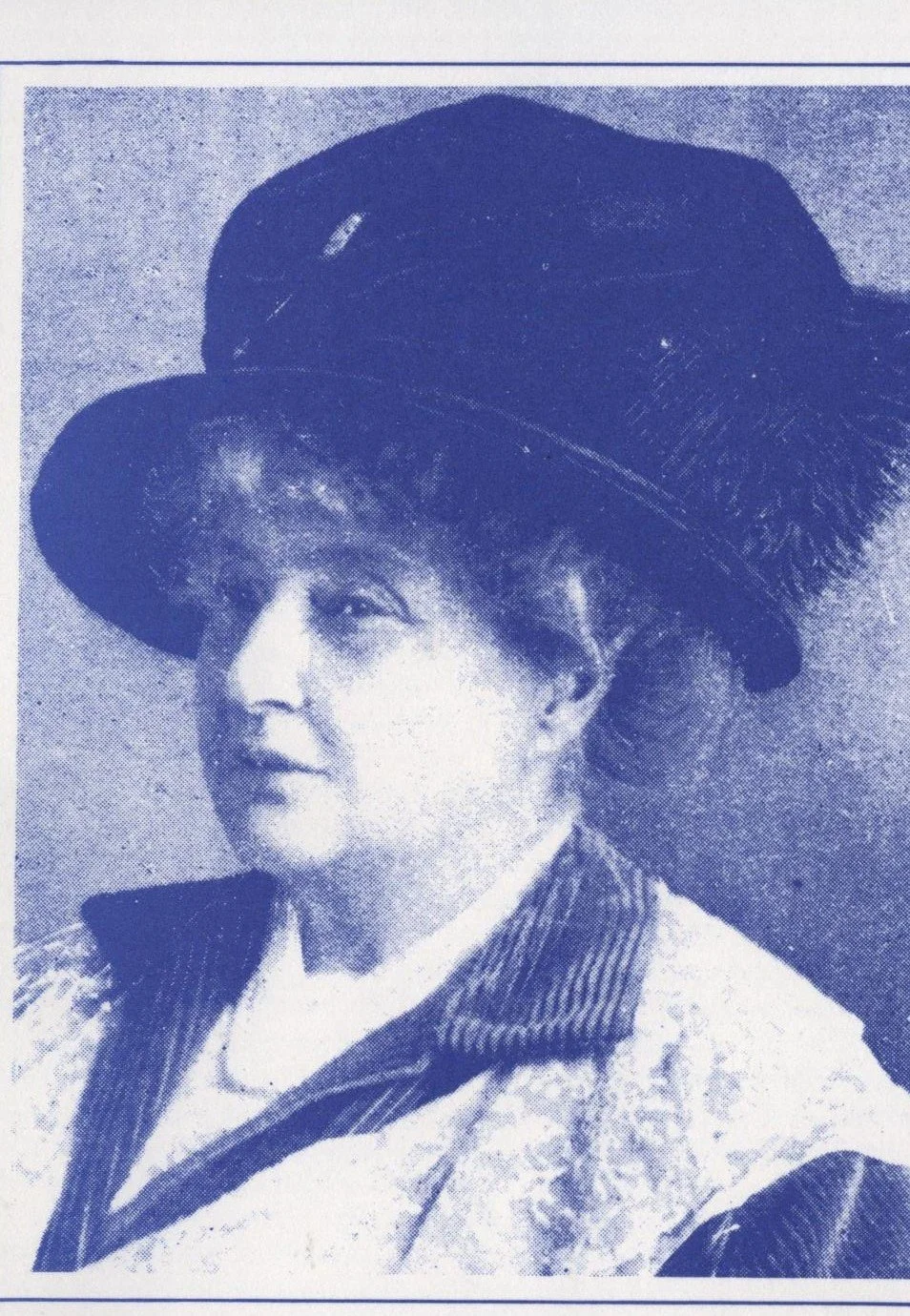
Ella Rowcroft came to Torquay just before the first world war and lived here until her death in the early days of the last war. Her name is remembered in Rowcroft Road, Paignton, in the Ella Rowcroft Ward in Torbay Hospital, and most significantly of all in the Rowcroft Hospice. She was one of the great benefactors of the town, of which she was made a Freeman.
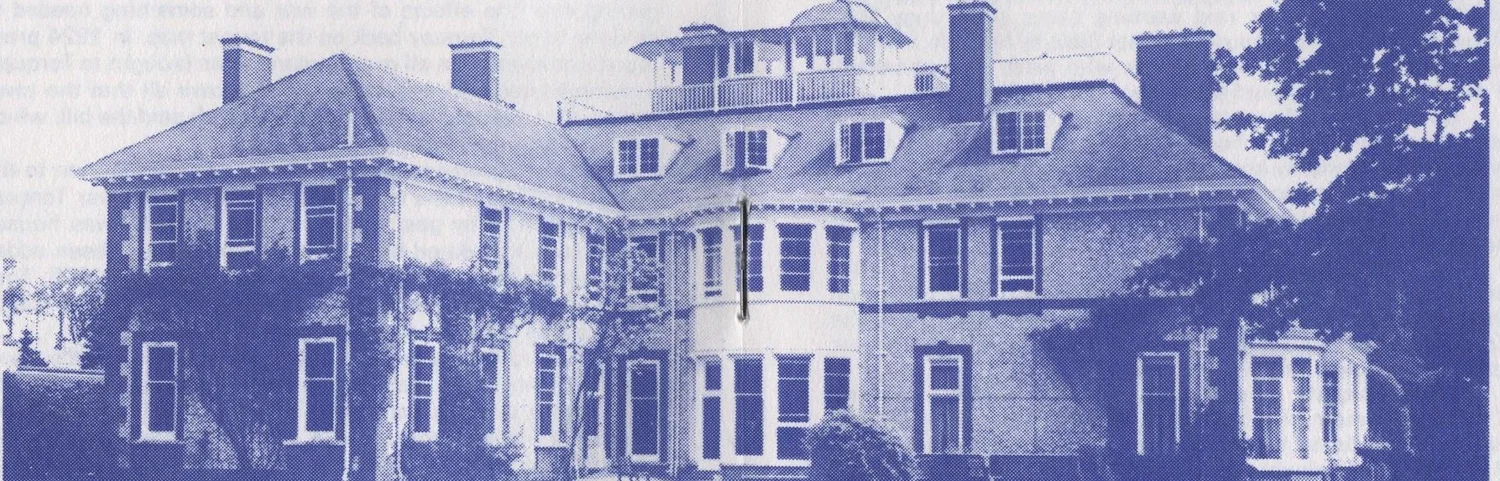
She bought Pilmuir and lived there for fifteen years. She endowed it as a Convalescent Home in 1935 and in 1982 it became Rowcroft Hospice. The Rainbow she built in the grounds of Pilmuir for her companion and housekeeper, and lived there herself for the last six years of her life. Ella Rowcroft’s memory and these two buildings are an important part of the history of the town.
Ella Wills was the daughter of Sir Edward Payson Wills, a Director of the Imperial Tobacco Company. She married Francis G.T. Rowcroft in Bristol Cathedral on 25th November 1905. Little is known of Francis Rowcroft or what became of him beyond the fact that he was the son of Lieut-Col T.T. Rowcroft of the Bengal Army, that he was a B.A.(Cantab.) and that he came from Tilehurst in Berkshire.
When Ella Rowcroft arrived to take up residence in Torbay in 1912 she came with her sister, Violet Wills. Their first home was Barcombe Hall, Paignton, where they lived for some eight years. They then moved to Pilmuir, a large house in five acres of ground quite recently built on the site of a Georgian residence, the home of Lord Sinclair, which had been demolished.
The first service rendered by Ella Rowcroft to the citizens of Torquay was a public relations exercise. The country was getting over the effects of the war and something needed to be done to put Torquay back on the tourist map. In 1924 press representatives from all over England were brought to Torquay, accommodated and entertained, and shown all that the town had to offer the holidaymaker. Ella Rowcroft paid the bill, which was said to come to some £3,000.
But she is remembered chiefly for her contribution to the medical welfare of the town. After the first world war Torquay hospital, still lit by gas, and with only 64 beds, was housed in buildings that dated back to 1850, and had not been added to except for the provision of a children’s ward in 1909. They occupied a small and quite unsuitable site, where Castle Chambers is today. The problem was money.
In the days before the National Health Service most hospitals were paid for and supported by voluntary contributions and public subscription, and Torquay was no exception. Residents were encouraged to join a contributory scheme, costing 1d. a week for everyone over 14 years, and 2d. a week for all the children in the family. If a person who was not a member fell sick he was charged 3/- admission and he had to undertake to become a subscriber when he recovered. If he didn’t he was fined 5/-. Those who subscribed a guinea a year were allowed to recommend one person for in-patient treatment.
In 1891 the population had more than doubled and the hospital was finding it difficult to cope. Steps were taken to try to find a bigger site and build a larger hospital. By 1925 the population had doubled again and still nothing had been done. A town meeting was called and a committee set up under the chairmanship of the Mayor. It had first to raise £100,000 and then build a new hospital on a site away from the centre of the town.
Major Kitson offered to sell Hengrave House, a freehold property with some fifteen acres of land off the Newton Road. There was some opposition on the grounds that if, as seemed likely, Torquay and Paignton were to join together, a more central site would be better, perhaps at Cockington. But the Committee eventually decided in favour of Hengrave House, and Ella Rowcroft produced the £8,000 for its purchase.
But she did much more than that. She offered, in the words of a contemporary, “a gift of such munificence as has not been equalled in Torquay before”. She wrote to the Committee and offered the sum of £100,000, a sum worth millions of pounds by today’s money. In addition she and her sister found a further £13,000 between them to set up an Endowment Fund to pay the stipend of a Hospital Chaplain.
Her letter setting out the conditions of the gift was businesslike and illuminating. She pointed out that her gift would not meet all the costs and said:
In offering my gift I do so subject to your Committee undertaking that they will not relax their efforts to raise these further moneys and that they will do all in their power to obtain the funds required for the equipment and furnishing and also a substantial amount (say £30,000) for the foundation of the Endowment Fund by the time of the opening of the Hospital.
She continued:
As provision has already been made in the title deeds of the site of the new Hospital that no vivisection or cognate treatment shall be permitted on these premises it shall be a condition of my offer.... that this provision in the title deed will be loyally and honourably observed in the new Hospital.
She also had very definite views on Church matters and it is of interest that she was able to stipulate the type of spiritual care the hospital patients were to receive. The chaplains must be....:
Christian Churchmen and believers in and teachers of the plain truths and doctrines of the Bible as taught in the Church of England in the past and free from the new and questionable modernist teachings and from the teachings of the Anglo-Catholic Church and the Roman Catholic Church...
The foundation stone was laid by Ella Rowcroft on 23rd June 1926, the hospital was opened on 17th November 1928 by Lord Mildmay of Flete, Lord Lieutenant of the County, and the Chapel was dedicated on 12th August 1930 by the Rt. Revd. Lord William Cecil, Bishop of Exeter. By a sad irony illness confined Ella Rowcroft to a wheelchair for the first event and prevented her ever from attending the other two.
Among the other recipients of her charity was a rescue home for girls in Japan and a YMCA hut for soldiers in France.
Mrs. Davey, who as a girl of 15 worked for a short time on Mrs. Rowcroft’s staff at Pilmuir, has given us an account of how things were. She describes Mrs. Rowcroft as a very charming lady, gentle and sweet, always concerned about her staff and their families. Each morning Mrs. Davey had to put chairs on each side of the landing, with prayer books on each chair, and all members of the staff were expected to attend morning service at 10.15. It was the morning service on the radio, and it was relayed from Mrs. Rowcroft’s bedroom.
Each Saturday she had to collect boxes of fruit for each member of the staff and put them in their bedrooms, together with a little dish of sweets. The head gardener used to come each morning with flowers and violets whenever possible and freshly cut grapes.... she had quite a few cars, one being specially designed for her wheelchair.
In 1935 she commissioned Edwin Lee to build a second house in the grounds for the use of her companion and housekeeper, Miss Mary Delve. When he showed her a photograph of the new house with a rainbow behind it she found the name for it there and then.
In design and materials and conception The Rainbow was a very special house. It had a magnificent staircase in white and fleur de peche marble from France; it had splendid oak panelling and wallpaper specially designed by Graham Sutherland. In the grounds was a boating lake and a boat in the shape of a swan. The house cost £70,000.
When Miss Delve died shortly after its completion Ella Rowcroft decided to move in there herself. Her sister Violet published a book of Ella’s poems some years later, and it is possible this one may have been written in the house.
The Rainbow
The Rainbow is a solemn pledgeOf God’s true promise from above
It speaks throughout the strain and gloom
Of light and radiancy and love.
So when earth’s sky is overcast,
And we cast down, look up and sigh,
God’s glorious Arch is there above,
His golden promise lights the sky.
When the war came she spent another £24,000 on building an air raid shelter, bomb proof and gas proof, some 30ft. down, reached by lift, with its own kitchens and electricity supply. In Ella Rowcroft’s bedroom it had fake windows giving a pretend view of Dartmoor.
According to a newspaper report she never used the shelter: “When an air raid warning came in Torquay Mrs. Rowcroft stayed in the house with her Bible by her side, thinking not of herself, but of other people who were being bombed. ‘I’m not afraid’ she would say to her staff of 18 servants.”
She created a Trust to manage Pilmuir and five acres of land as a convalescent home catering exclusively for women patients from Torquay and Bristol. She felt women had a special need, since otherwise they went straight from hospital to their homes, and were faced at once with the full responsibility of house and family.
By 1975, as a result of the sharp inflation of the ‘70’s, the original endowment fund was no longer adequate to finance the Home and it was closed. In 1981, on the initiative of the Torquay Lions Club, it was taken over and opened one year later as the Rowcroft Hospice.
Ella Rowcroft died on 26th January 1940, leaving £1,623,000, most of which went to her sister, who in 1937 had become Dame Violet. For many years the future of The Rainbow was in doubt. Fortunately Messrs. Bearne’s stepped in and it has now become a focal point in the area for those interested in paintings and antiques.
Research: Arthur Day
About this series
This leaflet, and the plaque, is one of a series commemorating notable people, buildings and events in the history of Torbay, prepared by the Torbay Civic Society.