
Torbay Civic Society
Torquay MarketMarket Street, Torquay
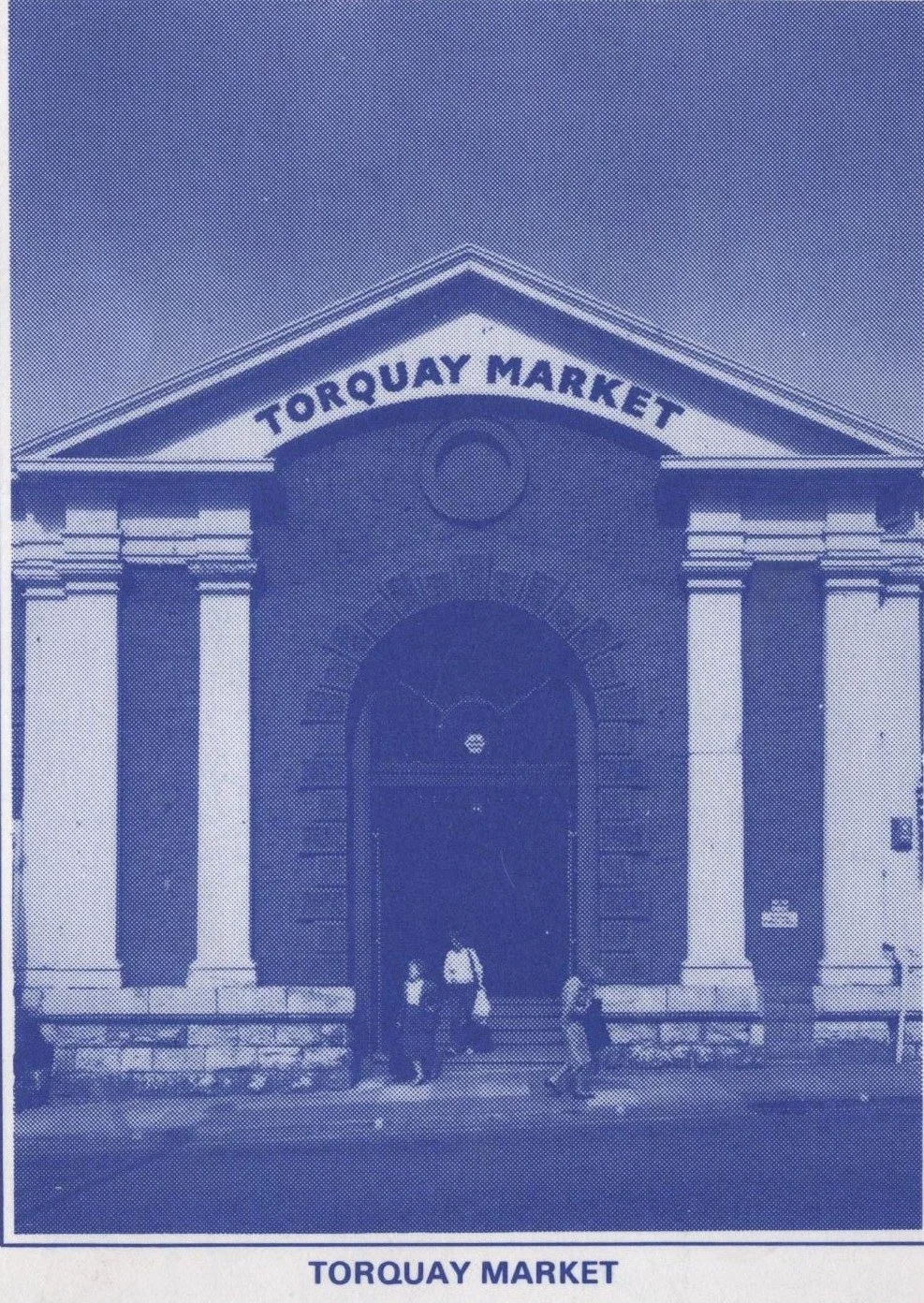
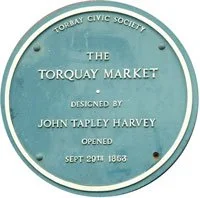
Torquay Market is one of our oldest and largest public buildings, and architecturally one of the most distinguished, being the work of John Tapley Harvey, son of William Harvey, the great master builder of the town.
It was opened in 1853 and after all these years is still operating as a market and is still in private hands.
It was not Torquay’s first market. That had been built some thirty years earlier by the Lord of the Manor, Sir Lawrence Vaughan Palk. It was known as the Rotunda, and stood in what is now Torwood Street, just a couple of minutes walk from the Inner Harbour.
This first market was a curious building, constructed around a circular grassy space in the middle of which grew several chestnut trees. There was one entrance, from The Strand end. The stalls or shops were small, and faced inwards, and in front of them extended a colonnade supported by heavy columns of red sandstone. It was a pretty cottage-like little building, quite adequate for a town whose total population was less than 2,000.
Some idea of its shape and size can be had from looking at what is now the Rotunda Restaurant, which incorporates all that is left of the old building. The public house nearby is still called the Old Market Inn.
In the early days meat, vegetables, fruit and dairy produce were brought in from Paignton, St. Marychurch, Upton and Torre. But as the town grew in size and wealth the market fell into disuse, and the farmers and the market gardeners and the fishermen increasingly hawked their produce round the streets. Many people felt this was quite unacceptable in a town that was being described as one of the most opulent and fashionable in the country.
In 1847 a Town Meeting was held at which it was agreed that a larger and more centrally situated market was required. But in view of the enormous cost of the project — a figure of no less than £6,000 was mentioned to cover the buildings and the land — it was apparently agreed without discussion that this was beyond the means of the Ratepayers. It was decided that a private company should be formed to undertake the work.
A first task of the Torquay Market Company was to seek the approval of Parliament. A Private Bill was drafted. Its preamble recited:
Whereas the town of Torquay in the parish of Tormohun in the County of Devon and the neighbourhood thereof has of late years greatly increased in population and is much resorted to by visitors; and Whereas a market has for many years past been held in the said Town... And Whereas the market place where the said Market is held is unfit for the Wants of the said Town it would be of great Benefit and Advantage to the said Town and the Neighbourhood thereof if the said Market were put on a permanent footing with proper rules and regulations....
The Bill gave the Company power to construct a Market building, the site of which was to be in Warren Place, behind what is now Dingles, almost opposite the General Post Office. The Bill required Sir L.V. Palk to close the Rotunda, for which he was to receive compensation.
There was considerable opposition from members of the public, and a Committee was set up to campaign against the market under the chairmanship of C.H. Mallock of Cockington. Among its members were Lord Sinclair, of Pilmuir, Robert Shedden and the Rev. W.G. Parks Smith. The local paper reported that in 1849 poor people queuing for their weekly relief at the Town Hall were sometimes required to sign a petition against the Market.
Be that as it may, the Bill received the Royal Assent on 13th July 1849.
But the promoters of the Bill had reckoned without the Carys, an ancient Catholic family who owned the western part of Torquay. They regarded the Palks as upstarts, and not without reason. Sir L.V. Palk’s grandfather, a man of humble birth from Ashburton, after a short spell in Holy Orders, had made a vast fortune with the East India Company and had bought the Manor of Torwood, roughly the eastern part of Torquay.
Cary land and Palk land met in Warren Place, and some of the properties needed for the market site belonged to the Carys. The Carys blocked the project simply by refusing to sell their property. One wonders why they had not been consulted before the Company embarked on the lengthy process of putting the Bill through Parliament.
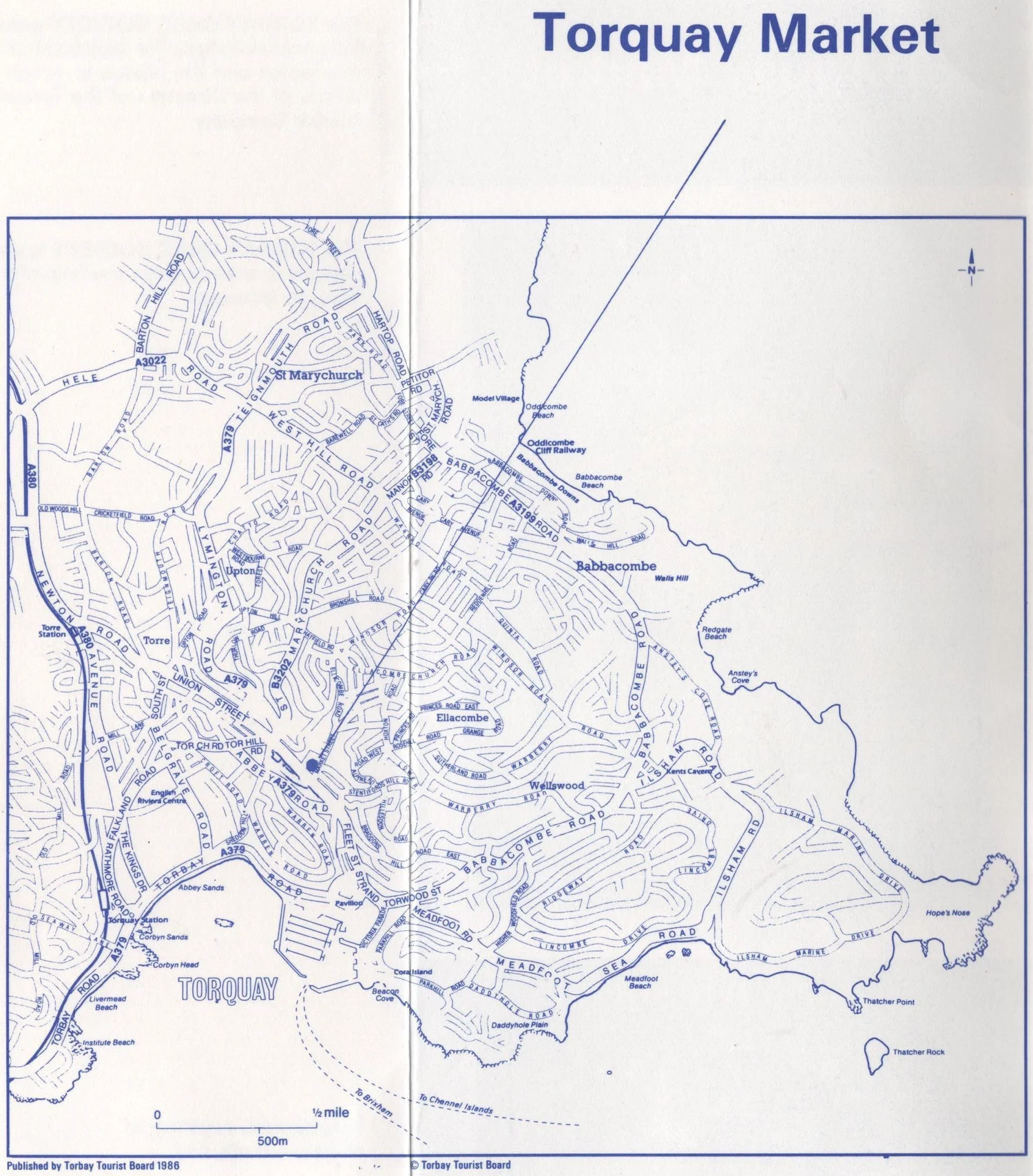
A new site was found, “at or near Union Street”, in what was then Ellacombe Lane and that is where the Market stands to this day. Another Bill had to be promoted in Parliament to authorise the change of site. It received the Royal Assent on 30th June 1852. The failure to consult the Carys, or the refusal of the Carys to co-operate, put it how you will, had set the project back virtually a whole three years, during which time the railway had arrived and the town had started to expand at an even more rapid rate.
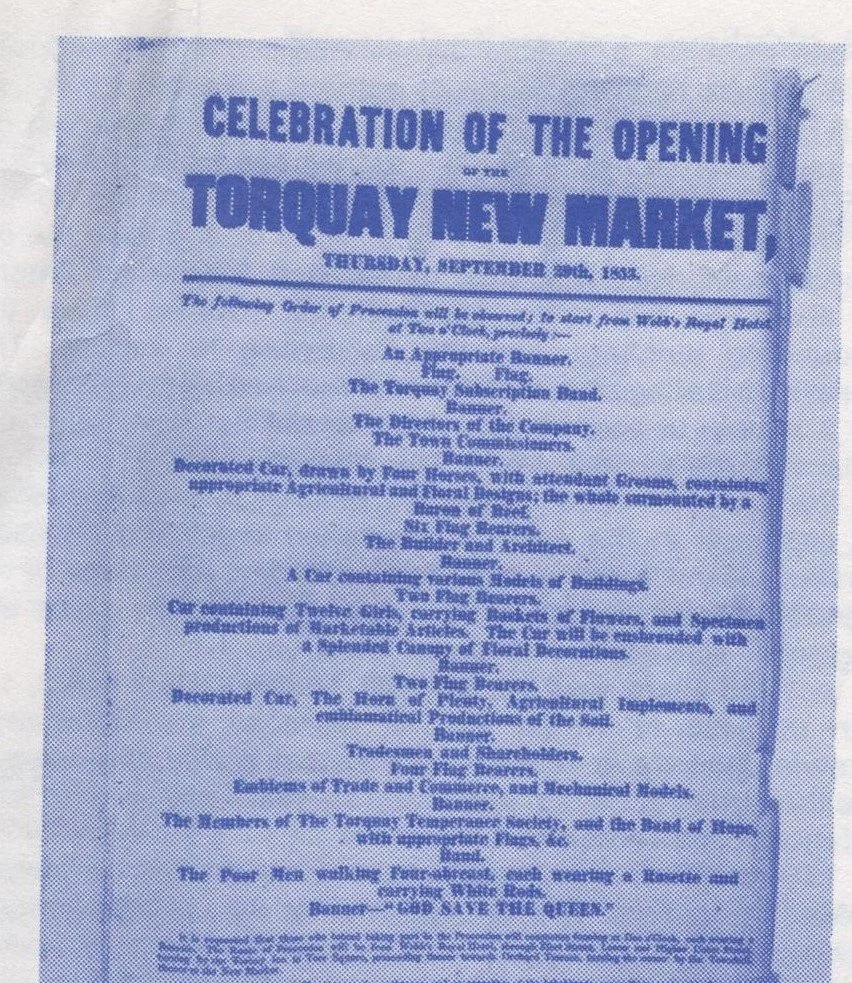
No more time could be lost. The foundation stone was laid that October, and the new Market building was opened for business on 29th September 1853, amid much celebration. By this time the population of the town had grown to over 12,000.
There was a grand procession through the streets of the town. 1,400 persons sat down to dinner. There was a “Tradesman’s Ball” in the Union Hall and the Torquay Directory reported that “the utmost hilarity prevailed throughout the evening”.
The objection to the Market was not on the grounds of the nature of the building, or its ownership, or where it was placed. The difficulty was that everyone had got used to the practice that had grown up of hawking goods around the streets. Many people argued that it would seriously add to the living costs of the poorer members of the town if they had to buy their goods in the Market.
The chief magistrate, Henry Cranmer March Phillips, who later agreed to lay the foundation stone, wrote a public letter to William Kitson, one of the promoters of the Bill and Solicitor to the Company, in which he suggested that the house-to-house sale, without payment of any toll, should be permitted of herrings, sprats, mackerel and hake, “these being chiefly consumed by the poorer people”. The idea of house-to-house hawking was thrown out but his plea was effective to the limited extent that the Bill was amended to permit the sale of fish from boats alongside the Quay at Torquay, on condition that the purchasers of such fish had to remove them within two hours.
Things did not go smoothly however in the first years of the Market and a large volume of trade continued to be transacted outside its walls. The Market Company, who saw the economic viability of their enterprise endangered, now decided that instead of trying to prevent hawking altogether, they should be empowered to require that street traders should be licensed and pay dues to the Market Company for the privilege of hawking their wares in the same way as they had done in the past without payment.
On this issue the town was sharply divided, with Edward Vivian and March Phillips being opposed, and William Kitson and the other directors of the Company were in favour. William Kitson said he would have consulted March Phillips before making his proposals but “the hostile attitude he had shown to the Market Company was so uninviting”.
In the event the Market Company won its case. A list of tolls payable for street hawking astonishes by its severity, considering the value of money in those days. It should be realised that the Market Company took the money and rendered no service in return beyond perhaps limiting the number of traders who could afford to pay the tolls and continue in business.
Tolls payable for street hawking
- For up to two dozen eggs
- 1d.
- For every turkey
- 1d.
- For up to 12 lbs of butter
- 1½d.
The tolls were strictly enforced. In January 1855, to give just one example, a William James was committed to prison for 14 days for hawking bootlaces without a licence.
It is no surprise to learn that the tolls now accounted for the main revenue of the Market. Its revenue from this source in 1876 for example was no less than £700.
The new Market was very different in design from the old Rotunda, comprising one large trading hall, 270 feet in length, and about 75 feet wide. The building towered above the surrounding buildings like the Parthenon in Athens. The comparison is altogether far fetched. What had been constructed was a temple of commerce, which would not have been out of place in the ancient world. The Market in Exeter, of which only the facade has been preserved, belongs to the same period and was built in the same monumental style. The imposing character of the building remains to this day, and many of the original features, including the floor of York stone slabs and the plaster work around the radial windows.
In 1855 there was yet another Torquay Market Act, the main purpose of which was to increase the Company’s borrowing powers. It seems very odd that it was necessary to have three Acts of Parliament within six years to authorise such a relatively small enterprise. Someone did well out of it!
119 years, however, were to pass before the Company again troubled Parliament. The Torquay Market Act, 1974 permitted the raising of more capital and the granting of longer leases. Up to then the maximum term had been three years. In 1896 part of the market was converted into an Ice Factory, and remained as such until comparatively recent times. In September 1909 the south west corner was let on a three year lease to Mr. W. Mellor for cinematograph entertainments. It was known as the Picturedrome.
On two occasions, in 1896 and again in 1918, it was proposed that the Market should pass into public ownership, but on both occasions the overtures by the Council were turned down by the Market Company.
Although no sign of it remains today the establishment of the market led to a great improvement in the arrangements for slaughtering cattle. The Company was authorised to build and operate a slaughterhouse in Lymington Road, and this replaced the 17 existing establishments, which were no more than the backyards of butchers’ shops. A contemporary describes the holdups to traffic and the danger to health resulting from animals being herded to their death through the narrow streets of the town.
It is not surprising that a building of these pretensions should have played its part in the social and public life of the town. In the late 1860’s, when events on the continent aroused fears of an invasion, the market was used at night as a drill hall for the training of volunteers. At Queen Victoria’s Golden Jubilee in 1887 the Market Hall was the scene of a dinner for the aged and poor. The Palk family provided 56 lbs. of beef and Madame Casavetti put her establishment and servants at the disposal of the organising committee and provided 24 gallons of ginger beer. The columns were decorated with greenery and the Italian Band played throughout the proceedings.
Research: H. Sykes-Balls, Chairman, Torquay Market Company
About this series
This leaflet, and the plaque, is one of a series commemorating notable people, buildings and events in the history of Torbay, prepared by the Torbay Civic Society.