
Torbay Civic Society
The Old ClinkPaignton
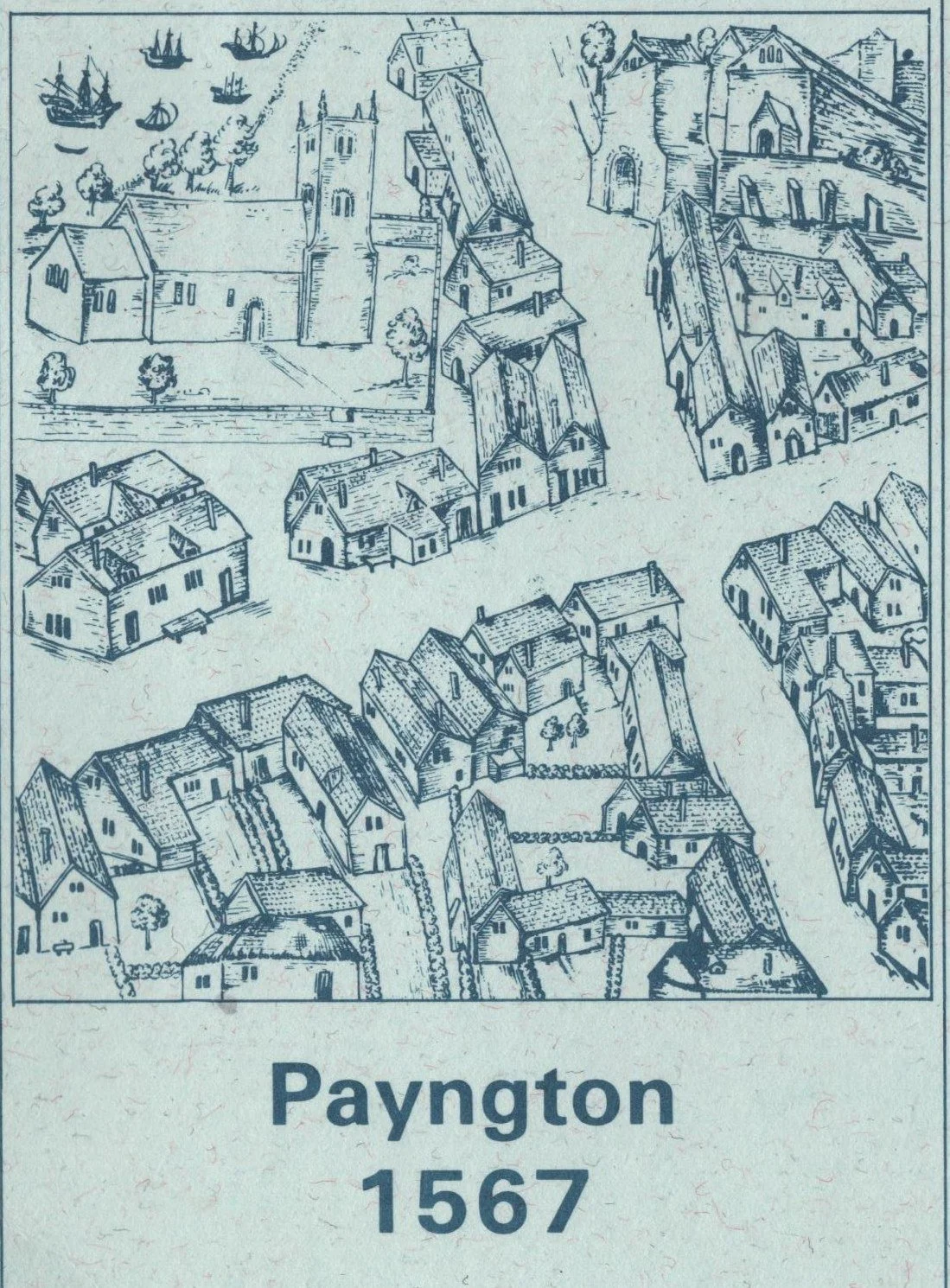
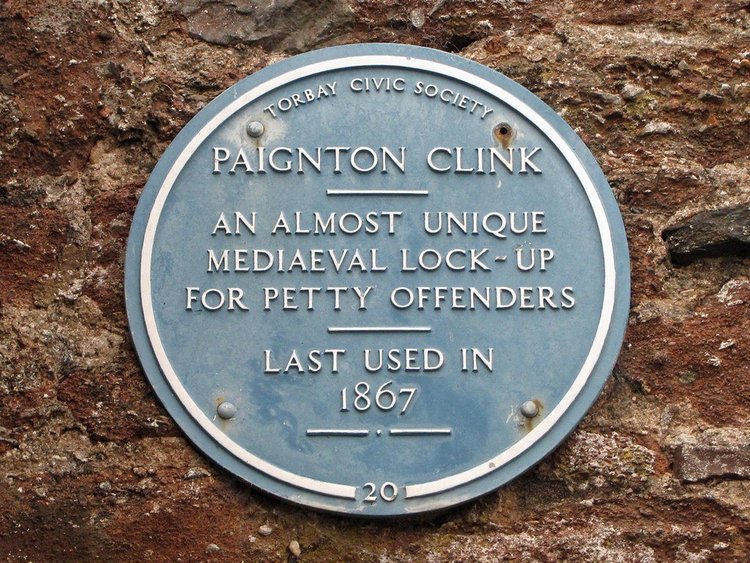
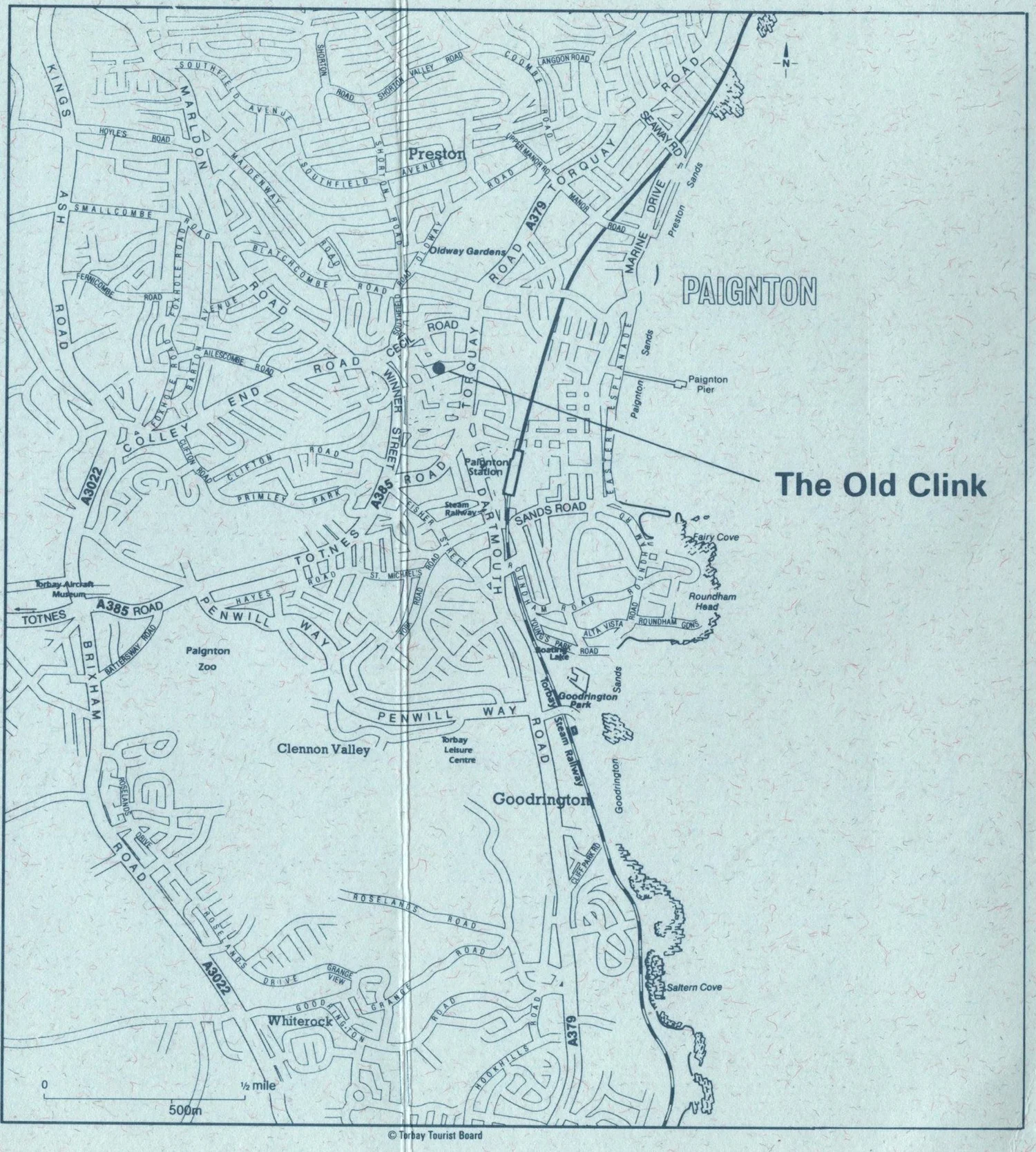
In the days when Princes Street was called Duck Lane and the mill stream used to run nearby it there stood a small building that had been used as a prison since the Middle Ages. The cottage of the parish constable, which stood alongside, has long been demolished.
There was some pretty rough justice in those days. The Lord of the Manor (in the Middle Ages the Bishops of Exeter) had the right to impose capital punishment, and, until 1934, there stood at Blagdon, at the spot known as ‘Gallowsgate’, on the parish boundaries of Paignton, Marldon and Berry Pomeroy, the old hanging tree. When it was felled some skulls were found there, no doubt of unfortunates executed for what today would not be regarded as very serious offences.
Paignton’s first recorded crime was in 1265 when Hendy de Pomeroy, of Berry Pomeroy, sided by some of his retinue, poached the deer from the Bishops’ Palace deer park (probably on the site of Palace Avenue). For this he appeared before the Lord of the Manor (Bishop Walter Bronescombe), apologised and promised to re-stock the park. A lesser person would probably have found himself on the road to Gallowsgate! The old Paignton Police Station which stood in Palace Avenue was thus quite near the scene of the town’s first recorded crime.
The “clink”, the pillory and the stocks were the main means of enforcing law and order in the town. At the first Manor Court whose records have survived (September 1664) the Lord of Paignton was “presented” for failing to maintain the stocks, pillory and cucking-stool (ducking stool). These apparently were also the penalties for infringements of regulations for the sale of food and drink (dealt with at a manor court known as the “Assize of Bread and Ale”), e.g. an innkeeper could only sell his beer at a price equivalent to a fixed fraction of what he had paid for his malt.
A local tradition has it that a parson-magistrate, Samuel Belfield, Vicar of Paignton 1732-92, would administer justice in the south porch of the Parish Church. Offenders were placed in the stocks (old drawings show them near the Lych Gate) from before service until dusk. The stocks were removed about 1848.
The word “clink” is interesting. It was originally the name of a prison in Southwark, but the Oxford English Dictionary mentions that in Devon and Cornwall it was used for a small prison cell or lock-up. Very few remain. The window is very narrow, which is perhaps just as well, for it never appears to have been fitted with glass. The small size of the window could be one reason for the building having another local name The Black Hole.
There are many stories about “the clink”. One prisoner is said to have turned the tables on his captor by locking in the parish constable with his own key. On another occasion the village idiot, confined for some misdemeanour, lifted the flagstones, let himself down into the sewer and emerged on the beach.
In 1857 Paignton lost its responsibility for police matters to the County of Devon, but it is reported that the clink was in use until the 1860s. If that were so, the clink must have served to incarcerate prisoners awaiting trial before the local magistrates, and some may indeed have served their sentences in the minute jail.
For minor offences the magistrates awarded fines, for others they might award two or four weeks in prison, while the more serious cases had to be referred to the Assizes in Exeter. But we need to look at some examples to understand what really happened, and exactly who might have been the last prisoners in the clink and what their offences were.
In May 1849 Thomas Bird, aged 39, was tried on a charge of stealing ‘mangold wortzel roots’ from Richard Hunt of Paignton. For that he did not have the soft option of the clink; he was sentenced to ten years transportation to Australia.
In January of the same year the Ashburton Hunt rode over a field of wheat on Windmill Hill. The owner of the field was greatly alarmed at the possible damage to his crop, and his son-in-law rushed up to the leading horse and caught it by the reins. The rider, although he was technically trespassing, struck the son-in-law with his whip and ‘double thonged’ him. The owner of the field charged the huntsman with assault, and the case came before the magistrates.
The huntsman made a spirited defence. He said he struck the son-in-law so tenderly that he did not feel it at the time. Moreover he said that the best agricultural authorities were of the opinion that the trampling of horses was beneficial to wheat. The magistrates found against the huntsman. But he was not sentenced to transportation. He did not even get incarcerated. Just a fine of 5/-, with 7/- costs.
In the same month George Harvey, aged 12, and James Easterbrook, aged 16, were sentenced to ten years transportation for stealing meat from the shop of Miss Anne Perryman.
There is nothing exceptional in these cases. All historians of the period comment on the fact that the magistrates, being all members of the landed gentry, had little understanding of the hunger and the poverty of ordinary people and saw the law primarily as an instrument for the defence of property.
Who then did go to the clink? In September 1857 a little boy of ten years of age was up on a charge of stealing two half crowns, a florin and a gold ring. He was sentenced to one month in prison and to be once privately whipped.
In August 1858, before the Paignton Petty Sessions, Edward Daniel aged 11, George Daniel aged 13, and Fred Dowell aged 20 were charged with stealing apples from a farmer of Paignton. Dowell was given 14 days; the others were dealt with more leniently. The father was required to give them a severe chastisement in the presence of the police, and to pay a fine of 1d. and 14/- costs.
On August 5th 1860 John Williams, a 40 year old farm labourer, who had been incarcerated in the clink by a P.C. Wattson after being detected stealing cider from the outhouse of Mr. Richard Hunt, farmer, of Barns Hill (the northern section of Winner Street), hung himself there by his neckcloth.
A contemporary press report of the inquest states:
“The Jury, a respectable body of Tradesmen, with the Coroner (Mr. W.A. Cockey) repaired to the dungeon to view the body, which was placed on the iron bedstead, and, having shut the door, found themselves in nearly total darkness, and the stench of the privies (there are two) was so great that they very promptly quitted the abode of death. Verdict: ‘Destroyed himself, but in what state of mind it was difficult for the jury to determine’.
The worthy Coroner remarked that the dungeon was not fit for a dog-kennel, and passed severe strictures on the authorities for not having it cleaned.
The deceased was interred with the whole of his clothes on, and the funeral service impressively performed by the Rev. M. Evelyn.”
John Williams was the last offender to occupy the Clink.
During the great storm of Brixham in 1866 the clink was put to use as a mortuary, and in World War II it served as an air raid shelter.
Research: C.H. Patterson and A.R. Day
About this series
This is one of a series commemorating notable people, buildings and events in the history of Torbay, prepared by the Torbay Civic Society with the approval of the Torbay Borough Council. The plaque appears on the building or boundary wall adjoining the road. The leaflet gives more information about the person, building or event. The notelet shows where to go and what to read for further information.
Subjects included in the series:
- 1Rev. H.F. Lyte and Berry Head House, Brixham
- 20The Old Clink, Paignton
- 21Herbert Whitley and Primley House, Paignton
- 24The Bijou Theatre, Paignton
- 40The Town Hall, St. Marychurch, Torquay
- 60The Vivian Institute, Torquay
- 91Baroness Burdett Coutts and Rosetor, Torquay
- 112Beverley Nichols and Cleave Court, Torquay
This leaflet, together with the plaque and notelet, have been made possible by the Torbay Borough Council.