
Torbay Civic Society
Oldway Mansionand The Singer Family
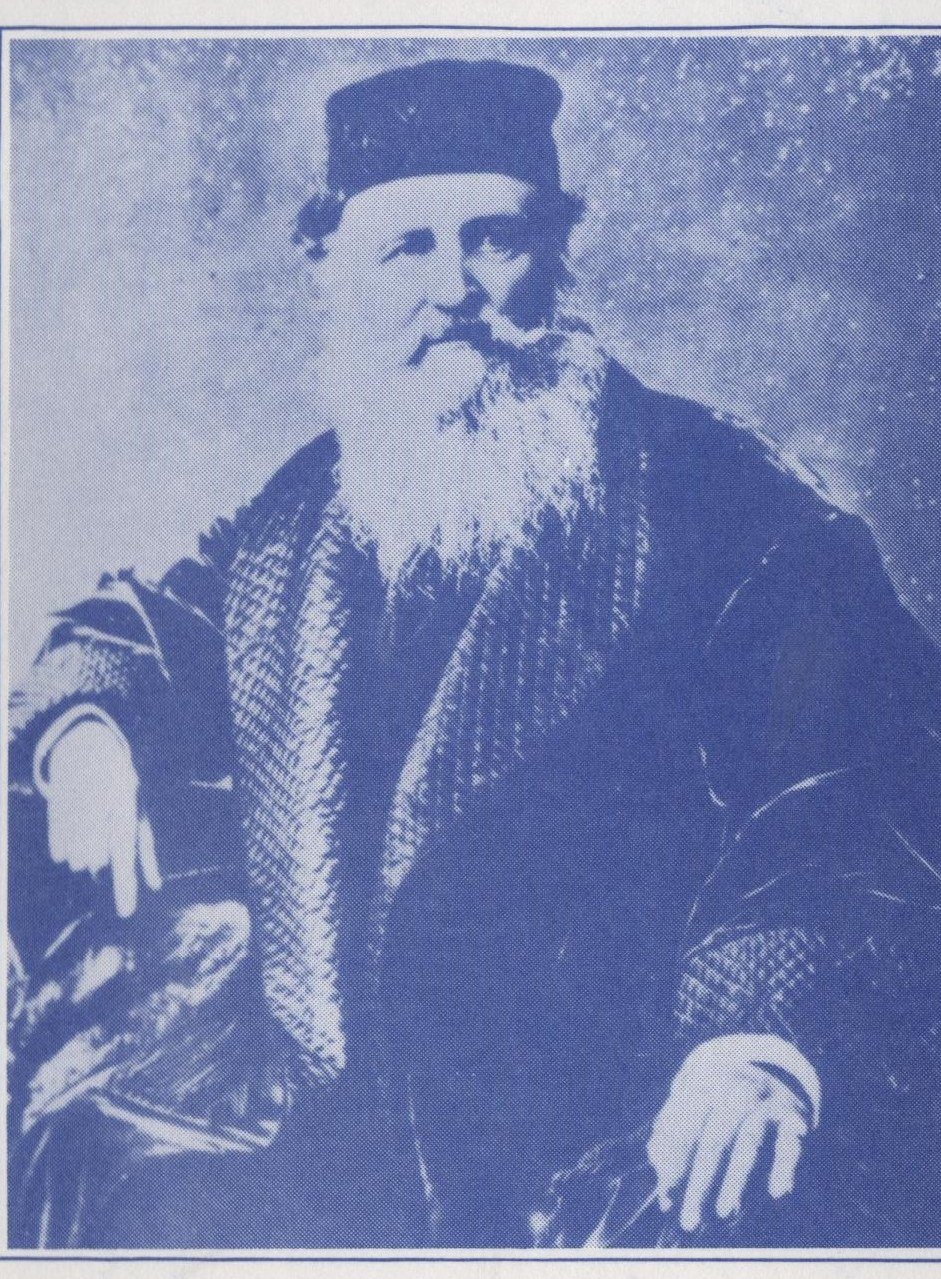
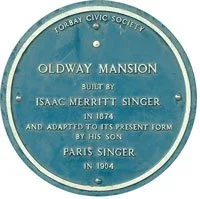
Isaac Merritt Singer was born in New York of destitute German immigrant parents in the year 1811. When he died in Paignton 63 years later he left an estate worth around £10 million and a product that was soon to be found in homes throughout the world. He also left behind him Oldway Mansion, a fitting memorial to a very remarkable man, and to his son, who within 20 years had redesigned and largely rebuilt it.
Singer was only twelve years of age when his divorced father remarried and he decided to leave his New York home. Such was his enthusiasm and his capacity for hard work that he was soon making his own way in the world. By the time he was 21 he had been apprentice lathe-operator, a cabinet-maker, and a printer. He was also the father of two children by his wife Catherine Haley, whom he married when she was only fifteen.
It was at this point that he developed an overwhelming passion for the theatre, and he went barn-storming across America for several years with a New York Theatre Company. But as an actor he seems to have had more enthusiasm than talent. By the time he was 28 he found himself penniless in Illinois, and no prospect of a further engagement in sight.
He found himself a job as a labourer digging the Illinois-Michigan Canal. And it was at this point, when any other man might have given way to despair, that Isaac Merritt Singer discovered where his real genius lay. He invented the first mechanical excavator, which he patented and sold for 2,000 dollars. With this money he founded the Merritt Players and continued his theatrical career as an actor-manager. But with no more success than before, the enterprise ended in a welter of debts. It is curious thought that if he had been a better actor the world might never have seen the Singer Sewing Machine.
He went back to inventing, this time in the printing trade. He invented a type-carving machine and toured the East Coast of America trying to promote it. Now fate took a hand and he found himself sharing lodgings with a man who was trying to develop a sewing machine, which was not working out. The machine was totally unreliable but Singer saw the possibilities, and worried at the problems involved with his characteristic enthusiasm and his restless, inventive mind. Eventually he hit on the idea of a shuttle moving back and forth and a needle moving up and down. Like all brilliant ideas it seems simple, once someone else has thought of it.
Isaac Merritt Singer may not have been technically the inventor of the sewing machine, but it was his skill and innovative turn of mind that made the sewing machine an everyday item for our grandparents.
This was partly because his firm invented hire purchase. Little wonder he was able to build such a large house.
He was forty years of age when he patented his sewing machine. The year was 1851, the year of the Great Exhibition in London.
Shortly after, he left America in a hurry and fled to France. It was a move that had nothing to do with business but everying to do with the fact that Isaac Merritt was as productive of children as he was of ideas. He had entered into a bigamous second marriage with a Mary Ann Sponsler, who bore him ten children. When his attentions to her became less ardent, he went in pursuit of other women and had a further six children. When Mary Ann sued for alimony, naming seven co-respondents, he packed his bags and bought a steamship ticket to France.
Here his philoprogenitive predilections once more came to the fore, and he met, married and gave six children to yet another woman, Isabella Boyer. This mother of six was later chosen to be the model for the Statue of Liberty.
When the Prussians invaded France in 1870 he packed his bags again and brought his new family to England, or to Paignton, to be more precise. Their first idea had been to go to Watcombe, where Isambard Kingdom Brunel had laid out his Park some twenty or so years earlier. But Brunel's family wouldn't sell, so they settled for Fernham, where the present building was eventually erected. At the time, apart from the land, it consisted of a pub, a number of cottages, and the villa where they took up residence. This is now known as Little Oldway and houses an old peoples' home at the back of Oldway Mansion.
Before very long they decided to commission a young architect, George Soudon Bridgman, to design them a house. Considering the number of their children, to say nothing of the continued sale of the sewing machines, this was hardly surprising.
The specification was not very precise, if we are to accept contemporary reports. “Build me a big Wigwam”, was all Singer is supposed to have said. But Bridgman knew how to make allowances for the speech habits of our American cousins, and in due course Mr. J. Matcham of Plymouth was contracted to build a mansion that was certainly big if it was nothing like a wigwam.
It was styled in Kingsteignton brick with designs in stone and in glazed earthenware, which was then very popular and known as faience.
It had over a hundred rooms on four levels. The main entrance was on the same side of the house as it is now, the North side, but one floor higher up, access being gained by an impressive carriageway. Having got inside, the visitor was reminded of the owner's earlier days, for an integral part of the house was a specially constructed theatre.
Mr. Singer was also very fond of horses, as befitted a gentleman in those days, and they also were to be housed in a big wigwam. Hence the Rotunda, the round stables to be seen opposite the entrance on the other side of the car park, and this really is a bit like a wigwam. Here the horses could be exercised under cover, as if they belonged to the Spanish Riding School in Vienna.
This fascinating and unique building has been leased for many years to a local company engaged in the manufacture of electrical components. Maybe one day its historic importance and appeal will be realised, and the public will be allowed to go in and see it as it used to be.
Isaac Singer died in 1875, before the mansion was complete. His funeral was a great occasion and in American style, with full mourning dress and no ladies present. Attired in a black mourning suit he lay on a satin-covered couch in the innermost of three coffins.
The cortege was headed by a large cross of maidenhair and other ferns, Japanese lilies and the rarest of exotic flowers. It is reported that as the hearse reached The Strand the last carriages, filled with business dignitaries, were still passing Livermead Sands. He was buried in a white marble mausoleum in Torquay Cemetery, where he has been joined over the years by more than a dozen members of the family.
Oldway as we know it today is the work of his third son, Paris Singer. The first name, Paris, gives us a clue. In 1904 he decided to spend a second fortune on Oldway, and to remodel it in the style of the grandest building he knew, the Palace of Versailles.
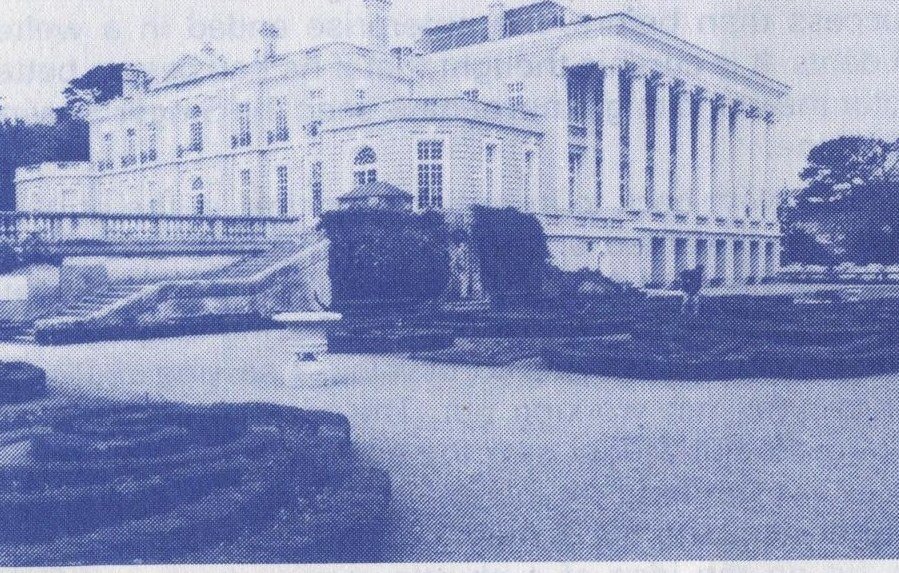
The side that faces away from the main road, on the west, he left as it was, and it remains to give us an idea of how the original building must have looked. But everything else was altered. He removed the raised carriageway, and the main entrance is now on ground level under a portico with a triangular pediment in the Greek style above it.
The South side, the side that faces towards Brixham, is based on the design of a music pavilion in the grounds of the Petit Trianon Palace at Versailles.
The most spectacular alteration was to the side you see as you approach up the drive from the Torquay Road. The whole of the original wall has been faced with a row of great Ionic columns reaching from floor to roof. It is an entirely unexpected and startling sight which makes an impression never to be forgotten.
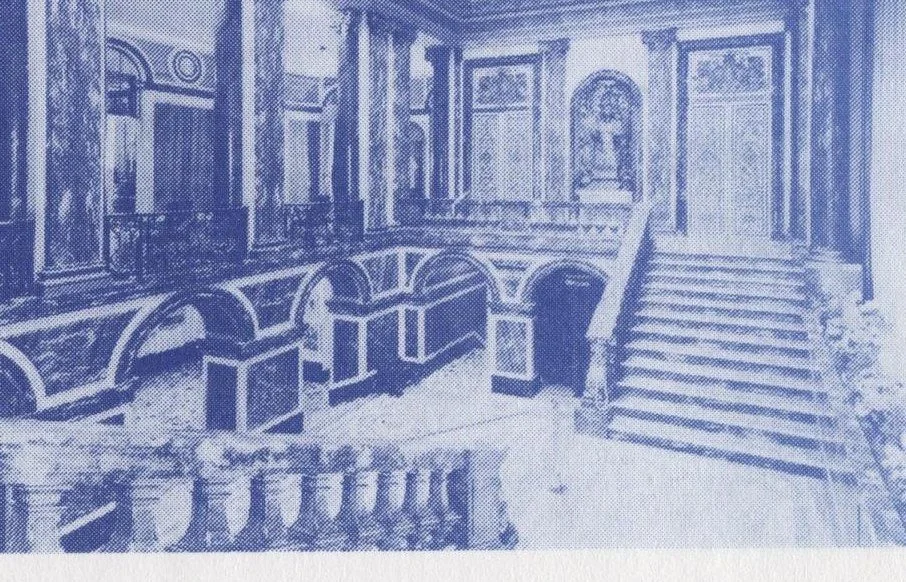
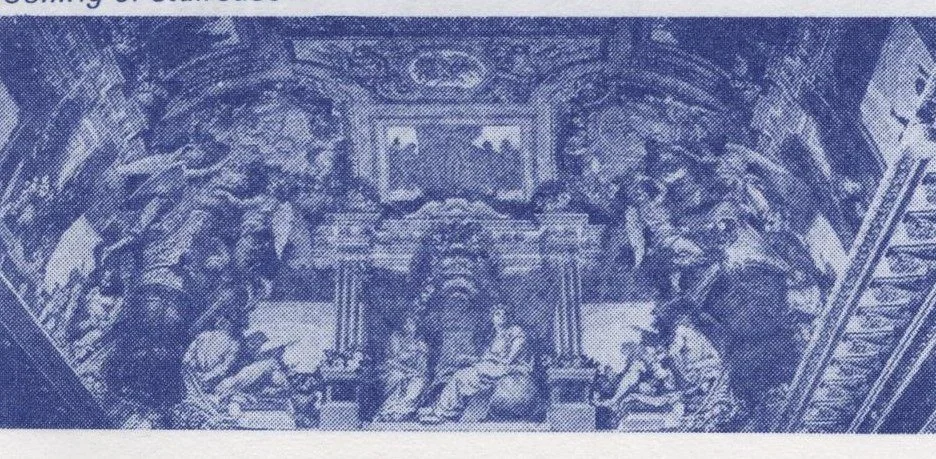
The inside is dominated by a vast branching staircase in many-coloured marble. Above it is one of the main attractions of the building, a magnificently painted ceiling, supported by columns, with gilded capitals, spiral shapes or volutes, and with a splendid ornamental moulding or cornice that runs round it.
The staircase must have been even more impressive when Jacques Louis David's vast painting The Crowning of Josephine hung against the wall. It was sold back to the French Government in 1946 and is now on display in the Palace of Versailles.
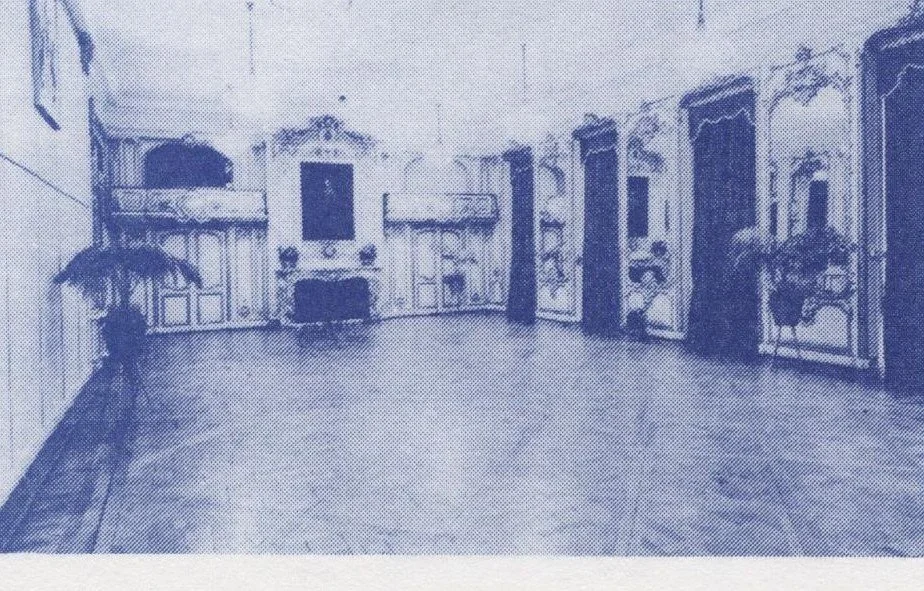
The great ballroom at the top of the stairs, with its sprung parquet flooring, is interesting for its Minstrel's Galleries, its ten silver backed tunnel mirrors and the painting of Louis Bourton, Prince of the Asturias, that hangs over the marble fireplace.
Thanks to the heritage of Oldway, Paignton has the most splendid setting for a registry office wedding to be found throughout the length and breadth of Britain. It is the Singers' original dining room, richly decorated and most elegantly proportioned. But no confetti, please.
The privilege enjoyed by Paignton brides is also shared in some measure by the Mayor, who enjoys as his/her Parlour the room which Paris Singer designed as his study. It is lined in a dark wood, richly carved, with half columns and with pilasters, which are also half columns but square. It is a room with a rather heavy atmosphere, very different from the lighthearted colour and sparkle of the ballroom and dining room. Should it ever happen that the Mayor of Torbay wears a cast of countenance somewhat more solemn than usual we can guess the reason. They have been too long in their Parlour.
The rooms which were built as the servant's quarters on the third floor are now occupied by the Education Offices of Devon County Council.
On the ground floor the Civic Society is putting together a Heritage Room with various items of particular interest in the history of Paignton.
The gardens were designed by the French landscape artist Duchesne and provide a splendid setting to view the exterior of the house.
Paris Singer became closely involved in the affairs of Paignton, both as a Developer, being responsible for much of the building in Preston and Barcombe, and as a philanthropist, helping with the Cottage Hospital, the Church and the lifeboat, named The Winaretta after his sister. During the first world war Oldway was converted into a military hospital at his expense. In the second world war it was used by the Royal Air Force and the Commonwealth Air Forces. It was subsequently purchased by Paignton Council for £45,000 and officially handed over by Lady Leeds, the daughter of Paris Singer, on 18th December, 1946.
Oldway was used in the making of the film Isadora, which starred Vanessa Redgrave. Paris Singer had met Isadora Duncan in France and had fallen passionately in love with her. They had a son Patrick who died tragically in a car accident at the age of two. Isadora spent some time in Oldway, but the relationship came to an end after eight years. Isadora was a great performing artist and a pioneer of contemporary dance and was not prepared to sacrifice her career for a quiet life in Paignton. By a tragic irony she herself was to die in a car accident ten years later, when the long scarf she was wearing got caught in one of the wheels.
Although Paignton is now incorporated with Brixham into the Borough of Torbay, Oldway Mansion is still used for many local government and civic purposes, Societies and individual members of the public are invited to hire some of its rooms for private functions and for gatherings of different kinds.
Research: Margaret Barraclough, Terence Clifford and Denis Walton
The Plaque
The plaque to which this leaflet refers is affixed to the wall of Oldway Mansion, on the left hand side of the main entrance.
How To Get There
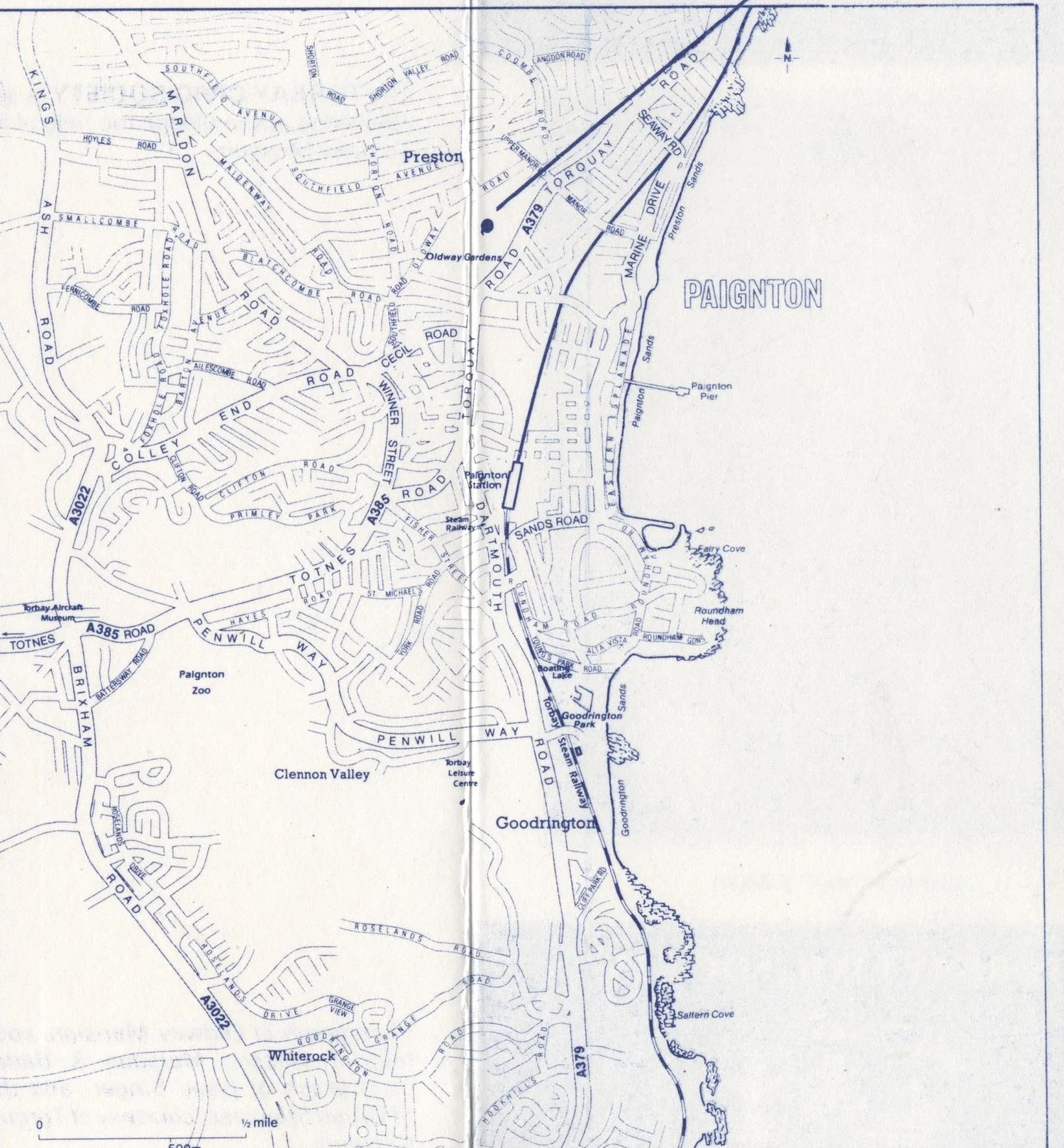
The Mansion is situated off the main Torquay to Paignton road, 1¾ miles from Torquay Railway Station and ¼ mile from Paignton Railway Station. A number of Devon General and Bayline bus services pass along this road.
What To Read
- Eastley, Charles. The Singer Saga. Martin Books.
- Duncan, Isadora. My Life. Liveright.
Where To Go For Further Information
- Torquay Central Library
- Torquay Museum, the Museum of the Torquay Natural History Society
Acknowledgements
The Torbay Civic Society gratefully acknowledges the sponsorship of this leaflet, and of the plaque to which it refers, by the Borough of Torbay. The Society is also pleased to acknowledge the help of Torquay Museum.
Photograph of Oldway Mansion courtesy of Messrs. Marsdon & Batley. Photograph of Isaac Singer, and that of the grand staircase, courtesy of Torquay Museum.