
Torbay Civic Society
William Kitson1800–1883, the Maker of Torquay
The golden days of Torquay, when it was the most fashionable watering place in Europe, began with the coming of the railway in 1849. In the thirty or so years after that Torquay as we know it today came into being and took much of its present shape.
The shape it took could be said, in a very special way, to be the work of one man.
That man was William Kitson.
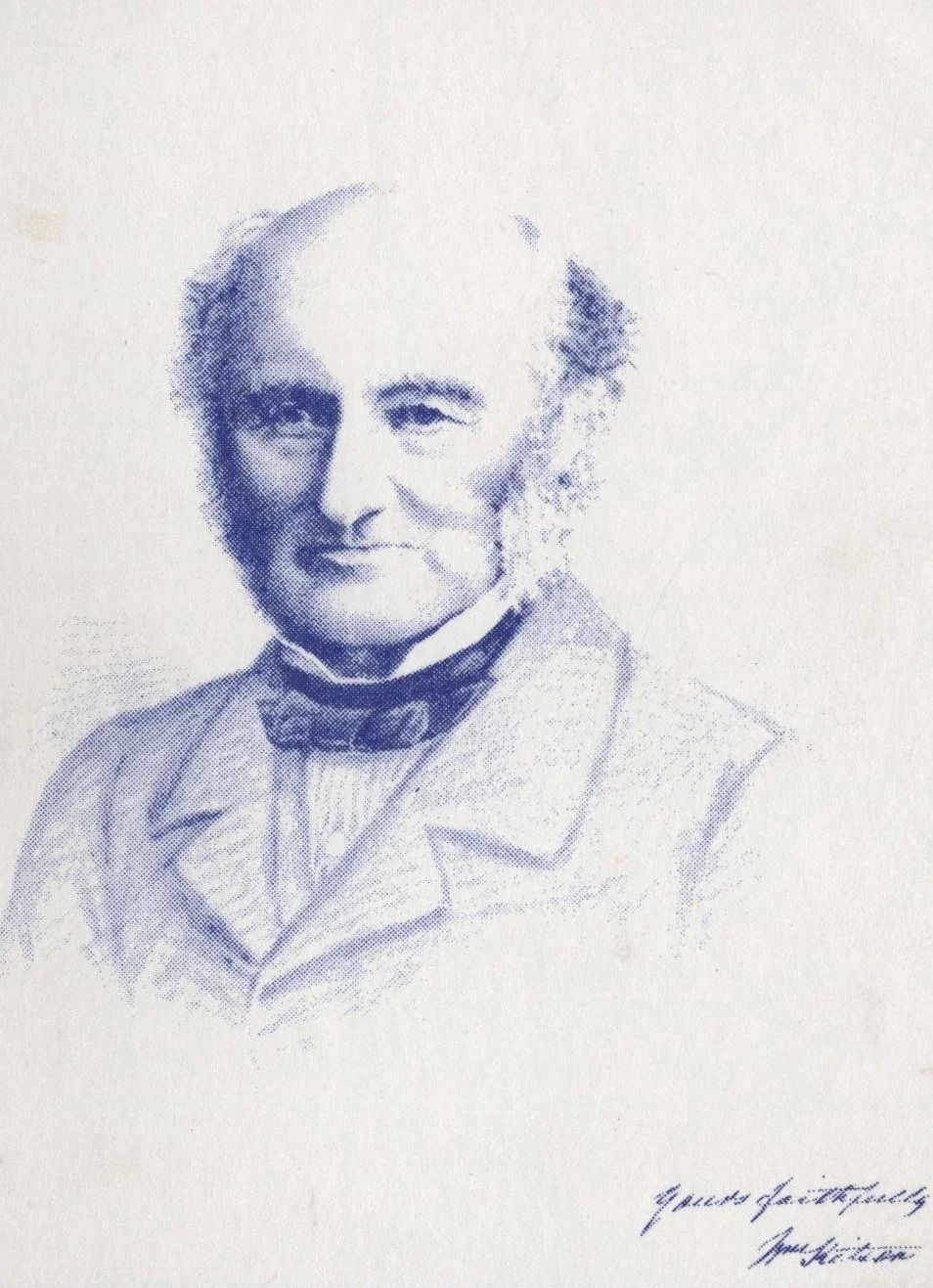
His portrait hangs in a place of honour in the Town Hall. He is clearly an eminent Victorian, austere, upright and rather forbidding. Gaiety or bonhomie is not noticeably present in his features. Indeed he seems to be just the opposite of such a Shakespearean figure as Toby Belch. Some people would say he was more like Malvolio. His lunch was reputed to cost him no more than a penny. He was known by some as “penny bun Kitson” and by others as “darning needle Kitson”.
How was this one man able to run the town and stamp his personality upon it as if it were his own?
It belonged, or at least three quarters of the land upon which it was built belonged to Robert Palk who had bought it for £12,000 on his return from service with the East India Company. He bought a virtually uninhabited patch of land with the intention of developing it as a port to rival Dartmouth. He died shortly after he had set in motion plans to build a harbour.
The other quarter of the land belonged to the Carys, a Roman Catholic family and one of the oldest in Britain. To them Robert Palk was an upstart, a nabob, which was the term they used for someone who had returned from India with a large fortune.
These were days of acute religious controversy and the Carys had to keep a low profile, as we would say today. All they wanted was to continue to enjoy the seclusion of Torre Abbey.
And so the Cary part of Torquay remained unchanged, while the Palk side, to the east of Fleet Street, began to develop, but not as a port, as originally intended, but as an exclusive watering place for the few visitors prepared to brave the journey by the steam packet from Portsmouth.
When Robert Palk's grandson took over and appointed William Kitson as his agent it was clear that a new and powerful force had appeared on the scene.
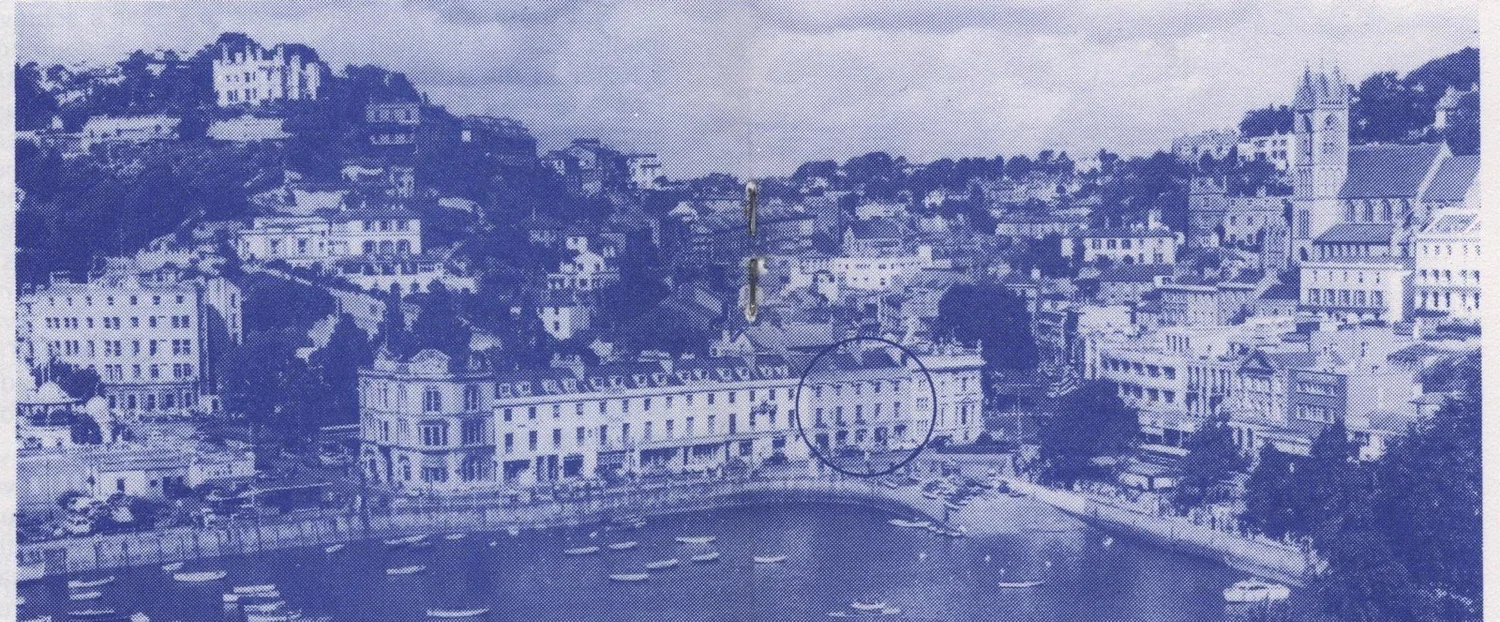
A staunch Anglican, with a brother and father in Holy Orders, Kitson had qualified as a solicitor in Ashburton. His offices from 1826 were in Vaughan Parade, where the firm of Kitson is to this day, and here also for many years was his home. Next door was Kitson's Bank, which for a long time he ran in partnership with Edward Vivian.
Two years later he became the Chairman of the newly-established local authority, a position he occupied without interruption for the next twenty-five years. But his interests did not stop there. He was associated with the Market, the Gas Company, the Regatta Committee, the Turnpike Trust and indeed almost every organisation in the town. He was Chairman of the Teign Valley Railway Co., which was later taken over by the GWR. He played a major role in providing the town with a proper draining system and a supply of pure water from Hennock.
What interests us today is how this concentration of power was used by Kitson to shape the face of our present day Torquay.
His central and most important contribution was in the way he developed the Palk Estate, where he had virtually a free hand. This was because the landowner himself, Sir L.V. Palk, who was the same age as Kitson, was virtually an absentee landlord, and spent his time womanising, drinking and gambling in London and on the continent. He was indeed the Toby Belch to Kitson's Malvolio. Before very long Kitson had become not just the agent but the joint trustee of the Estate.
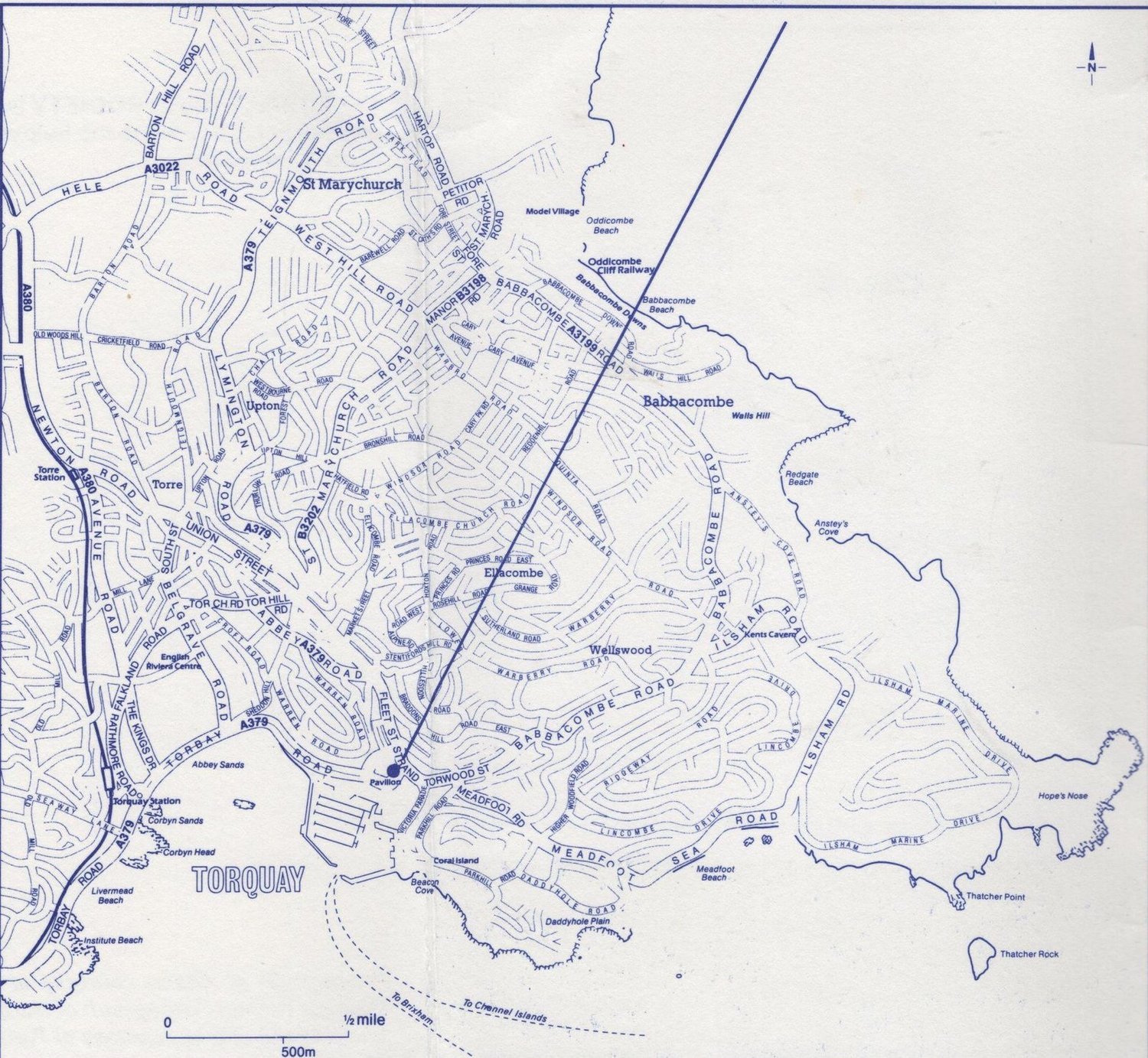
His plan was a simple one. It was to concentrate all attention on the hilly areas by the sea, the Lincombes and the Warberries, and to develop them as an exclusive enclave for the rich. He cut wide roads with gentle gradients, parcelled the land into leasehold two acre plots, and required substantial houses to be built on each. Prospective tenants could be put in touch with a reliable firm of solicitors, finance could be arranged through an equally helpful bank, and the local authority was unlikely to raise time-consuming difficulties about planning permission and other bureaucratic obfuscation.
In this way Torquay became, to quote the Western Morning News of 1864, “the most opulent, the handsomest and the most fashionable watering place in the British Isles.”
When those words were written Torquay consisted of something like four or five hundred large houses, each with its stables and extensive grounds, and living accommodation for at least six or seven servants. There was a gentlemen's club, two or three reading rooms, a public baths and one or two hotels with large assembly rooms. But the focal point of fashionable life was in the large houses themselves.
But there was something else. The churches. And here William Kitson's mark is equally manifest. He was churchwarden of the original parish church, a position of enormous importance in those days, since in allocating sittings he was the final arbiter of social status. As the population of Torquay expanded, it doubled in twenty years, Kitson put all his influence and authority behind the building of new Anglican churches, including St. Mary Magdalene at Upton, St. Marks and St. Matthias. It was in no small measure due to him that the architectural landscape came to be dominated by the large villas on the hills and the splendid churches in commanding sites around them.
Kitson's achievement however was not merely to make Torquay an outstanding example of Victorian town planning. It was also to ensure that the thrust of the town's development during the formative years was residential rather than industrial. When Robert Palk's original intention to develop the town as a commercial port was revived by his great-grandson, Lord Haldon, it was too late. The interests of the residents, of the visitors and of the tradesmen who serviced them had become so entrenched that Lord Haldon's plans were decisively defeated.
But there was a negative side to Kitson's achievements. Kitson's bigoted Anglicanism was undoubtedly a factor in the antagonism that grew up between the Palk and Cary Estates, a factor that made it quite impossible to do any joint planning. This was particularly true in respect of the area where the two estates met, the valley of the River Fleet, which curved down to the harbour on the course now followed by Union Street and Fleet Street. An early lithograph shows this as a charming natural feature, but because the two landlords could not agree this attractive natural feature was completely lost. Fleet Street was never built wide. The area behind it became a squalid slum and remained a disfigurement in the heart of the town until redevelopment was eventually set in motion in 1987.
During his period of greatest power Kitson was acting on behalf of a landlord whose reckless expenditure and profligate lifestyle was eventually to plunge the estate into bankruptcy. It could perhaps be fairly said that one reason for Kitson's parsimony was that he had before him, every day of his working life, a living example of what the opposite could lead to.
It was his mission to avoid extravagance, both in the spending of his own monies and those of the town. Two examples of what this meant must suffice.
The gas company, of which he was a director, signed a contract with the local authority, of which he was Chairman, to illuminate a fixed number of street lamps for an annual payment of £40. Kitson then gave a ruling that the lights did not need to be lit on the night of a full moon.
One very cloudy night in the middle of winter the full moon fell on a Sunday. There was pandemonium outside the churches as the congregations came out of Evensong and were unable to find their carriages. Kitson relented but only a little. Reluctantly he delegated to the superintendent the authority in his absence to waive the rule should the weather justify it.
More serious perhaps to our eyes was the town's lack of concern for the conditions of ordinary folk. In 1864, the year when the Western Morning News had spoken so highly of the town, 2,000 of its inhabitants, both men and women, were accommodated in six common lodging houses in George Street, Swan Street, Pimlico, and Madrepore. Residents still living in Torquay recall having heard how their grandparents were forbidden as children to go near these houses on account of the appalling stench. Edward Vivian, his banking partner and fellow councillor, proposed that the local authority should build a public wash house. He proposed it year after year, and for nearly twenty years Kitson rejected it as an extravagance.
In 1860 the absentee L.V. Palk was succeeded by his son, the first Palk to become Lord Haldon, and things began to change. The son gained control of his estates and was barely on speaking terms with Kitson, whom he accused, surely unfairly, of feathering his own nest at the expense of his employer. More significantly, Kitson was voted out of the Chairmanship of the local authority, much to his own chagrin and astonishment, but he remained a member until his death in 1883. The hegemony of William Kitson had come abruptly to an end. And the control of local government was no more to be in hands of the Lord of the Manor.
It was a sign that the people of Torquay had come of age. But they did not forget the man who had made Torquay what it was, and who was to continue to be elected to serve the town for another 23 years. They gave him a Dinner. It was one of the most important occasions in the town. Everyone was there, even the ladies. The speeches went on for hours, and were full of appreciation and regard.
And to crown it all a salvo of guns was fired in his honour from Corbyn Head.
The Plaque
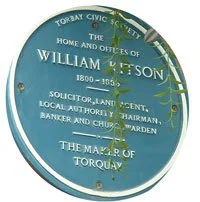
The plaque to which this leaflet refers is affixed to the exterior wall of Messrs. Kitsons offices.
How To Get There
Vaughan Parade is in the very centre of Torquay facing the harbour.
Where To Go For Further Information
- Torquay Central Library
- Torquay Museum, the Museum of the Torquay Natural History Society
The Plaque Inscription
Torbay Civic Society. The home and offices of William Kitson, 1800–1883, solicitor, land agent, local authority chairman, banker and churchwarden. The Maker of Torquay.