
Torbay Civic Society
Madrepore Road SchoolTorquay’s first voluntary elementary school
Education today is big business. A huge Government department, with its Minister occupying a seat in the Cabinet; the cost of providing all the many and varied educational facilities in Devon alone budgeted at £268 million (for 1989/90); the Sunday papers occupying hundreds of column inches to educational topics; teaching is now a national institution of great significance.
It was not always so.
In 1807, a Bill was introduced into the House of Commons by a certain Samuel Whitbread which, if enacted, would have provided two years of free schooling for children between the ages of 7 and 11, whose parents could not afford to pay the fees. Opposition to the Bill from both Church and secular establishments, was fierce. In the House of Lords, the Archbishop of Canterbury said that “it would go to subvert the first principles of education in this country, which has hitherto been .... under the control of the (Church) establishment”, and in the Commons it was argued that “however specious in theory the project might be, of giving education to the labouring classes of the poor, it would be prejudicial to their morals and happiness; it would teach them to despise their lot in life, instead of making them good servants in agriculture and other laborious employment. Instead of teaching them subordination, it would render them fractious and refractory .... it would enable them to read seditious pamphlets, vicious books and publications against Christianity. It would render them insolent to their superiors”. The Bill failed, as did others. Another 63 years would pass before the State acknowledged any resposibility for the education of the young.
Opposition to Whitbread's Bill, however, was not entirely due to perversity. There was the cynical view that the Revolution in France and the ensuing Terror, had sent a shiver down the collective spines of the King and his ministers. Had not Louis, in recent memory, lost his head in gruesome fashion? And if this could happen with an unruly mob of uneducated peasants, what point would be served by improving the lot of the English labouring classes? England's aristocracy led a pleasant, cultivated and contented life. Why give hostages to fortune?
But Whitbread's Bill was opposed for another reason and because of another revolution. The invention of the power loom, the Spinning Jenny, the steam engine, new methods, new devices all had come together to cause the most momentous upheaval ever experienced in the country and its people. The peace and calm, the stability, features of life which had been taken for granted for so long, had been shattered. The north of England, and the Midlands, were desperate in their needs for labour, for pairs of hands, any hands, men, women, children, even infants. The years of the late 18th century, dubbed the ‘Industrial Revolution’, are well documented and have no place in this pamphlet; sufficient to record that the appalling conditions in which so many children worked, and the long wearying hours, left no time for even the most elementary teaching.
The Church had a different reason for opposing any Bill which would grant to the State some influence in the education of children. Education had for centuries, been exclusively in the care of the Church. From early times, great numbers of men were in holy orders, and thus for many boys, the object of education was as a preparation for ordination, and this meant largely, the teaching of Latin grammar, the name survives today. But this was not at all. The role of the Church throughout has been of the greatest influence. When the 1870 Education Act was passed, it was not intended that the State should supplant the Church in the educational field, rather that it would extend schooling to those who did not receive it. By 1900, 40% of children in receipt of education were attending Church of England schools, and in passing, it may be noted that there is a substantial body of opinion today, which believes that the ‘opting-out’ provisions recently enacted, provide a golden opportunity for the Church to re-establish its dominance in education, and thus restore Christianity to the core of the nation's life.
The contribution of the Church to the elementary education of the poor, was fundamental in two regards. First, the Sunday Schools. The demand of manufacturers for child labour left only the Sabbath free, and this made possible the development of the Sunday Schools movement. Credit for its rapid growth is usually given to Robert Raikes, a well-to-do newspaper proprietor in Gloucester, the centre at the time of pin manufacturing, who used his wealth to open schools for the ill-disciplined and illiterate children, who, whilst working 12 hours and more a day in the factories, were let loose on Sundays. The aims of the Sunday Schools were religious and social rather than intellectual. Indeed the Sunday Schools Society ruled that ‘neither writing nor arithmetic is to be taught’, the curriculum being confined to religious instruction, reading and domestic manual work. The Schools had a rapid success. In 1787 there were 250,000 attending. By the end of the century 150,000 in London alone. A generation later, it was estimated that more than 1½ million children were benefiting from this form of instruction.
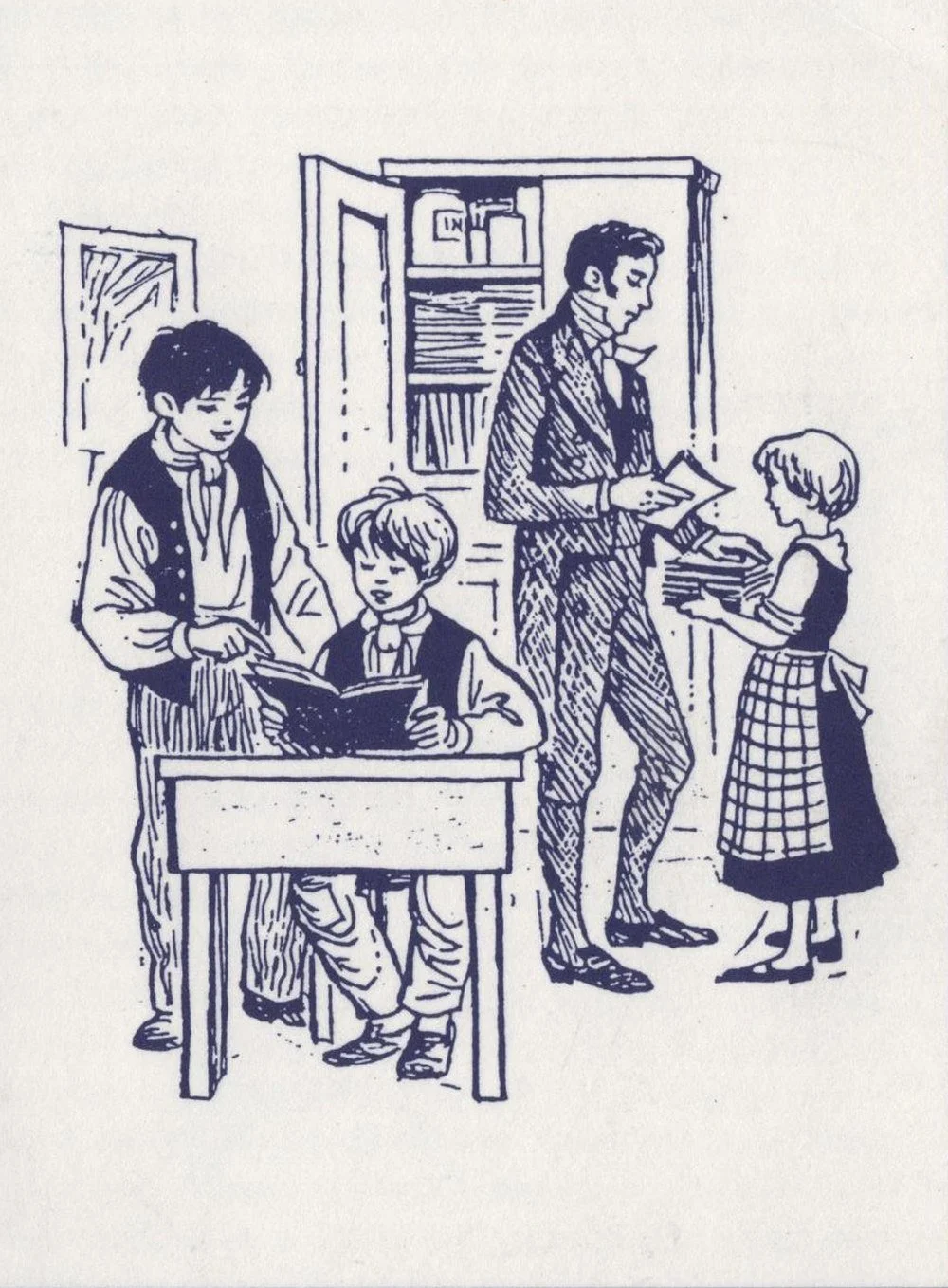
The other leg of the Church's staunch support of elementary education was the development of the ‘monitorial’ system, based on the principle of using the older children to teach the younger ones, a kind of pyramidical system. The credit for this cheap, effective and hugely successful way of instilling some basic discipline and instruction into unruly and uninformed children, is usually given to two men, Bell and Lancaster. Dr. Andrew Bell was an Anglican clergyman who, whilst serving as a missionary in Madras, had been forced by shortage of staff, to put classes in the care of more senior pupils. It worked. On returning to this country, he tried out the scheme in some parochial charity schools and found that the system was equally successful. Meanwhile, Joseph Lancaster, a Quaker, had opened a school in Southwark using similar methods and achieving similar success. In 1811, Bell had founded the ‘National Society for Promoting the Education of the Poor in the Principles of the Established Church’, whilst Lancaster had formed the ‘British and Foreign School Society’. It can be said with justice that Bell, the establishment man, and Lancaster, the non-conformist, between them created the English elementary school of the 19th century.
Both systems spread rapidly, but Bell's ‘National’ schools found a natural home in Torquay. The town was attracting the rich and prosperous, all members of the Church of England (at least on the surface!) and the fisher-folk and others were Church people by tradition. On 13th June 1813, an advertisement appeared in the Exeter Federation Press: ‘Wanted at Torquay a Master to conduct a School upon Dr. Bell's plans. Besides a regular salary, he will have the great advantage in teaching private pupils the principles of navigation. Apply Mr. Cosserat, Torquay’. James Cosserat was at that time, a Member of the Select Vestry, but a close examination of the Minutes of their Meetings fails to reveal any financial assistance in the setting up of the early elementary schools, but in 1826 the first National School in Torquay was established, using Dr. Bell's system, supported by voluntary contributions, together with such fees as might be collected, and capable of housing 108 boys and 120 girls. The site of the school was just down stream from the old grist-mill, in regular use until 1838, and using the River Fleete for its power. One has to shut one's eyes and imagine the scene in those days. Most of Pimlico and Union Street was then meadow-land, with the River Fleete flowing down from the top of the town, along Fleet Street to the sea, the mill being approximately where Marks & Spencer now trade, and the school situated on land now occupied by the sheltered housing flats known as ‘Madrepore Place’.
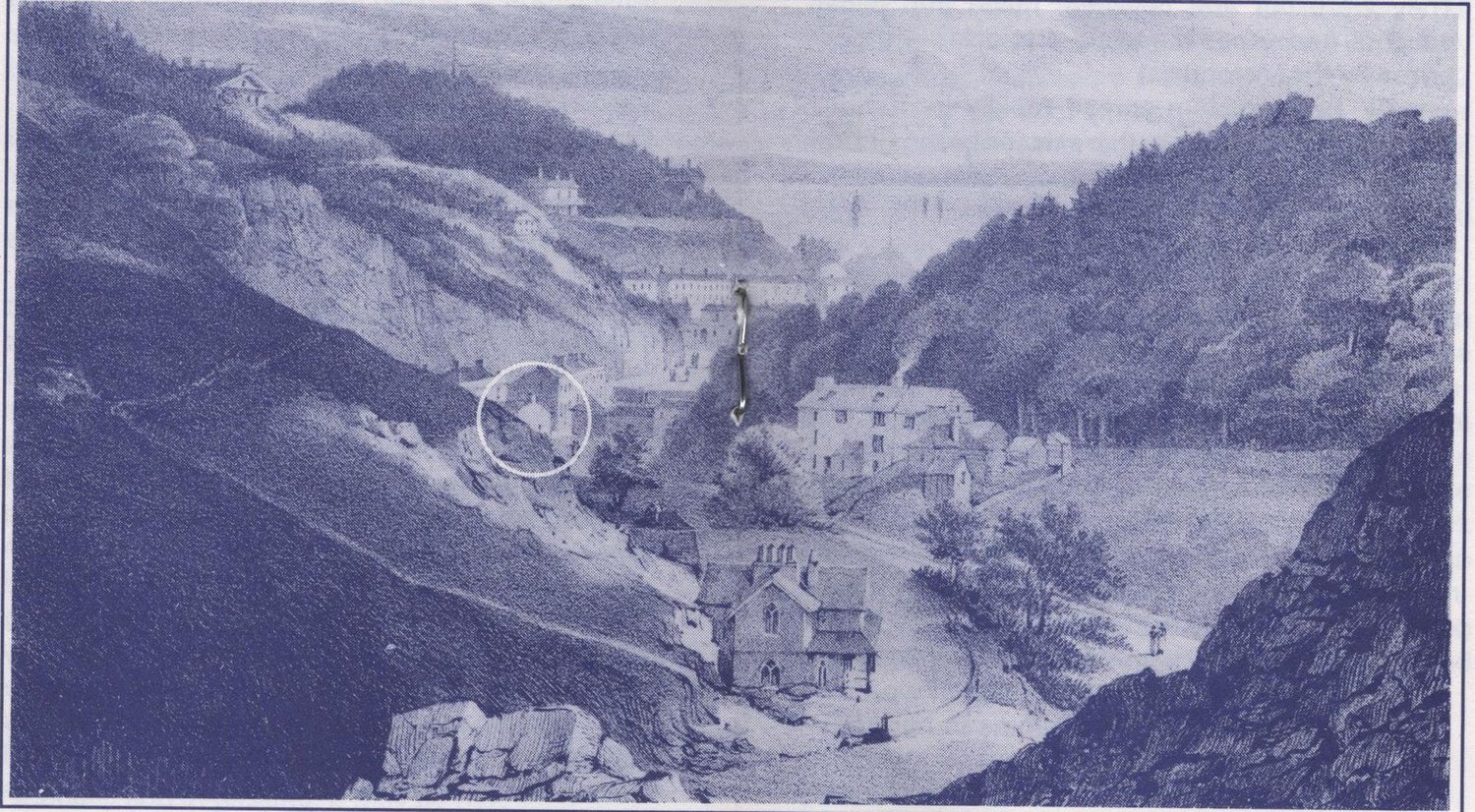
Instruction in the National Schools was basic, the Liturgy and Catechisms of the Church of England considered to be the most essential teaching. Other than these strictures, teaching was at first only the ‘three R's’, but gradually the curriculum was extended to cover other basic subjects. Although ‘Torquay National School’ was undoubtedly the correct name, colloquially it was frequently referred to as ‘Pimlico’, or later ‘Madrepore’, the latter name deriving from the ‘madrepores’, pieces of white coral fossil found in the area, and which provided valuable employment. They were cut and polished, made into paperweights and other domestic artefacts, greatly prized by the Victorians.
Dr. Bell's system spread rapidly in Torquay. By the end of the century there would be ten Church of England Schools, and three of Lancaster's non-conformist, and one Roman Catholic. By 1853 Madrepore had added an infants department and now had a capacity of 349 pupils. Infants could be taught in one class, but it was not considered ‘proper’ for the junior boys and girls to be in a mixed class, so that the upper storey was occupied by the girls and approached by a separate entrance to that of the boys, who were housed on the ground floor. It must be emphasised that the relatively well-ordered routine of modern educational establishments has nothing in common with the schooling of the early 19th century, valuable as it was. These were ‘voluntary’ schools, and even by the middle of the century only about one child in five was in receipt of any instruction at all. Two-thirds of the capacity of any school seems to have been regarded as a good attendance, and this by no means regular. The teachers' salaries would hardly have found favour with the National Union of Teachers. As late as 1866 the average salary was no more than £60 per annum. Fees for pupils whose parents could afford to pay were 3d. a week. Monitors were paid 6d. a week.
In 1826, Pimlico was of course, part of the original Parish of Tor, then with a population of about 2,000 souls. By 1861, there were 16,000 with the parish bursting at the seams. Peel's New Parish Act was a great relief, enabling the Commissioners for Improvements, who succeeded the Select Vestry, to carve up the parish into more manageable ecclesiastical division, thus allowing the great surge of church construction, which in turn led to the building of schools to serve their districts. Pimlico became part of Upton Parish. Further sub-division in 1869 placed the school in St. Lukes, and only two years later further division had Pimlico in Torwood, which had superseded Trinity. To complete the sequence of events, in 1906, the term ‘National’ was deleted from all schools; in 1921 the name ‘Pimlico’ was officially changed to ‘Madrepore Road’ and finally in 1972 the school, now for nursery and infants, together with Torwood Junior School, was closed down, the building demolished, and all transferred to a brand new building, Warberry Church of England Primary School in Cedar Road.
Although Pimlico School operated under Dr. Bell's ‘National’ system, there is no evidence that it was ever the recipient of financial aid from the National Society. Indeed with the rapid development of further schools in Torquay, the financial help given by the rich congregations became more widespread, resulting in severe problems for the school. This is not to detract from the sterling work of the National Society which since its inception 178 years ago has been instrumental in establishing 6,724 Church of England Schools (1986 figures) providing for about 1½ million children. A proud achievement.
Postscript: As noted above Madrepore School was closed down in 1972 and the building demolished. The site remained vacant until 1983 when it was purchased by the Westcountry Housing Association, who have developed the site to provide 20 one-bedroomed flats let at Fair Rents to the elderly in housing need.
Written by Denis Walton, 1989, who gratefully acknowledges the help given by Jim Boddy, one-time Head of Warberry Primary School.
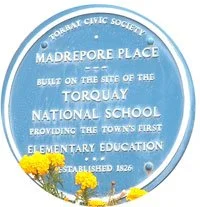
The Plaque
The plaque to which this leaflet refers is affixed to an external wall of Madrepore Place, the sheltered housing development referred to in the text.
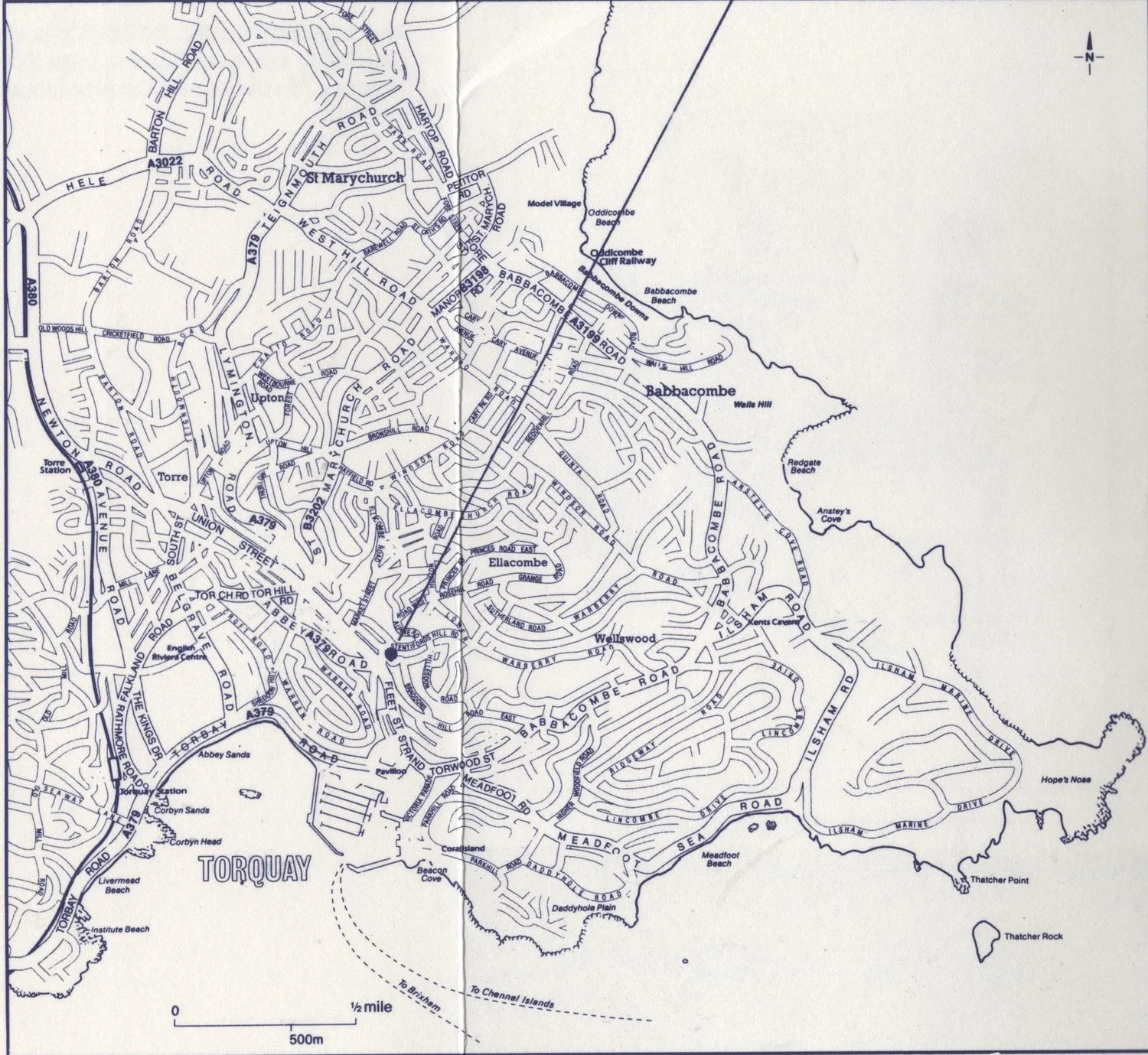
How To Get There
There is probably no easier way of describing the original site of the school, than to say that Madrepore Place is behind Marks & Spencer.
What To Read
- Barnard, H.C. A History of English Education from 1760.
- Smith, Frank. A History of English Elementary Education 1770–1902.
Where To Go For Further Information
References to Madrepore School are hard to come by. Readers are referred to the Archivist of the National Society, Church House, Great Smith Street, London, S.W.1.
Teachers, parents and others may well be interested too in the Log Books of the School which are available for inspection at the Devon Record Office, Exeter.
Acknowledgements
The Torbay Civic Society gratefully acknowledges the sponsorship of this leaflet and the plaque to which it refers, of the West Country Housing Association Ltd., Torquay. The Society is also pleased to acknowledge the help of the Torquay Museum and Central Library, Torquay.
The Plaque Inscription
Torbay Civic Society. Madrepore Place, built on the site of the Torquay National School, providing the town's first elementary education. Established 1826.