
Torbay Civic Society
Cockington CourtManor house of the Squires of Cockington
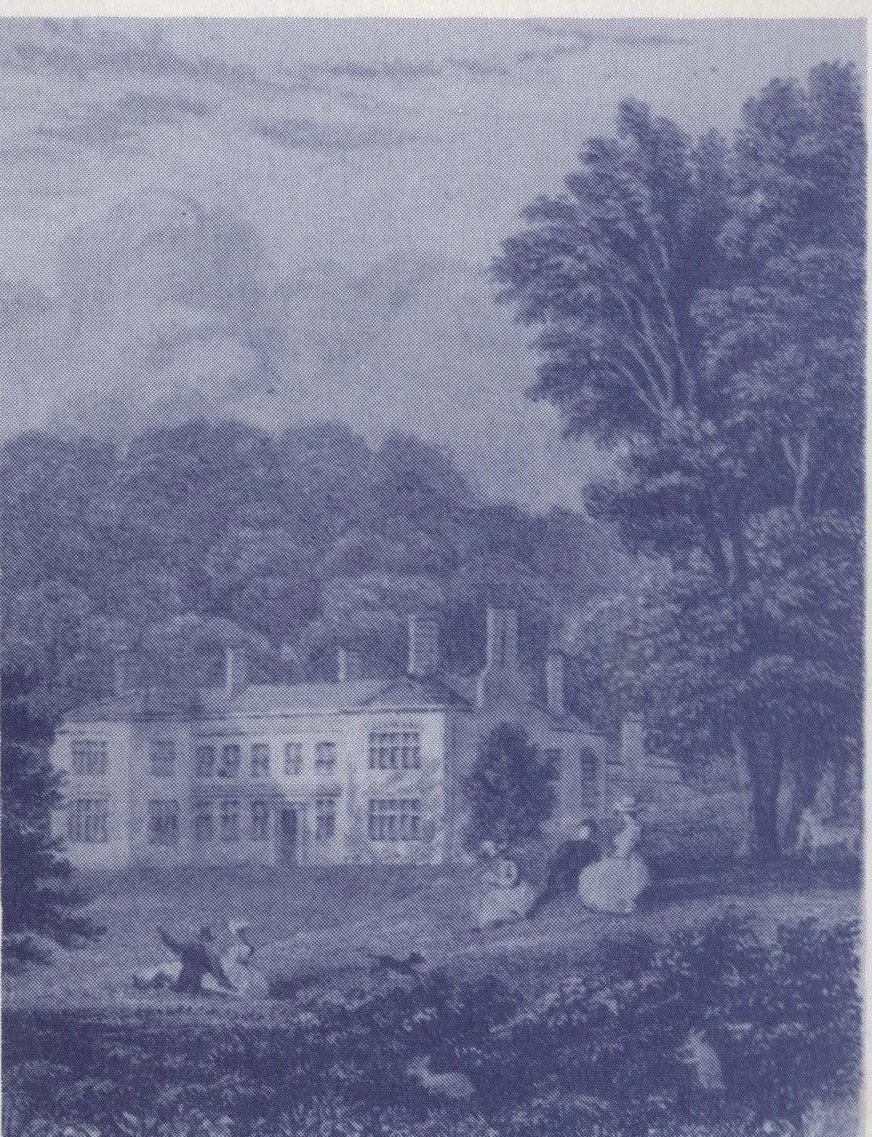
A country church and a manor house, how well they go together! At Cockington this is particularly so, for here both stand in close proximity in a typical Devonshire valley of red soil and abundant trees. Though hard-pressed in retaining its country aspect, with the ever-growing town of Torquay threatening it on all sides, Cockington has so far managed to preserve its rural character. It is still approached on all sides by lanes, and the visitor is given the illusion that he or she is far from urban growth. Perhaps this is why each year, so many flock here in their thousands to enjoy the peace of the park, with its lakes, meadows and wooded slopes.
On approaching the park, with its picturesque lodge of thatch and timber on the left, the eye is immediately attracted by Cockington Court, standing before us with such dignity at the head of the valley. It is a challenge to the imagination. How old is it? Who lived here?
The story of this attractive old house is as simple as it is undramatic, for it has always been just the manor house of a small village. So far as we know, no startling events have ever occurred here, and it has never been anything more than the dignified home of the lords of the manor. But it was here, as the very name attests, that the manor court was held, as it had been from time immemorial. It was thus the place where justice was meted out to the miscreants of the manor; so to the men of old this house on that account would be doubly respected. Even today, an air of severity lingers there, which the brightness of a summer's day never quite succeeds in dispelling.
At the time of the Domesday survey, Cockington was a thriving manor, but of the Saxon manor house of those days, not a shred remains. We may be certain though, that it stood on the site of the present house, for it stands at the head of a stream. With regard to the later mediaeval house, this was probably L-shaped. Only fragments are visible on the north side, though many of the ancient walls may remain yet, encased in outer walling of the 17th century. In the north wing, which contains the kitchen, such treatment may have been done to provide a symmetrical frontage, both north and south wings matching each other.
The visitor will also want to know what families have lived here over the years. Since Norman times, only three families have lived at the Court for any length of time, with another for only 23 years. The Saxon thane Alric, who held Cockington at the time of the Conquest, was a rich man, for he owned no less than 23 manors. Whether he ever lived at the court house we do not know, but he was dispossessed by the Norman, William de Falaise. It was not long, however, before the manor was in the hands of Robert FitzMartin, but by 1130 it was held by Robert's nephew Roger, who, residing there, styled himself ‘de Cokynton’. There followed an unbroken descent of the de Cokynton family until 1350, when a Walter de Wodelonde acquired the manor. His widow Katerina continued living at Cockington until 1373, when it was purchased by John Cary. Except for a period c.1471 when we find Sir Thomas Bourchier mentioned as lord of the manor, the Carys were at Cockington until 1654. Members of the family of whom we know something are Robert, who gave the handsome font in the church, c.1485, and Sir Thomas who died in 1567 and has a fine canopied tomb in Torre Church, now the Greek Orthodox Church. His eldest son, Sir George, was undoubtedly the most distinguished of the Carys of Cockington for it was he, with Sir Edward Seymour of Berry Pomeroy and Torre Abbey, who was in charge of the defence of Tor Bay at the time of the Spanish Armada. This they accomplished with great vigour, 397 prisoners being taken from a Spanish galleon and housed in Sir Edward's barn at Torre Abbey.
Queen Elizabeth I thought highly enough of George Cary to bestow a knighthood on him, following his defence of South Devon. The end of the century saw him in Ireland as Lord Deputy. Unlike the Carys later to own Torre Abbey, Sir George's family were never Catholics, and he lies buried in a vault before the high altar in Cockington Church where he was interred on 19th February, 1617. It was he who endowed the seven almshouses which once stood north of the Court, but are now opposite the Drum Inn in Cockington village. His descendants backed the Royalist side in the Civil War. The last of the Carys of Cockington was Henry, born 1613, High Sheriff when he was 30, and three years later in command of the garrisons at Kingswear and Dartmouth Castles. After a long siege at Dartmouth Castle, he eventually had to surrender to the Parliamentary forces, but was allowed to depart a free man, although heavily fined. But later, because of his support of Prince Charles in 1651, his estates were confiscated; even though these were eventually restored to him, he could no longer afford to live at Cockington, and in 1654 sold the manor to Roger Mallock, a merchant of Exeter, for less than £30,000.
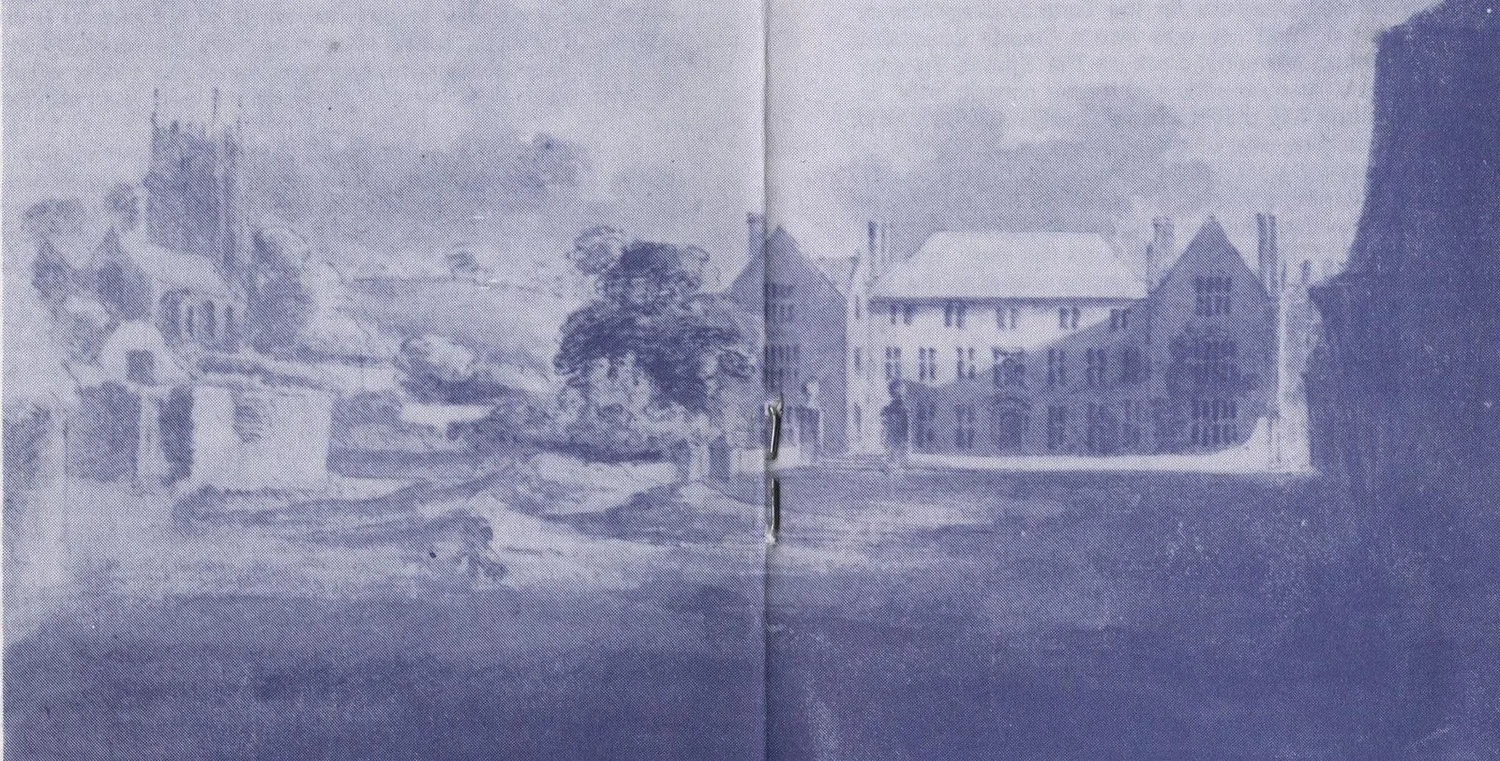
The Mallocks were to live at the Court for 278 years, until 1932. Roger's grandson, Rawlyn, was an outstanding figure. He was twice a member of Parliament for Ashburton and he enlarged the house on an ambitious scale. The sketch reproduced in this brochure shows that in 1795 it was, to quote Prince, ‘as elegant and gentle a house as any in the county’. But disaster was to strike, for just prior to 1800, Rawlyn's descendant, Rev. Roger Mallock, now lord of the manor, found himself unable to pay his way. In a drastic effort to economise, he ruined the appearance of the house by demolishing the fine gables and chimneys and apparently the whole of the second storey. Actually, the rooms, reduced in height and lit by skylights, still exist. The windows of the inner sides of the two projecting wings were blocked, and still are. But with the top storey windows gone, the Rev. Roger saved a great deal in window tax, which was then in force. He also got rid of his deer, selling the park to local farmers.
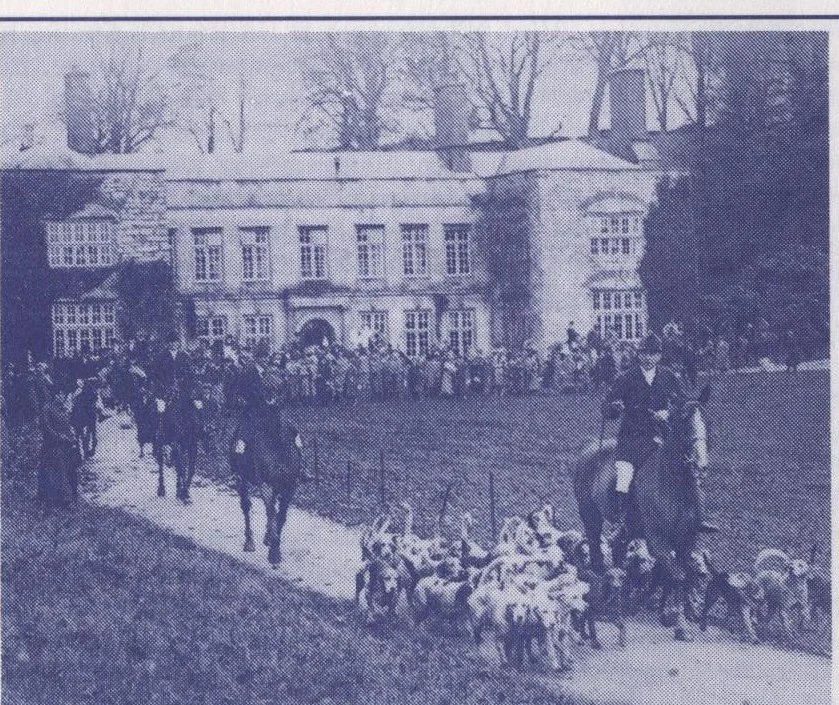
His fourth son Herbert, who succeeded him in 1846, devoted himself entirely to local interests, being Vice-President and Trustee of Torquay Hospital. When he died in 1873, he was succeeded by his son Charles Herbert Junior, a barrister and J.P. He was followed in 1875 by his eldest son Richard who became Member of Parliament for the Torquay constituency for nine years from 1886. He was also a County Councillor and J.P. The Mallock Memorial clock on The Strand, Torquay was erected by his ‘many friends and former constituents’, in 1902. His son, Major C.H. Mallock served both in the Boer War and the First World War, where he died of wounds in November 1917. His son Richard leased the Court to J.H. Charlesworth after the war, returning however, to celebrate his majority in 1928. After living at the Court for a further four years, he sold it to the Borough of Torquay, along with the park and the meadows by the lane, which leads from the village to the sea, 223 acres for £50,000.
The Court is presently being used as a Centre for the Devon Rural Skills Trust.
Written by Deryck Seymour, 1988
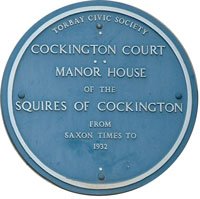
The Plaque
The plaque to which this leaflet refers is affixed to the exterior wall of the south-west wing of the Court.
How To Get There
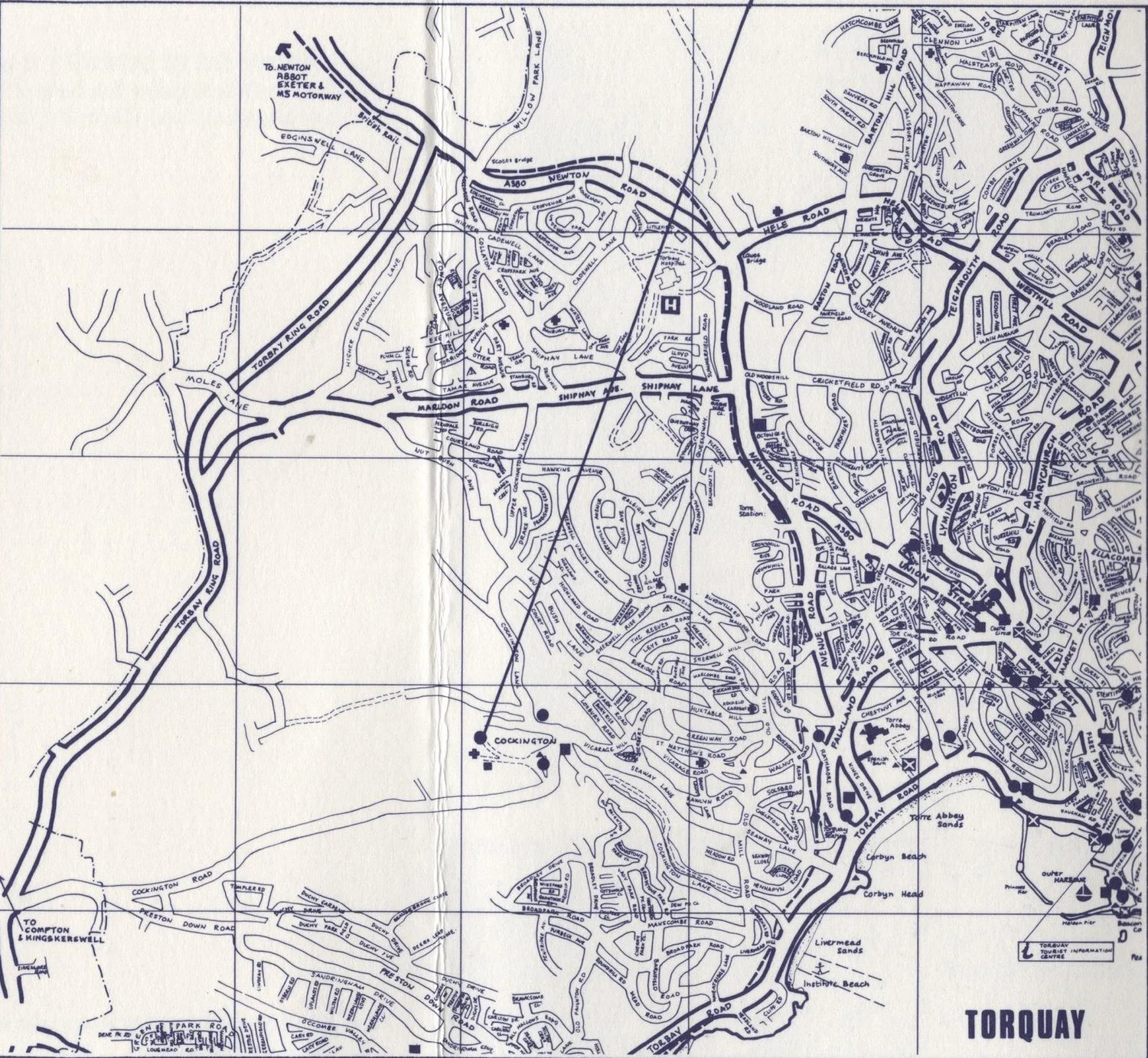
There is as yet no public transport to Cockington. Cars can be parked in the village car parks, and throughout the holiday season a horse-drawn carriage takes up to four people at a time from the sea front, near the Corbyn Head Hotel, to the village. The Court is approached through the park gates.
What To Read
- Dymond, R. Manor of Cockington. 1881.
- Ellis, A.C. An Historical Record of Torquay. 1930.
- Russell, P. A History of Torquay. 1960.
Where To Go For Further Information
- Torquay Central Library.
- Torquay Museum, the Museum of the Torquay Natural History Society.
Acknowledgements
The Torbay Civic Society gratefully acknowledges the sponsorship of this leaflet and the plaque to which it refers, of the Viscount of Falkland, Lucius Henry Charles Plantaganet Cary.
The Society is also pleased to acknowledge the help of the Torquay Museum and Central Library, Torquay.
The Plaque Inscription
Torbay Civic Society. Cockington Court, manor house of the Squires of Cockington from Saxon times to 1932.