
Torbay Civic Society
Livermeadan ancient harbour with nearly 800 years of history
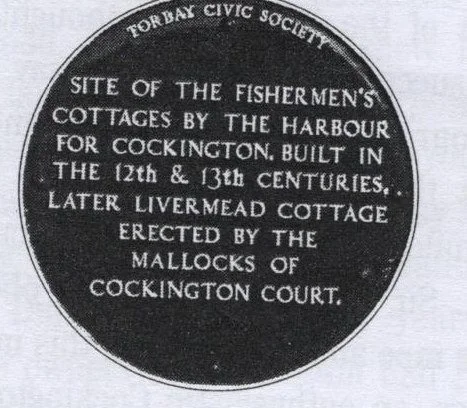
The Livermead Cliff Hotel's plaque, unveiled in April 1997, records the part this tiny harbour has played in Torbay's history.
To give the local inhabitants time to disappear on to the high ground behind when sea invaders threatened rape and pillage, the little medieval villagers around Torbay built their homes a mile or so from the shore. Brixham Church Town had Brixham Quay, Paignton, Rowneham, Tormohun, Torre Quay and Cockington, Livermead. Fiction perhaps but when the Press Gang was active, their young men escaped in this way. A letter from HMS Venerable in Torbay, 20th April 1803 reads: ‘Sir, In pursuance of your order, I went last night to Dartmouth, with the Officers and men previously directed, and made a strict search in all the Public Houses, and in every other place where the Lieutenant of the Rendezvous thought there might be a probability of success... I am sorry to say that as a result of these endeavours only produced two men... indeed I am informed that the greater part of [the local seamen] are retired some miles into the country, particularly at the back of Teignmouth ... Sir, Your respectful and obedient servant, J C Searle’. On the rape and pillage story, this may be the answer.
Many years ago, an enthusiastic Cockingtonian explained that the pier here at Livermead was built by Phoenicians in ancient times and they moored their biremes by the prow before setting off to Dartmoor in search of tin, hence its strange semi-circular shape. This story is completely without foundation; it is unlikely the Phoenicians ever sailed around Berry Head. Early maps apparently called it ‘the Roman Pier’ but the historian Arthur Ellis rightly discounted this theory. It is interesting to note that when Johannes Stöwell, armiger, an esquire entitled to a coat of arms, made his drawing in 1662, ‘Leuermead key’ had quite a number of large buildings. It was already an ‘old pier’ then.
As part of the history of the manor of Cockington, it is accepted that William the Conqueror gave it to William Hostarius who quickly sold it to William of Falaise. It was probably this William who built the pier shown on the 1662 map; this would have enabled him to embark for France easily, thus dating its construction to early in the 12th century. Stones weighing several tons each were used in its construction; these formed the inner and outer walls, the centre being filled with smaller stones creating a quay some 10 metres wide. It has almost certainly been there since medieval times; in 1327/8 James de Cokyngton gave fishing rights to the canons of Torre Abbey and they were also permitted to dry their nets on Cockington land. By that time fishing both by the monks and residents must have been well established and this might have stemmed from the long existence of a pier there. The Mallock documents in 1534 record the purchase of oars and one drag net bought new for 2s.0d. and a seine rope also for 2s.0d. The first Tithe Returns in 1535 show that it was quite extensive; the fishing rights belonged to the lord of the manor and tithes were due to him on catches landed.
In the year that the Armada was sailing up the Channel, John Filde and Otho Rendell were presented to the Manor Court at Cockington and fined for allowing their cellars at Livermead to be in bad repair in both plastering and timberwork. In 1671 William Adams left a ‘cloake’ and a new pilchard net to his son in his will. Pilchards were caught around the South Devon coast for many years from the mid-16th century. In 1867 an estimated 10 million herring were caught in Torbay and sold for between four and sixpence a hundred. One 16th century lease for two lives between George Cary and ‘Johan Drewe the wieff of John Drewe of Cockington, Marryner and John Drewe their son’ of ‘a cellor or Fyshinge house and a pallace... on a parcell of land called Leavermeade Close’ at an annual rent of 2s.0d., the fine, which was paid each time a new tenancy was granted, being £3.10s.
Leland, on his visit to Torbay in 1525, writes of ‘a small peere as a socour for fischar boats at Livermaed’. It may have fallen into disrepair by the beginning of the 18th century because in 1711 Rawlyn Mallock obtained a lease authorising him to use the pier at Torquay.
There was some industrial activity about which very little is known. In the 1870s ‘Hart's Shipbuilding Establishment’ was established on the Livermead side of Corbyn Head, the old Turnpike road, it was said, being converted into a slipway; the remainder of the road had been washed away in storms. It appears to have built only a number of small fishing boats. I have not identified Mr Hart so far. Another important event which seems little known, the Devon County Agricultural Show was held at Cockington in 1882. Other than dropping the ‘Agricultural’ and the location permanently in Exeter, much remains the same.
‘Livermead Cottage’ was being built in September 1825 and was ‘erected as an hotel’ according to the Exeter Flying Post. Other extensive building was then proposed on Mallock land but the plan was not proceeded with. By the 1880s it was described as an ‘old-world thatched cottage’ and the residence of Mr T Bevington. On the evening of 5th November 1886 he was in Brixham with his wife when he received a telegram to say that the property was on fire. He returned to find it destroyed totally although his family and servants had escaped without injury. It remained a ruin for some years until Benjamin W Stedham, a well-known Torquay resident, bought the land and built a house he called ‘Livermead Cliff’ in 1905. He continued to live there until 1917. Soon after this it was occupied by Sir Edward Wills and Lady Wills, a relative of Mrs Ella Rowcroft of Pilmuir. It ceased to be a private residence soon after the death of Sir Edward in 1921, the first advertisement for ‘Livermead Cliff, the new Marine Residential Hotel’ appearing early in 1922.
However, from the early 19th century there were two elegant properties beside the sea here. William Hurrell Mallock writes: ‘My grandfather built two houses Livermead House and Livermead Cliff in answer to this demand [homes for officers of the Fleet]. Both were for personal friends, one of them being the first Earl St. Vincent (history however says that he stayed at Torre Abbey with Mr Cary who was a relative), the other Sir John Colbourne afterwards Lord Seaton’. It is known that ‘Livermead House’ was built about 1810 and that it had ‘a bathing machine attached to the establishment’ in its earliest days. It was a handsome, well-proportioned house in dark red sandstone. Possibly Lord Polingdon's son stayed there, the ‘one house in Torquay where they [can] lodge and board, the house is neatly furnished and looks to the sea’. As is now well-known, Kingsley and his family stayed there in 1854. He took it on a short lease. Charles and his family enjoyed walking on the sands and searching the rock pools under Corbyn Head; these were taken back, shown to their mother and then kept in a vivarium. Much of this research was later incorporated in his volume of natural history called Glaucus.
When a photograph of the Haldon Pier being built in the 1870s was taken, there were just three buildings on Cockington land across the Bay, ‘Cockington Cottage’ was not visible. One was the first Torquay railway station, built in 1859, the second is Livermead House and the third ‘Chelston Cross’, now the Manor House Hotel, built by William Froude as the Admiralty Experiment Works. There is an elegant ‘flying staircase’ designed by Henry Brunel and the building included a small covered tank and workshops for making models etc., a carpenter's shop and stables. In 1870 the larger covered tank was constructed on the other side of Old Mill Road. Surviving plans show how water from the mains was laid on there by the Corporation; this had been allowed because of the work Froude did with his Appold/Froude scraper on the Torquay water mains, which were ‘furring up’ even then. W H Mallock explained why it was built: ‘During the first sixty years of the growth of Torquay, the owners of Cockington had preserved their rural seclusion intact, having refused, during that long period, to permit more than two villas on their property. But somewhere about 1860, a solitary exception was made in favour of Mr William Froude, my mother's eldest brother, to whom, by paternal uncle, a lease was granted of a number of acres on the summit of what was then a wooded and absolutely rural hill’. It was the very first ship-tank in the world and influenced ship design throughout the world. A professor of naval history came from Japan researching the story of the man who had played an important part in the development of the Japanese Navy.
Although the foreshore rights at Livermead were claimed by the Mallocks for a long period of the 19th century, they remained in the hands of the Duchy of Cornwall until 10th April 1888 when they were finally sold to Mallock, together with Right of Wreck of the Sea, for £84. In 1906 Captain Mallock gave Corbyn Head to the new Borough of Torquay, he had offered it some years before but it had not been taken up, Livermead Beach passing to the Council in April 1910, Mallock retaining the rights he already held to continue to remove sand from it and also to erect a bathing tent there.
The first major building on the headland was ‘Torbay Hall’, the home of the Chillingworth family for many years; it later became the ‘Headland Hotel’. In more recent years it had been successively a convalescent home and a nurses' home. It was demolished in 1985 and replaced with residential flats.
The question why the little beach beside the Livermead Cliff was called ‘Institute Beach’ has never been properly answered. One suggestion is that the orphans from St. Vincents in Torre were taken to bathe there by the Sisters.
John Perry, the proprietor of the Livermead Cliff Hotel, adds: ‘When my family built the bedroom extension to Livermead Cliff in 1976 we discovered various artifacts, clay pipes, pottery and so on, charred by a fire which had destroyed one of the cottages. In addition we found a cavernous basement, possibly a cellar, which required 25 tons of concrete to be poured in before building could begin’.
John Pike, Historian
The Plaque
The plaque is mounted at the Livermead Cliff Hotel on the Torquay seafront, and was unveiled in April 1997.
The Plaque Inscription
Torbay Civic Society. Site of the fishermen's cottages by the harbour for Cockington, built in the 12th and 13th centuries. Later Livermead Cottage erected by the Mallocks of Cockington Court.
Acknowledgement
This leaflet was published by the Torbay Civic Society in association with the Livermead Cliff Hotel.