
Torbay Civic Society
William Froude1810 to 1879, pioneer of ship model testing
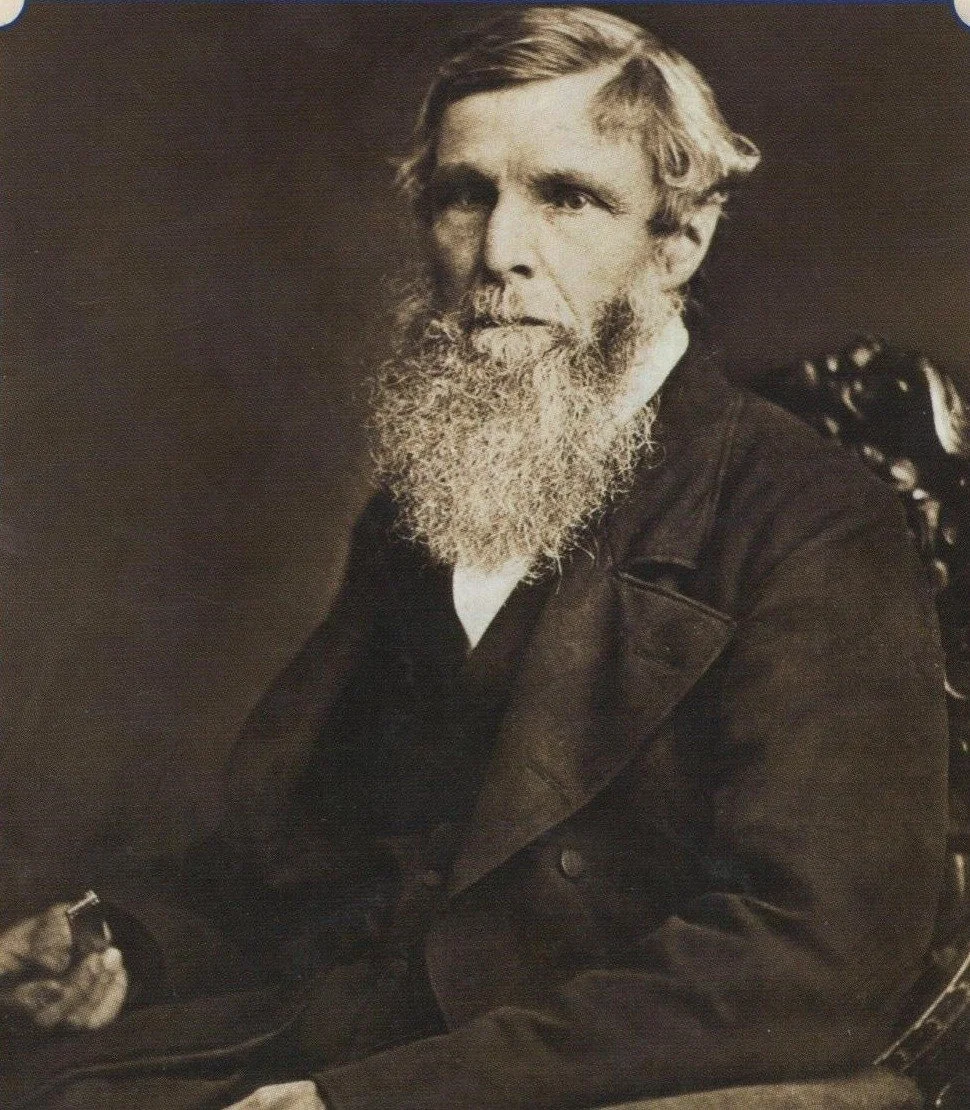
The official history of the Admiralty Experiment Establishment at Haslar, Portsmouth, begins: ‘The first ship model tank in the world originated from a proposal by William Froude, a civil engineer of considerable ingenuity and skill who had been for many years in ship model testing. His proposal to the Board of Admiralty in 1868 pointed out there were serious discrepancies in the then current ideas about ship resistance and claimed that his work [on models in the River Dart] demonstrated that accurate estimates of ship resistance could be made from model tests. He proposed that a towing tank should be built and run for 2 years for £2,000 to undertake the basic studies’.
It took the Lords Commissioners of the Admiralty two years to sanction the plan and for the work to start. Even after Froude's early death in May 1879, their Lordships took over a year to settle the outstanding account. It was not until June 1880 that his executors received a letter stating ‘the enclosed order for £1,673.1s.10d. payable to his legal representatives in settlement’ (as a copy of a letter in the archives at the Manor House, reveals). The actual cost had been considerably below that first estimate. The tank was completed and the first test on a model of HMS ‘Greyhound’ took place on 3rd March 1872.
The history continues: ‘By the time the lease ran out in 1886, William and R Edmund Froude had established the foundations for almost all the experimental techniques used on the models of surface ships. Frictional resistance coefficients were obtained which are still in use today’. That first ship tank was at Cockington, Torquay.
William Froude was born in 1810 at Dartington Vicarage; his mother Margaret's maiden name was Spedding, and her family had a tradition for scientific and technical interests. In 1828 William went to Oriel College, Oxford, where he graduated in 1832, taking a 1st in Mathematics and 3rd in Classics. His main interests there were sailing, chemistry and mechanics. In 1833 he became a pupil of the resident engineer of London Docks but also worked on surveys for the South Eastern Railway. In 1837 he joined the railway builder Isambard Kingdom Brunel and was in charge of the Exeter section of the Bristol and Exeter Railway, of which Brunel was Chief Engineer.
The major change of direction came five years later when, in 1844, he gave up full time work to look after his father, who was in failing health. From his papers we know he kept in touch with Brunel and occasionally did work for him. In 1850, for example, he carried out tests on propellers, using clockwork models made of tin plate. He also investigated friction problems on the ‘Great Eastern’ launch ways. When she finally went to sea he carried out measurements on how much the vessel rolled.
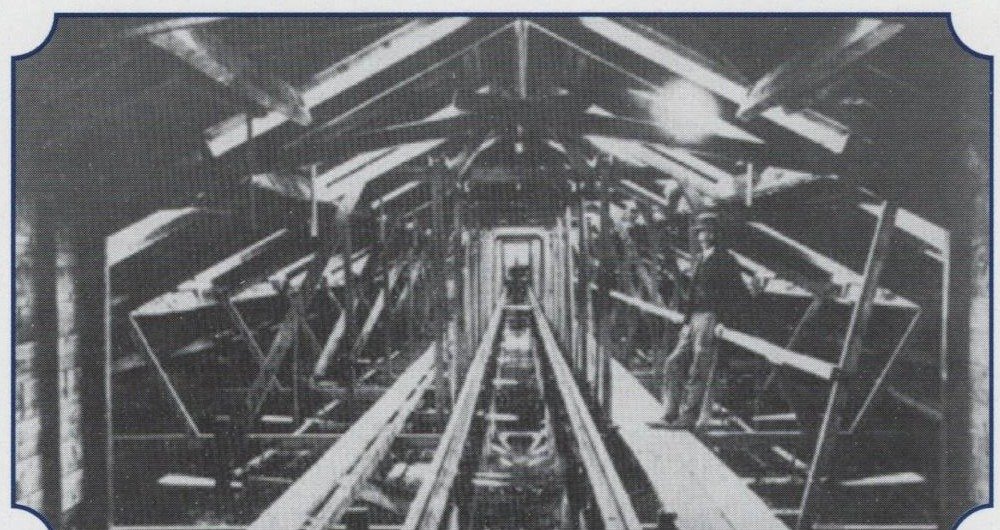
After his father died in 1859 he moved from Dartington to a house in Elmsleigh Road in Paignton. As well as testing his models in the Dart, he constructed a tank in the roof with a gravity weight outside that pulled the models along at a constant speed. As a result of the work he did there he formulated his ‘Law of Comparisons’, in effect that real ships behave at sea just like his models did in the tank. Over the next century and a half this was to revolutionise ship design throughout the world, as it does to this day. One of Froude's published papers shows details of the complex machine he designed to build his unique models, which ‘were generally about 10 feet long, made hollow with about 1½ inch thickness when finished and weighed 200 lbs. (100kg.). The mould is of plastic clay’.
In the 1860s Froude was given the task of improving Torquay's water supply; this involved inventing a scraper to clean the corrosion out of the mains. His knowledge of the flow of the Dart was well known, and when the Dart Harbour Commission was formed in 1862 he was one of the nine Commissioners appointed.
In 1863 he took a lease on land at Cockington where in 1867 he built ‘Chelston Cross’, now the Manor House Hotel. In the entrance hall is the ‘Flying staircase’, designed by Henry Marc Brunel, I. K.'s son, for William. Described as resembling the stairway between the decks of a ship, it is ‘built like a bowstring girder and is made entirely of pine, being fastened together with wooden pegs and is remarkably rigid’. The new house also included a small covered tank and workshops for making the models, a carpenter's shop and stables.
In 1870 the larger covered tank for model testing was constructed on the other side of Old Mill Road by Thomas E Dyer, builder, of Paignton. The reason this large house and its outbuildings were allowed to be built was explained by William Hurrell Mallock. He wrote: ‘The owners of Cockington, his father and grandfather, had preserved their rural seclusion intact, having refused, during that long period, to permit more than two villas on their property. But somewhere about 1860, a solitary exception was made in favour of Mr William Froude, my mother's eldest brother, to whom, by paternal uncle, a lease was granted of a number of acres on the summit of what was then a wooded and absolutely rural hill’. In another account his official biographer concludes: ‘The enterprise soon attracted the attention of other governments also, Admiral Popoff, on behalf of the Czar, having come all the way from Russia, and the rumour that Mr Froude was conducting a series of mysterious experiments which bade fair to revolutionise the naval architecture of the world, stirred interest in many men of mark, statesmen and others who were far from being naval experts, and also ladies, whose attention was, in my opinion, sufficient to throw a halo of success round any experiment which excited it. It would have been difficult to find a house more frequented than Chelston Cross in Torquay, by a society of well known and entertaining persons, not only English, but continental and American also’.
Before moving to Haslar in 1886, some 46,000 experiments had been done in Torquay, at the ‘Admiralty Experiment Works’, as it had become. There are now over 300 ship testing tanks throughout the world. A tale told by a Haslar officer during a visit in the 1950s was that a carboy of Cockington water went with them in the 1880s, and that a test tube from it still provides the ‘christening’ of all new installations worldwide. This cannot be confirmed.
In 1879 ‘Eddie’ (Robert Edmund), William's third son, born at Dartington in December 1846, was left in charge at a salary of 12 guineas a week while his father was in South Africa. He was originally engaged as his father's assistant at a wage of 3 guineas a week. William Froude died on 4th May 1879 at Simon's Town.
Robert Edmund took his place as Superintendent, though he was not so called until 1890. Soon after his appointment it was realised the Torquay tank was too short and that the buildings, designed for a short life, needed replacement, so a new site was sought. Eventually the Gun Boat Yard at Haslar in Portsmouth was chosen, and the Torquay operation closed down on 3rd February 1886.
William Froude is held in such high esteem in Japan, and is felt to have contributed so much to the naval architectural principles adopted there, that some years ago Professor Yoshioka, Professor Emeritus of Yokohama University, came to Britain researching material for a full length biography. It is not known if it was ever published, but some of the Professor's interim findings were published in Japan, in English.
When ‘Chelston Cross’ was first built its only neighbours nearby were ‘Livermead House’ and ‘Livermead Cottage’, both smaller and less grand. The house looked over an unspoilt shoreline across Torbay, and yet, in spite of the vast changes at Cockington since then, the Manor House Hotel, now privately owned, still enjoys those same open views across Torbay, and externally the original house has changed little in appearance.
Written by John Pike
The Plaque
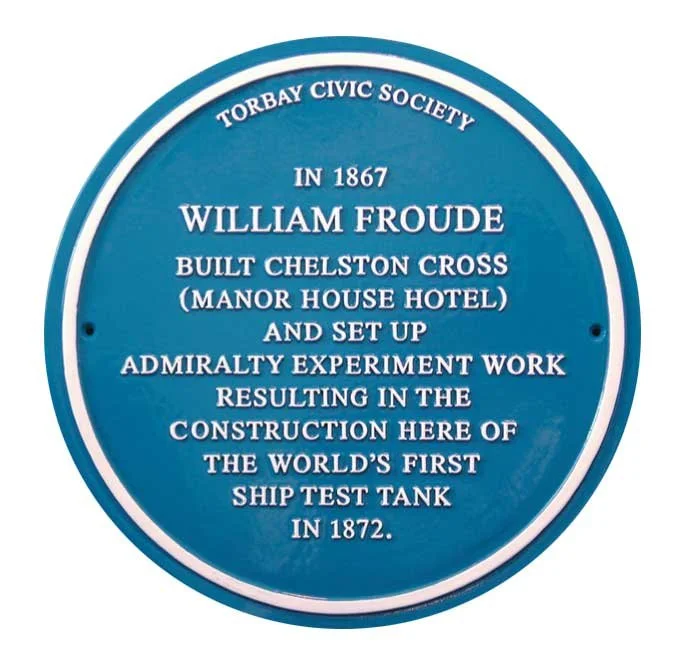
The plaque is affixed to Chelston Cross, now the Manor House Hotel, at the top of Old Mill Road, Cockington, Torquay. Find Cockington Lane off the Torquay seafront, then take the first right into Old Mill Road; the Manor House Hotel is 200 yards ahead, at the top of the hill.
The Plaque Inscription
Torbay Civic Society. In 1867 William Froude built Chelston Cross (Manor House Hotel) and set up Admiralty experiment work resulting in the construction here of the world's first ship test tank in 1872.
Acknowledgement
Our thanks to John Lake Estate Agent for the sponsorship of this publication.