
Torbay Civic Society
The First Torquay
Methodist Church1807, the Chapel in the Meadow
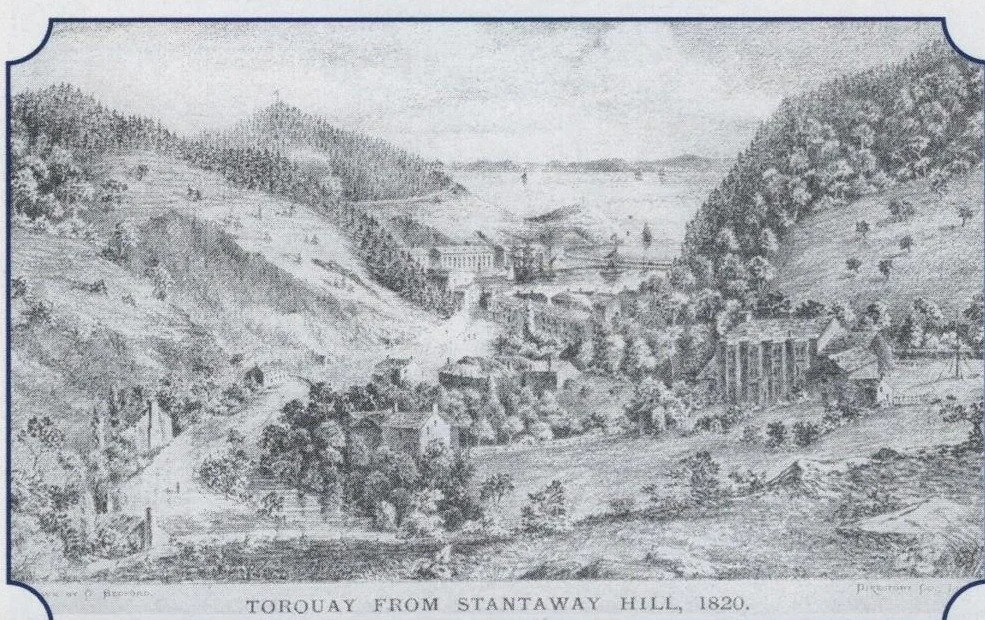
At the end of the 18th century communications throughout Devon were improving rapidly. Trewman's Exeter Flying Post was the newspaper for the whole of the county, and turnpike trusts were improving roads and making travel between towns easier. In 1785 the Keyberry Turnpike Trust opened the road from Barton to Newton Bushell (Abbot). It was at this time that John and Charles Wesley went on their preaching tours in the West Country.
So it was that two brothers, Edward and John Henley, travelled to Exeter to hear John Wesley preach. Subsequently, Wesley stayed with them and preached at both West Hill and Pavor Meadow. Edward lived in Swan Street, behind Fleet Walk, and John lived at Barton. In 1788 they began to preach in accordance with Methodist principles from a room in George Street and, after objections from neighbours, used Edward's home in Swan Street. Edward and his wife still attended Matins at St Saviour's, Torre, and trotted out to Barton, on one horse, for an afternoon service at brother John's, then returned for an evening service at home.
Their preaching proved effective, and in 1802 a thatched chapel was built, or possibly a cottage was converted, at Barton; an adjacent cottage was later purchased to allow for expansion. The Torquay congregation was outgrowing the Henleys' home, and in 1807 two cottages of a row of eight in the Fleet valley were acquired and converted into a chapel. This became known as the Chapel in the Meadow. Services continued there until 1852, when the congregation had outgrown the building and a prominent site in Rock Road was purchased and the Rock Road Chapel built on it.
By the middle of the century there was much discussion on the development of the lower Fleet valley. In 1864 the existing buildings were removed and the row of shops from Rock Road to George Street was built. By 1870 the shop on the corner of George Street, on the site of the Chapel in the Meadow, had become the premises of Peter Thomas, draper. In the 1880s this was taken over by J. F. Rockhey, twice Mayor of Torquay. Rockheys became a household name and continued until 1973, when it was bought by Dingles of Plymouth, remaining so until 1988, when the premises stood empty for two years before Burger King took over the building in 1990.
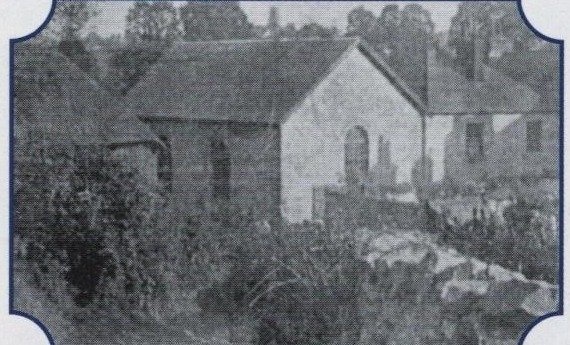
In the 1850s a group of Primitive Methodists began meeting in Torquay. When the Baptists moved into the new Baptist Church in Upton Vale, the Primitive Methodists bought their old chapel in Temperance Street in 1863. This congregation ministered to the spiritual needs of the growing population of Ellacombe, and eventually purchased a site in Market Street; the Market Street Primitive Methodist Chapel opened in July 1877. Meanwhile, another Wesleyan Chapel had been built in Torwood Street.
The high buildings of Fleet Street hid the Rock Road Chapel, and its congregation was outgrowing it. The problem was made worse by the Sunday School, started originally by the Anglican Miss Anna Gray and using various buildings in the town, which had been taken over by one of her pupils, Mary Henley, daughter of Edward, and was now using the Rock Road premises for around three hundred scholars. A site in Union Street was purchased, and a Sunday School was built there from 1876. It opened in 1878, with the adjoining Chapel following in 1879. This building burned down in October 1926, and although there was talk of abandoning the site in favour of Torquay's growing suburbs, it was rebuilt.
By the 1950s, dwindling congregations and the upkeep of Victorian buildings unsuited to twentieth century worship led the Trustees of Union Street Methodist Church to consider redevelopment. At the same time, the congregation of Belgrave Congregational Church, Tor Hill Road, were thinking along similar lines. Neither congregation's own development plans found approval, but the discussion led both to consider joining together. This became reality with the sale of the Union Street and Market Street Methodist Churches and the building of Central Church on the Belgrave site, opened and dedicated on 4th September 1976.
In the 1860s a Bible Christian Chapel had been established in East Street. Under the 1908 union of the smaller branches of Methodism into the United Methodist Churches, this became Zion Methodist Church, remaining in use until 1954, when it was put up for sale together with the successor of the original Barton Chapel and a small chapel in Western Road. Chelston was served by two Methodist churches in turn, meeting first over the stable in Walnut Road and later in a vacant house, before the Wesleyan congregation built a church at the bottom of Huxtable Hill, still in use today. In Innerbrook Road there was a chapel of the New Connexion ministry, which came under Zion Church in the 1908 union but closed during the Second World War.
Methodist services were held in the Plainmoor area from the 1830s. After the cholera outbreak of 1849, a slum clearance was undertaken in Torquay and displaced families were housed in temporary buildings on Barton Fields, an area that became known as Victoria Park as permanent houses were built. The increased population allowed the Wesleyan Methodists to build a chapel and schoolroom in 1864, still in use today.
In 1930 an Enabling Act of Parliament empowered the Wesleyan, Primitive and United Methodist Churches to unite as the Methodist Church in 1932. Since then Torquay has seen two further Methodist churches built: St Andrew's, Shiphay, in 1952, and St George's, Watcombe, in 1954. The former still serves Shiphay; the latter is now closed.
Thus it was that Methodism reached Torquay and the surrounding area. Paignton and Brixham arrived at the same goal by different routes. Of their two principal places of worship, that in Fore Street, Brixham, was built around 1816, and that in Palace Avenue, Paignton, in 1895 to 1896, although a congregation had been meeting there since around 1840.
In the early days of Methodism there was a single Circuit covering the whole of South Devon. As churches multiplied, this was broken up and rearranged many times. By the 1970s there was a Torquay and Paignton Circuit and a Brixham and Dartmouth Circuit within the Plymouth and Exeter District. All three towns now come under the Torbay Circuit, as does Kingskerswell.
Written by Lorna Smith
The Plaque
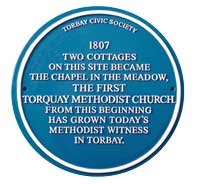
The plaque commemorating the church is set in lower Fleet Street, at the beginning of Fleet Walk, Torquay.
The Plaque Inscription
Torbay Civic Society. 1807. Two cottages on this site became the Chapel in the Meadow, the first Torquay Methodist Church. From this beginning has grown today's Methodist witness in Torbay.
Further Reading
- Pike, John. Torquay, the Place and the People: A Centenary History. Torquay Centenary Committee, 1992. ISBN 0 9519930 03.
- Scribe. Methodism in Torquay. Bendles, 1929.
- Smith, Lorna Ruse. Forward on the Pilgrim Way: A Brief History of Central Church, Torquay. Privately published, 1986. ISBN 0 9504468 15.
Acknowledgement
Pictures courtesy of Torquay Library. Our thanks to Gowrings Food Services and the Torbay Methodist Circuit for their contribution toward the production of this publication.