
Torbay Civic Society
Colonel Robert Smith
and Redcliffe1787–1873, Eminent Engineer, Artist and Architect in India
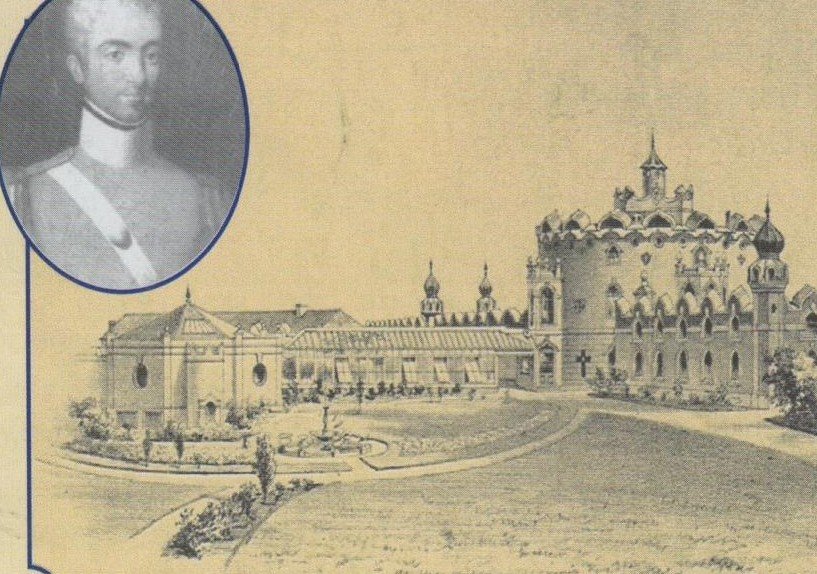
Redcliffe with its tower, minarets and oriental windows has long been conspicuous on Paignton's seafront, but it is only in the last thirty years that more has been learned about its fascinating designer and owner.
Robert Smith was born in Nancy, Lorraine in 1787, presumably while his parents were on a continental tour. The father, James Smith, at one time private secretary to the Marquis of Hastings, and his wife Mary lived at Bridgeland Street, Bideford, North Devon. They had had a long association with that town, although it is thought that they had connections with the Smiths of Braco and Methven in Perthshire, Scotland, and possibly a connection with Waterford, Eire.
Early in his life Robert showed tremendous artistic promise. A magnificent series of watercolour views of Weare Gifford House were commissioned by the Earl Fortescue of Castle Hill, North Devon, when he was only thirteen. Two other views of Bideford and the surrounding area are now in the Royal Albert Memorial Museum, Exeter, and one is dated 1803. At the age of sixteen this artistic promise was channelled into his training as an East India Company army cadet at Marlow. Before photography came on the scene, drawing instruction was considered absolutely vital to any would-be engineer, and at Marlow Smith was fortunate to be trained by the brilliant artist William Alexander.
So at the age of sixteen Robert followed his two older brothers James and John to India. A younger brother Edward was later to follow in their footsteps, but Robert was the only one to return to England. Arriving in Calcutta in 1805, he was ordered into the Bengal Engineers and worked on all kinds of projects, from building lighthouses, port modifications and bridges to work on a palace for the Rajah of Murshidabad.
At Calcutta he was very fortunate to be received into the artistic coterie of the artist George Chinnery, then escaping from debts in England and a furious wife. Chinnery had a profound effect on all who knew him, and this can also be seen in Smith's drawing of the time. Smith's skills were soon attracting official attention, and in 1812 to 1813 he was specially selected to travel up country with the Commander-in-Chief Sir George Nugent. His wife Lady Nugent wrote in her journal that Smith's views of Benares, Lucknow and Kanpur were so accurate that "I know every place immediately." Smith's beautiful volumes of survey drawings made on a later expedition in 1814 with the Marquis of Hastings (later Lord Moira) are now in the British Library, London, as is his portrait.
At the end of this expedition Smith was showing signs of fatigue and illness, and he requested to go on convalescence to Penang, but the outbreak of the Nepal War, from 1814 to 1816, prevented this. After distinguished service in the war as an engineer he was eventually sent to Penang, then known as Prince of Wales Island, as Superintending Officer.
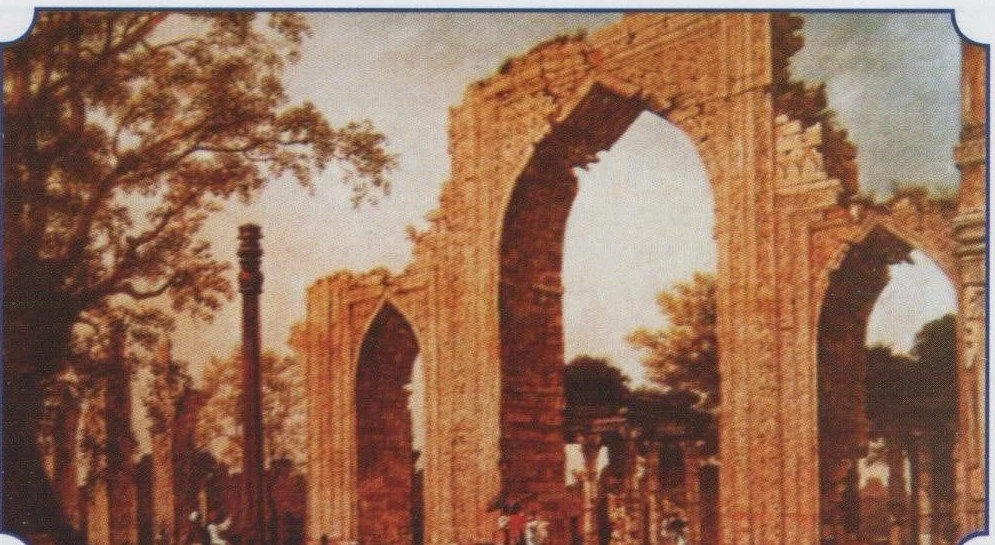
He found the beauty of the island very inspiring, and he painted many views of the hills and houses, some of which can be seen in the Penang Museum today. Officially he worked on the island's defences, but he also designed the church of St George's, still extant, and almost certainly some of the large classical houses of the spice plantation owners. But in working on St George's church Smith encountered official disapproval for the costs involved, and while on furlough to England in 1819 to 1821 he had to explain himself to the East India Company's Court of Directors. While in London, Smith took advantage of the artistic opportunities the city offered, meeting the famous artists of the Indian scene Thomas and William Daniell. It was William, being much taken by Smith's watercolour views of Penang, who produced a stunning set of aquatints entitled "Views in Prince of Wales Island" (1820), now very rare and much sought after.
By October 1822 Smith was back in India, this time way up country in Delhi. As the Garrison Engineer he was responsible for the Doab Canal, a pioneering project in British India, and completing the church of St James, as well as assisting in the repair of fortifications. While in Delhi he began restoring the old buildings of Mogul and pre-Mogul Delhi. The survival of the Qutb Minar, the Jami Musjid and the Red Fort owe much to Smith's skill and foresight. This experience deeply influenced his design for his own houses. In Delhi he is known to have lived in grand style, perhaps even taking an Indian wife.
In 1825 to 1826 he was severely wounded at the Siege of Bharatpur, and although highly commended for his bravery and later promoted to Major, he was forced into a lengthy period of convalescence in the foothills of the Himalayas. Mussoorie became his home, and here he painted continuously, often views of Delhi and the surrounding area. Some of these paintings are now in the Yale Collection of British Art in the USA. Unfortunately Smith was compelled through ill health to leave India in 1830, and he formally retired in 1832 as a Lieutenant Colonel. Twenty-two years later, in 1854, when the Ganges Canal was opened, Smith was appointed an Honorary Colonel in recognition of his canal work.
The next period in Smith's life is somewhat obscure. He certainly went back to Bideford and London for a time, but the next real thread in the story, which is poignant, is to be found in Florence, Italy. Here he married a wealthy French woman and had two children by her. But sadly their daughter Adelaide died in Florence aged thirteen in 1846. In 1850 Smith's wife Julia died there too. A distraught Smith returned to England with his six year old son Robert Claude, who had been baptised in Venice.
At the age when most people are contemplating their slippers and a hot cup of cocoa, Smith embarked on a huge building plan. Having come into a large sum of money, he began designing a house for himself. His only surviving relative, his sister Mary, had moved to Florence Villas, Warren Road, Torquay, from Teignmouth, and this is probably why Smith chose Torbay for his expansive architectural plan for a home here.
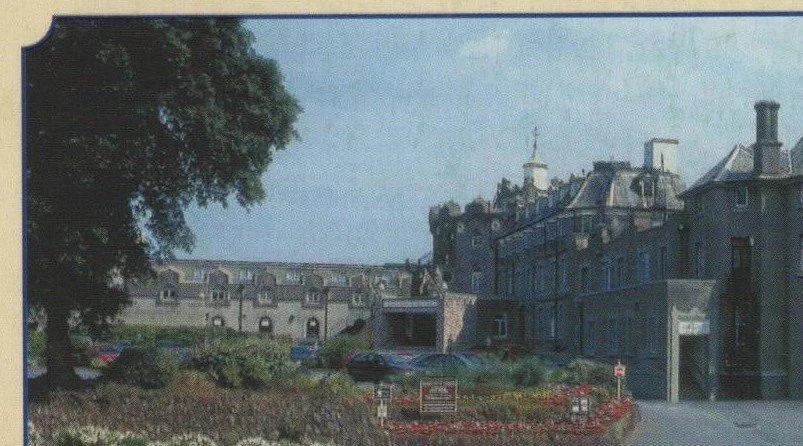
Paignton was then a quiet fishing port three miles from fashionable Torquay. The coast was quite deserted, and the front was made up of dunes and marshes which yielded reeds for basket making. All around, the hills were wooded. In 1852, on a red sandstone outcrop by the sea, Smith began work on Redcliffe using the local builder J. R. K. Tozer of Paignton. Work proceeded in several stages, the last completed in 1864, when this huge property comprised twenty-three bedrooms, picture galleries for his views of India, a billiard room and large dining room, a glass conservatory containing rare plants from India, steps reputedly oriented towards Mecca, as well as stables and outbuildings for servants, all in an Anglo-Indian style. Set in five acres with holm oaks, terrace walks, a fountain and Italian ornamental vases, it must have been truly memorable. Redcliffe was to establish Paignton as a resort.
Some novel features were the use of gas from the recently constructed Preston Gas Works, sliding internal doors which revealed fine views of Torbay, and a plunge bath on the seaward side that filled every day at high tide. This was approached via a tunnel which is still in use, although the bath was washed away in a storm in the 1880s.
The interior was magnificent, furnished with mahogany and walnut, including a Spanish mahogany dining room table, Florentine marble topped tables, collections of rare porcelain and cut glass, Brussels carpets and 300 of his paintings of India. It was the house of a connoisseur of taste with international ideals.
As if this was not enough, in 1858 Smith bought a pristine site at Mont Boron, Nice, France, and built himself a vast house in Anglo-Indian style called "Chateau Smith," now called "Chateau de l'Anglais." It still survives and began the building craze in Nice.
But Smith did not enjoy these places for long. In 1872 his sister died, to be followed in 1873 by Smith himself. Both were buried in East Teignmouth churchyard, where his father had been buried.
Locally Smith was known as a recluse, but he had visits from his few remaining "Indian" friends, and for a time he was Vice President of the local branch of the RSPCA. It was rumoured that he had animals, like tigers, at his house in France.
The house was bought by Mr V. Prendergast, who lived in it until 1893 when he sold it to Paris Singer, who probably bought the building for the development potential of its adjoining seafront estate. Singer later developed the land and built Preston sea wall and Marine Drive, donating Preston Green to the Council. He sold the first building plot to Robert Waycott, who built Villa Marina adjoining the Redcliffe, which was later used as a convalescent home for the Boer War wounded. In 1902 Paris Singer sold Redcliffe, and it was converted into a hotel in 1904.
For a time, until the Second World War, Smith's name persisted in local memory, but thereafter he was forgotten. His interesting life and career in the army were forgotten, his buildings in India and Europe went unrecognised, and of his artistic life nothing was known at all. Post-war interest in British relations with India, its art, architecture and culture has deservedly resurrected the life of this fascinating Torbay resident.
Written by Raymond Head
The Plaque
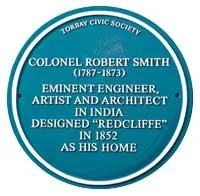
The plaque commemorating Colonel Robert Smith is affixed to the entrance tower of Redcliffe, on Marine Drive, Paignton, opposite Marine Park Road.
The Plaque Inscription
Torbay Civic Society. Colonel Robert Smith (1787–1873). Eminent Engineer, Artist and Architect in India. Designed "Redcliffe" in 1852 as his home.
Notes
The Torbay Civic Society plaque to honour Colonel Robert Smith was unveiled at the entrance tower on 22nd October 2001 by the Mayor of Torbay, Councillor Robert Pudner, and Society president Mrs Ena Hocking. This leaflet is a second reprint, issued in October 2014 and slightly revised using new material.