
Torbay Civic Society
Edward Vivian1808–1893, Banker and Benefactor to the Poor
Frank Cawson wrote of Edward Vivian as "one of the eminent Victorians of Torquay, active in public affairs, prominent in its educational institutions and a luminary in its social life." He was not without private means, and these he supplemented by being an insurance agent, hotelier and banker. Even this does not give a fair description of a remarkable man. Edward Vivian, a nephew of Lord Vivian, was born on 2 April 1808 at Bushey in Hertfordshire, later graduating at Oxford University with a BA and MA.
With two friends he purchased a yacht called "Paul Pry" in which they sailed around the south coast. His settling in South Devon was by accident. On his second visit to Torbay, he decided to make Torquay his permanent home. William Kitson and his brother, Captain W Vivian of St Catherines in Torre, had founded "Kitson's Bank" in Vaughan Parade in October 1833, and Edward soon joined his brother there. Known as "Vivian & Kitson's Bank," it was taken over by Lloyds (now Lloyds/TSB) in 1900.
The Edward Vivian story is firmly linked to Kents Cavern. Its full exploration dates from September 1845, when two members of the newly-formed Torquay Natural History Society "waited on Sir Lawrence Palk requesting permission to explore Kents Hole for the purpose of obtaining fossil remains" for a proposed museum. As a result, a major investigation took place between 1846 and 1847 by Vivian and William Pengelly. The results were said to be "meagre and misunderstood," but it was Edward Vivian who in 1847 read a paper to the London Geological Society on the work they had done in the cavern.
A second Kents Cavern "dig," also conducted by Vivian and Pengelly, lasted twelve years, from 1846 to 1858. This major excavation, overseen by the British Association Committee, had Edward Vivian as an active member. So much emphasis has been placed on Pengelly's name in connection with Kents Cavern that Edward Vivian's contribution to events "which changed the course of our knowledge of English prehistory" has not had the acclaim deserved.
In 1846 he also became connected with the Torquay Directory newspaper, which he edited for many years. He was president of the Devonshire Association for the Promotion of Science, Literature and Art in the year that it met in Torquay, and second president of the Torquay Natural History Society, before William Pengelly. Although better known for his educational and scientific work, Vivian, who was red/green colour-blind, was a talented artist. His sketches of South Devon were lithographed by Ackerman, and some of Torquay by T. C. Dibden.
His work was shown at many Torquay art exhibitions, and it was largely through his efforts that a School of Art was founded. Built originally as the "Salem Chapel" by Robert Stark, it had been a church for thirty years before being converted to become the "Institute for the Promotion of Science and Art," later the Vivian Institute, and finally the School of Art. To commemorate Her Majesty's Diamond Jubilee, a second storey was added to the school by public subscription in 1877. Now a restaurant, "The Piazza," Torbay Civic Society unveiled one of its blue plaques on this building in Vivian's honour in 1987.
Although derided by Lord Palmerston as "amateur soldiers," the Volunteer Movement was very strong in Torquay in the late 1850s. It is in this connection that Edward Vivian's name appears when, in December 1859, the Fourth Devon Volunteer Artillery Battery was formed under his command, as "Major Vivian." Months later the Government supplied two 24-pounder muzzle-loading guns that were placed on Corbyn Head. As its commanding officer, Vivian paraded at the head of the Corps when important visitors came to Torquay. One was the Grand Duke Michael of Russia, and the Artillery fired a salute in his honour.
The Torquay climate so fascinated Vivian that from 1842 he made daily observations of the weather at his home. From the late 1840s, when the Torquay Directory became a newspaper as well as a "List of Residents & Visitors," a summary of these observations appeared weekly and continued to do so for many years.
In the late 1840s the accounts of the Torquay Gas Company, in seeking additional funds, show Vivian already owning 150 shares, taking an additional 75 shares at a cost of £49. If the detailed records of other enterprises could be searched, the name of Edward Vivian would likely be there. Like Kitson, he was committed to supporting "his" Torquay, and was a member of the Improvement Commissioners, which became responsible for growing the town's local government in 1836, and later, when the Local Board of Health was formed in 1850, was one of the first eight elected, remaining a member for some years. He became a Justice of the Peace in 1841, serving on the Bench for many years, before finally becoming Senior Justice in 1880.
It was perhaps in one of these capacities that in 1852 he arranged for a present of Devonshire cream and flowers to be sent to Her Majesty Queen Victoria on board the Royal yacht at anchor in the Bay. This was dispatched in a silver bowl that was "very old." When the messenger returned, Vivian was told: "They nabbed the cream, basin an' all." This was a favourite tale that he often repeated.
Despite his privileged upbringing, Vivian was acutely aware that there were many who were, for a number of reasons, poor, hungry and needy. He identified three problems: drunkenness, the low wages of particularly agricultural workers, and the lack of educational opportunity. Over many years he was to devote a considerable amount of his energy, money and time trying to help the poor, and became known as a major benefactor to the poor.
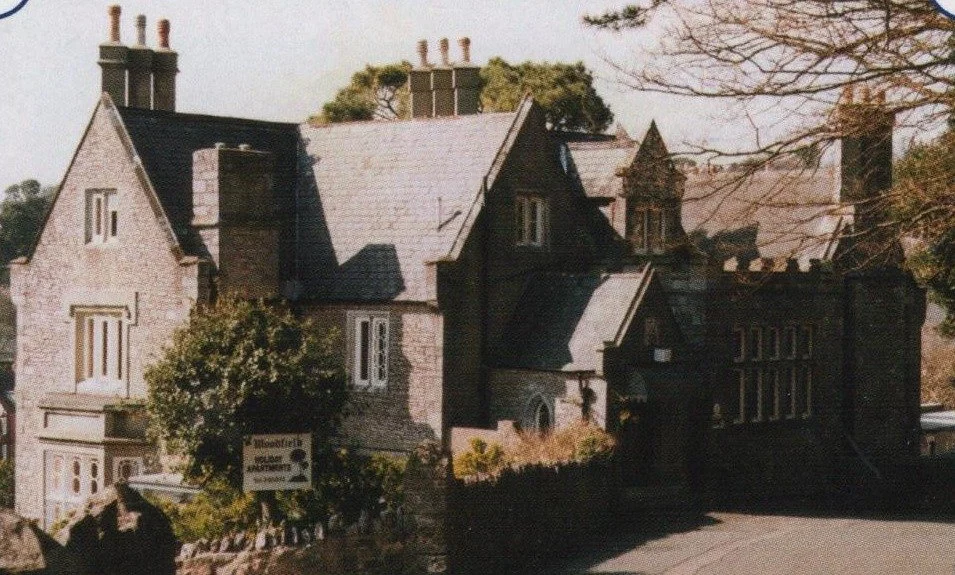
"Woodfield" was built for Edward Vivian, his wife and three children, by Messrs John Harvey (builders) in the early 1840s. According to Stephen Bretton, the nineteenth-century recorder of Torquay's history, when Woodfield was under construction the old Elizabethan house across the road, Torwood Manor House or Ridgeways Manor House, was being demolished, and the Tudor Purbeck marble mullions, coping stones, cornices and fine transom windows were presented to him by Sir Lawrence Palk, to use in the new house.
Percy Russell, a post-war historian, said that it was one of the first "Gothic" villas built by Harveys, and was soon followed by other smaller and more ugly ones nearby. These were demolished in the nineteen-sixties, so "Woodfield," with its double gables, remains a period house of importance. The house was bought by Sauro Sansoni in 1979, and at the time it was believed that a holy well had been found in its grounds. According to Arthur Ellis, the old well was originally located at Torwood Manor, and only the entrance arch of the well had been given by Sir Lawrence to Vivian, who erected the arch himself and named it the Grotto. It can still be seen in the grounds today.
From the deeds of the neighbouring property, now "Woodfield Villa," built around the same time, it appears that both were erected in "part of Woodfield, a close near Torquay," hence its name. The conditions of that lease included that no dwelling should be used as a place of public worship or as an Inn or Victualling House or sell beer or cider, a strange restriction for a grand property of this character.
Various cornices, stuccoed ceilings, a hallway oak fireplace, oak staircases and the coat of arms have survived and can be seen in Woodfield today. The Indian cedar, which came from a seed from the Himalayas planted by Vivian when a boy, also survives in the grounds. Woodfield, now a Grade II listed building, is privately owned as holiday apartments.
Edward Vivian died aged 84 on 30 March 1893.
Written by John Pike, with additions from D Walton
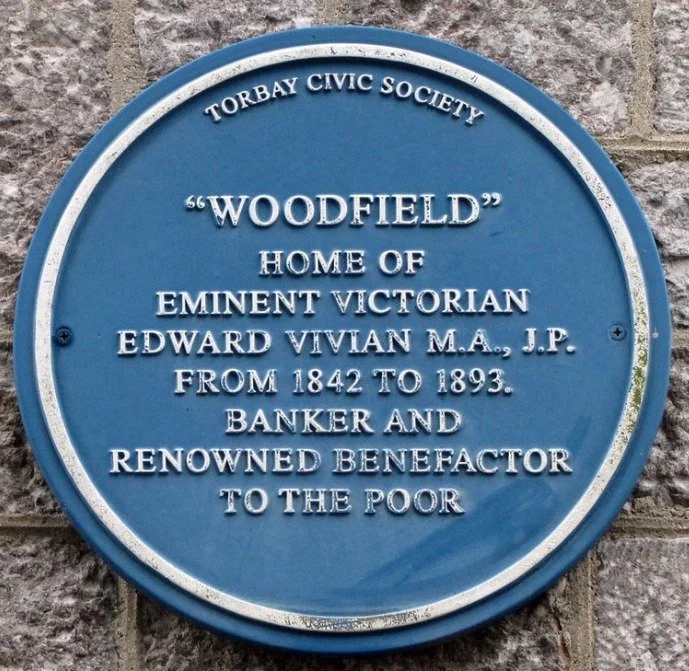
The Plaque
The plaque commemorating Edward Vivian is mounted on the front wall of "Woodfield," in Lower Woodfield Road, which is off Meadfoot Road, Torquay.
The Plaque Inscription
Torbay Civic Society. "Woodfield." Home of eminent Victorian Edward Vivian M.A., J.P. from 1842 to 1893. Banker and renowned benefactor to the poor.
Notes
Edward Vivian M.A., J.P. (1808–1893) was a banker, scientist, educationalist and benefactor to the poor. He was a key figure in the early exploration of Kents Cavern alongside William Pengelly, a founder of the institution that became the Torquay School of Art, and the builder of "Woodfield," the Gothic villa at Lower Woodfield Road that remains a Grade II listed building today.