
Torbay Civic Society
Oliver Heaviside1850–1925, Physicist and Mathematician
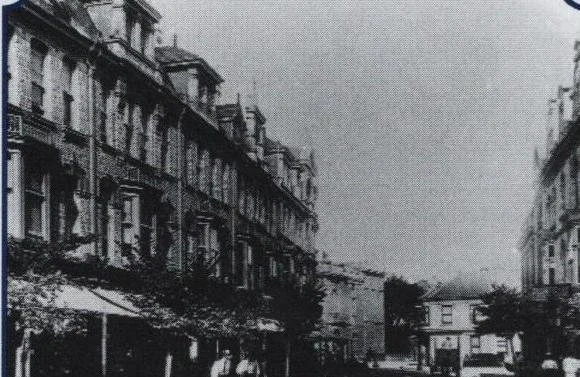
Imagine a boy with bright red hair, hampered by deafness brought on by scarlet fever, leaving school at sixteen. Imagine, too, a grown man constantly suffering from gout, plagued by bouts of jaundice, who chose a life of seclusion and lived, as a lifelong bachelor, a hermit-like existence. This was Oliver Heaviside, one of Britain's most eminent physicists in the new world of Victorian electricity. He became recognised throughout the world as a visionary scientist of outstanding courage, whose early theories would eventually be proven, and who is credited with one of the three greatest mathematical discoveries of the late nineteenth century.
A brilliant scientist, mathematician, physicist and electrical engineer, Heaviside even has craters on the Moon and Mars named after him. He was born in the same London slums as Charles Dickens, on 18 May 1850, and left Camden House School in 1866. He studied electricity, learned Morse code and became a telegraph operator in Denmark, pursuing another of his loves, languages. He was already publishing papers on electricity at the age of twenty-two, having taken inspiration from James Clerk Maxwell and, in particular, from his own uncle, Charles Wheatstone.
Wheatstone, in 1837, together with W. F. Cooke, had patented the electrical telegraph and later devised the resistance-measuring network that became known as the "Wheatstone Bridge." With this background, Oliver seemed destined to become a scientist and mathematical genius, and he became obsessed with the electromagnetic and electromotive forces of the natural world.
In 1871 he returned to England to work for the Great Northern Telegraph Company, then dealing with overseas telephonic traffic. In 1872 his first significant paper, "Comparing Electromotive Forces," was published, and in 1873 a further paper attracted the attention of Maxwell, who incorporated the results into the second edition of his own "Treatise on Electricity and Magnetism." The book so fascinated Heaviside that he devoted years to studying and mastering it. He later wrote: "I saw that it was great, greater and greatest, with prodigious possibilities in its power. I was determined to master the book. It took me several years before I could understand as much as I possibly could. Then I set Maxwell aside and followed my own course and progressed much more quickly." Heaviside eventually simplified Maxwell's twenty equations in twenty variables, replacing them with two equations in two variables, the form in which Maxwell's equations are still taught today.
It was during this period that his increasing deafness forced him to leave the telegraph company and continue his research independently. Although the alternating current system of electricity had been commercially established some fifteen years earlier, it was Heaviside who, in 1874, established the symbolic method of analysing a.c. circuits still used today. He was responsible for a number of words being accepted into the English language, including impedance, capacitance, inductance and attenuation, all familiar to electronic engineers today. Between 1880 and 1887 he developed an operational form of calculus still used in various branches of pure mathematics.
His visionary idea of inserting induction coils into long-distance telephone and telegraph circuits was a milestone in the development of telephony. He also greatly enhanced understanding of the relationship between the sun and the earth, and his theories correlating electromagnetism with gravitation still find an echo in modern energy research. The journal "Nature" described him as "a man whose profound research into electro-magnetic waves has penetrated further than anyone yet understands," while the mathematician Edmund Whittaker later described his operational calculus as one of the three most important mathematical discoveries of the late nineteenth century. In 1891 he was elected a Fellow of the Royal Society, and he later became the first recipient of the Society's Faraday Medal.
He is perhaps best known to the public for his prediction of a layer of ionised particles in the earth's upper atmosphere, off which radio signals would bounce, a theory only proven in 1924, the year before his death. It was Marconi who, in 1901, provoked the theory when he arranged for the first radio signals ever to be sent across the Atlantic; unable to explain how the signals had followed the earth's curvature, Heaviside's prediction that wireless waves might be "caught" by a reflecting layer in the atmosphere was included in the tenth edition of the Encyclopedia Britannica in 1902. A similar prediction was made about the same time by Arthur Kennelly of Harvard University, and today it is known, in joint recognition, as the Kennelly-Heaviside Layer.
By 1893 the first volume of his research on electromagnetic theory had been published, followed by the second in 1899. A third volume appeared in 1912, but his fourth and final book was never finished; extracts from the unfinished manuscript were published after his death. Moving to Devon in June 1889, Heaviside first lived at Paignton with his parents at Palace Avenue, and then for eleven years at Newton Abbot.
In those Newton Abbot years he became a bitter, reclusive man, with evident signs of a persecution complex and constant bouts of illness. Yet beneath his apparently warped nature was a delightful man with an impish, puckish sense of humour. He invested in a "new-fangled" machine, a safety bicycle with a spoon brake pressing on the front tyre, and was remembered by his family whizzing down the narrow lanes, whistling, with his feet on the front forks because the pedals span too quickly on a machine with no freewheel.
Later, ill health forced him to move nearer his relatives, and he finally went to Torquay in 1908, where his brother Charles had a music shop in Torwood Street. But the odd lifestyle, self-imposed solitude and constant recurring illness through jaundice eventually proved fatal. Found unconscious at his home, "Homefield," in Lower Warberry Road, he died some weeks later in a nursing home on 3 February 1925, in his seventy-fifth year.
The family grave in Colley End Road cemetery, Paignton, although badly in need of restoration, has become a place of pilgrimage for modern-day admirers, many from universities in Russia and the United States, where he remains much revered: a man whose work will live forever, of towering genius, who ranks among the highest this country has produced.
Contributed by Alan Heather, a member of the Heaviside family
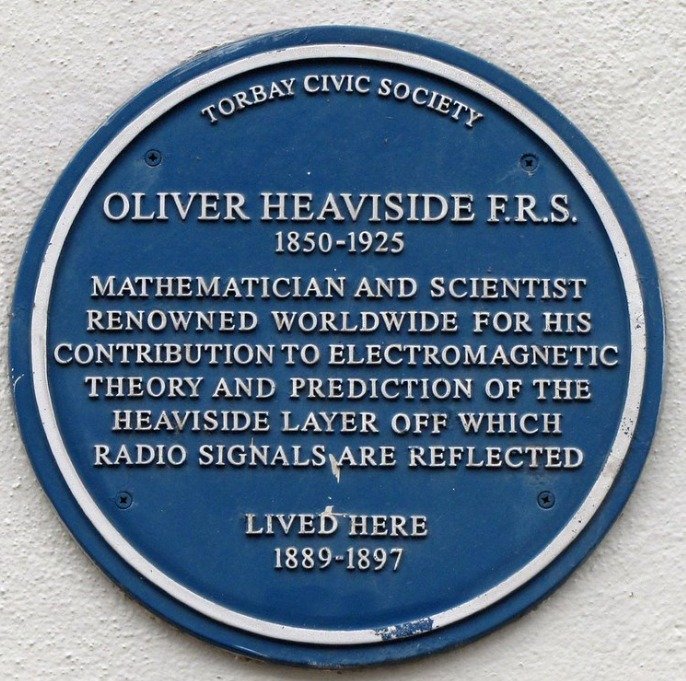
The Plaque
The plaque commemorating Oliver Heaviside is mounted on the left front wall of Barclays Bank, Palace Avenue, Paignton.
The Plaque Inscription
Torbay Civic Society. Oliver Heaviside F.R.S. 1850–1925. Mathematician and scientist renowned worldwide for his contribution to electromagnetic theory and prediction of the Heaviside Layer off which radio signals are reflected. Lived here 1889–1897.
Notes
Oliver Heaviside F.R.S. (1850–1925) was a physicist, mathematician and electrical engineer whose reformulation of Maxwell's equations, development of operational calculus, and prediction of the ionised layer that bears his name mark him as one of the great scientific minds of the Victorian age.