
Torbay Civic Society
Washington Singer1866–1934, and Steartfield House
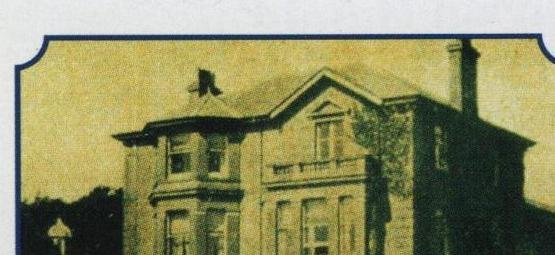
The Palace Hotel, Paignton, has a chequered history. Built around 1870 as a private residence, "Steartfield House," in Steartfield Road, it became the family home of Washington Merritt Grant Singer, second son of Isaac Singer, founder of the Singer Sewing Machine Company.
Washington Singer was born in Yonkers, New York, in June 1866, the third child of Isaac and Isabella Eugenie (née Boyer). Isaac, having dissolved a business partnership in the original sewing machine business in July 1863, decided to move his family to Paris. Already a wealthy man, his vast fortune as the major shareholder in the Singer Manufacturing Company would continue to grow long after he left America for the last time. Washington's Christian names came from the American city, a family name, and Grant, taken from General Grant, later U.S. President; an ardent supporter of Grant, Isaac had donated a thousand sewing machines to the American war effort before the family left for France, and then soon after for England.
Wanting an estate in Torbay, Isaac brought the family to the Victoria and Albert Hotel, Torquay, while searching for a home. His first choice was the late Isambard Brunel's estate, but with the Mallock and Cary families refusing to sell to a flamboyant outsider, Isaac purchased the Fernham estate in Paignton instead, comprising Fernham Villa, Oldway House, six cottages and the Rising Sun public house. Once in residence, Isaac set about planning his new home, a "Wigwam," a house nickname taken from America's Indians.
Washington, together with his brothers and sisters, lived in Paignton until their father's death in 1875, and although the family moved into the "Wigwam," their father never did. During this period they had a governess, a tutor and a nanny in residence, and the children's daily routine included riding, stable-keeping, fencing and boxing. By 1879, still unaccepted by the local Torbay gentry, Isabella, now thirty-eight, decided to move the family back to France, where she was immediately welcomed into Parisian society as the widow of the founder of the international Singer Sewing Machine Company. Soon after the return to Paris, Isabella married the impoverished Duc de Camposelice and became a duchess. She knew that once the children turned sixteen, if their individual inheritances were to be protected, they should return to England to become Wards of Court. Mortimer was the first to return, becoming a Ward of Court in 1879; three years later Washington followed. The brothers made England their principal home for a number of years and, as young adults, involved themselves respectably in many local associations and sporting activities, while each retained a separate London house.
Washington would later establish a cottage hospital in Paignton, and in Paris generously funded the purchase of an organ for Paignton's St John's Church. Like his father, Paris Singer was a flamboyant businessman, whereas Washington was a sportsman; with an inheritance in the region of a million dollars, Washington had always wanted to become a rancher in America, but had been discouraged from this by his brother.
After marrying Blanche Emmeline Hale in October 1887 at St George's, Hanover Square, London, Washington returned with his bride to Paignton to make Steartfield House the family home. Washington built stables in the fields near the junction of Manor Road and Old Torquay Road, and his racehorses exercised on gallops he established on the grassland now known as Preston Green; some horses bore Devon names and were popular with local supporters, if perhaps only for sentimental reasons. The stables were later converted into Tom Smith's garage, and today form the sheltered accommodation known as the Coach House.
Public records confirm that Washington purchased Blagdon Barton, a 489-acre estate, from a Mrs Hogg of Berry Head House for £25,000 on 25 November 1889, establishing his continuing interest in Torbay. His turf colours, myrtle, green and white, were first worn under Jockey Club rules in 1890. In 1891 he donated "The Crofts," a field with a 243-foot frontage, to provide the town's first cottage hospital, "The Hospital and Provident Dispensary," its deed carrying the proviso that no one be admitted "suffering from infectious or incurable diseases, or is not at the time living within the parishes of Paignton and Marldon."
Washington became the first president of the Paignton Swimming Club in 1900, then president of the Rowing Club, with several skiffs carrying Singer names, and a steward at the Newton Abbot Racecourse. He was Master of the South Devon Hounds between 1901 and 1907, and also purchased property on Dartmoor, where locally he was known as "Lord of the Manor of Haytor." In 1906 he arranged for the building of the Merritt Flats to assist the poorest families with no home of their own, an early example of a most caring benefactor; the building still fronts the Totnes Road at St Michael's. The Torbay and Country Golf Club was laid out on Singer land, and the family established one of the earliest private aircraft hangars in the country on the Preston seafront, from where their aeroplane gave trips around the bay.
Throughout his life, though, Washington's main preoccupation was horse riding, hunting and racing, and building a stud of racehorses. The "Washington Singer Stakes" at Newbury are still run every year. Although a wealthy patron of the turf, he never had luck in the Derby: "Lancegrove" came second once, and in 1905 another of his horses, "Challacombe," won the St Leger; his most successful horse, bought as a yearling, was undoubtedly "Orwell."
In 1909 Washington sold Steartfield House to his brother Paris Singer. The drawing room became the Singer Lounge, the billiard room became the Washington Bar, and a new ballroom was eventually added; a company was formed in the 1920s and Steartfield emerged as the Palace Hotel, on the Esplanade, Paignton. Having left Paignton to live at "Leighon" at Manaton, Washington went on to purchase the manorial rights on Haytor; he left us "Leighon Road" in Paignton, and from his new home he supplied stone for the building of London's Embankment. With a property at Newbury as well as a London house, he married his second wife, Ellen Mary Longsdon, in 1915, their permanent home becoming Norman Court, West Tytherley, near Salisbury, Wiltshire, a nine-thousand-acre property previously owned by the Baring family of bankers. In 1924 Washington became High Sheriff of Wiltshire.
The Palace Hotel, Paignton, although auctioned in 1925, continued to operate until the Second World War, when it was requisitioned by HM Government for the Canadian Armed Forces. Purchased by Trust Houses Ltd in 1950, it was sold in May 1966 to the Regal Hotel Group, and in 2001 it came back into private hands after eighty years when Mr S. Furness of Duchy Hotels purchased the property; major refurbishment has since seen much of the Singer heritage and memorabilia restored to its former glory.
Washington, by now ill, came to convalesce at Benet Wood, now Horsford, in Middle Warberry Road, Torquay, in the autumn of 1933, but suffered a haemorrhage and died on 11 February 1934. He had long suffered from the pressure of a broken bone in his head, the result of a hunting accident years before. Not wishing to be interred in the family memorial vault at Torquay cemetery, Washington was taken home and rests at West Tytherley, Wiltshire; his fortune, greatly increased over his lifetime, was estimated at his death to be equivalent to some £30 million in today's currency.
Written by Ian L. Handford, with the help and assistance of Mr John R. A. Wilson, AA Dipl. ARIBA
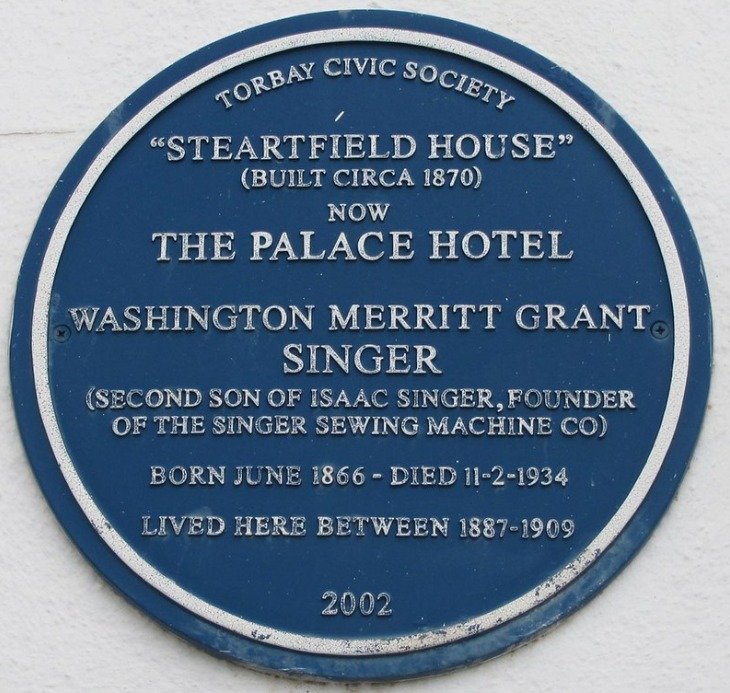
The Plaque
The plaque commemorating Washington Singer is mounted at the entrance to the Palace Hotel, at the corner of Steartfield Road and Paignton Esplanade.
The Plaque Inscription
Torbay Civic Society. "Steartfield House" (built circa 1870), now the Palace Hotel. Washington Merritt Grant Singer (second son of Isaac Singer, founder of the Singer Sewing Machine Co.). Born June 1866, died 11 February 1934. Lived here between 1887 and 1909.
Notes
Washington Merritt Grant Singer (1866–1934), son of the founder of the Singer Sewing Machine Company, made Steartfield House his Paignton home for over twenty years and became a noted local benefactor, endowing the town's first cottage hospital and the Merritt Flats. The house he built his life around later became the Palace Hotel, which stands today.