
Torbay Civic Society
Bishop Phillpotts1778–1869, and Bishopstowe
Born on 6 May 1778, Henry Phillpotts became the Lord Bishop of Exeter in 1830, remaining so until his death at ninety-one in 1869. His thirty-eight-year term of office had been exceeded only once, by Bishop Grandisson, 1338 to 1370.
As Lord Bishop of Exeter, Henry Phillpotts was intrinsically linked to that city, but chose not to live there. Soon after his appointment cholera had struck Exeter, and in not wanting to expose himself to its danger, in 1830 he went to stay in Torquay. On his return after the epidemic he was to be met with much hostility. Even the editor of the Western Times criticised his action, which saw the Bishop bringing a lawsuit against the paper. With a diocese stretching from the borders of Somerset and Dorset to the Isles of Scilly in the west, Phillpotts was a powerful adversary. A sworn enemy of new Church practices, he had already taken action against his own clergy when he felt they were conducting improper doctrinal practices. He was thus recognised as a strong litigant. On this occasion, however, the Western Times were successful, and this lawsuit became one of the few the Bishop would lose.
Living on the coast could never have been practicable, as it would have taken the Bishop several hours to travel from Torquay to Exeter. But with his medieval palace at Exeter in poor repair, and his undoubted unpopularity, the Bishop still commissioned a Torquay architect to build a new home for his family at Babbacombe. His family comprised his wife and, amazingly, eighteen children. In the meantime, the family were to reside at a villa in Teignmouth.
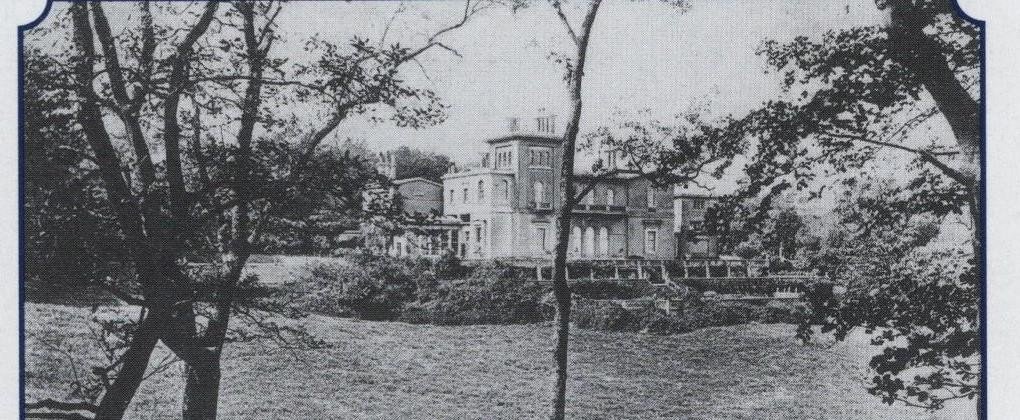
By 1841 the decision had been taken to build a mansion, fit to serve as a bishop's palace, in Italianate style, to comprise multiple lounges, nine bedrooms and eleven servants' bedrooms. The mansion was to have a massive shed for the washing of carriages, and would be built on land two hundred feet above Anstey's Cove, just off the Babbacombe Road. To this day one of the main paths nearby is called the Bishop's Walk. The property, "Bishopstowe," was much extended in 1921 to become Torquay's Palace Hotel, originally situated in the parish of St Marychurch but transferred in 1955 to the parish of Wellswood, which still applies.
With the controversy between High and Low Church running to extremes, Phillpotts was regarded by the local clergy as a political turncoat, having been a most controversial rector in Durham. But undeterred, the Bishop believed himself to have been ordained by God to protect the Church of England, and thus he gave little quarter throughout his life to anyone with contrary views on ecclesiastical matters to his own. He hated any ritualistic practices and saw the Church of Rome as the enemy, as unacceptable then as Communism is to some today. Icons of any sort were anathema to Bishop Phillpotts.
With the growing religious fervour of early Victorian times, the gentry were returning to the Church, and with services more popular, they were becoming necessary in the mornings and afternoons. Followers of the High Church believed themselves to be restoring Christianity, whereas those in the Low Church believed they were keeping Roman influence at bay. Even when summoning candidates to serve the Church for interview, his Lordship would provide a questionnaire for immediate completion. Woe betide a candidate intimating any Roman sympathies: he would get short shrift and would soon be hounded from his Lordship's diocese.
In being so intolerant of those with differing views, the Bishop during his lifetime would spend more than thirty thousand pounds bringing or defending lawsuits against, particularly, the clergy he believed were practising improper doctrinal services. He was an undoubted efficient administrator, but was also merciless against absentee landlords, expressing that "they should reside or resign." This was an interesting stance, considering he had chosen not to live in at his bishop's palace provided in the City of Exeter.
The most frequently reported example of his intolerance concerned the adornment of flowers decorating a two-foot wooden cross on the altar of St John's Church in Torquay. The curate, the Rev Park Smith, and his large congregation were witness to the Bishop sweeping the offending decorations from the altar with his stick, and this ultimately resulted in the first "ritual prosecution" in the Diocesan Court. The Rev Park Smith was formally condemned for the offence, and soon left Devon to serve as a chaplain in the Crimean War.
In another incident, in 1847 the Bishop became determined to prevent the Rev George Gorham from acting as vicar at Brampford Speke in Devon. Gorham had expressed a view that the grace of regeneration was not necessarily effected through baptism. The Bishop, however, held that according to the Book of Common Prayer, regeneration in an infant is always effected at baptism. The controversy went to the Court of Arches, which found in favour of the Bishop. But when the Judicial Committee of the Privy Council reversed the decision on appeal, the Bishop stormed to the Court of the Queen's Bench, then the Court of Common Pleas, and finally the Court of the Exchequer. He even formally and publicly announced that should any Church authority install Gorham as vicar in any diocese, they would incur the sin of supporting heretical doctrine. But all this did not stop the Archbishop of Canterbury, as he eventually installed Gorham, who, strangely, later became reconciled to his previously furious Bishop.
By 1850 the Bishop had decided the drift towards the Church of Rome had gone far enough, and he summoned a synod of the clergy of the diocese. His intention was to use ecclesiastical law to stamp out all "improper practices" in all churches of south-west England. It was little short of anarchy; nothing like it had occurred since the Reformation, and if successful it would probably have caused a schism in the Church of England. Fortunately, his Lordship was made to rethink the unthinkable.
The 1860s brought more controversy, when the Rev Park Smith, now back in Torquay and at St John's, received permission from his Lordship to replace the then Georgian chapel of St John with a proper church in Gothic style. His supporters brought in the architect George Edmund Street, a known sympathiser with those in the High Church, and he, favouring the Early English style, determined to use the best materials to create a chapel of beauty. Street, having warded off objections from all quarters including the Church trustees, completed the new chancel building within eighteen months. But problems then arose when Bishop Phillpotts, unable to approve the new sculptured reredos depicting the Crucifixion, refused to officially open the new church.
With the addition of two thieves, in plasterwork, the screen became less of a crucifix in the Bishop's eyes, and having initially forbidden its opening, he now reversed his decision and allowed the covering sheet to be removed. The remaining work and the church tower were not completed until 1883, by which time Mr Street and the Lord Bishop were both dead. Interestingly, after the Bishop's death the two thieves were removed from the reredos.
Clearly, Bishop Henry Phillpotts was not greatly loved, and he certainly lacked what today would be thought of as Christian values. Nevertheless, he was much admired for his administrative skills, his stalwart defence of churchmen, his high principles and his generosity. He founded a theological college at Exeter, and donated large sums of money to the restoration of Exeter Cathedral and to the establishment of many new churches. His most lasting achievements, however, were the separation of the County of Cornwall from the Diocese of Exeter, and the creation of new parishes and churches, particularly in the City of Plymouth.
He died at his Torquay palace at the incredible age of ninety-one, in 1869. Bishopstowe was later bought by a man christened "Sampson," whose family fortune came through a West Midlands brewery. One can only wonder what Henry Phillpotts would have made of that link. In 1906 the house was bought by a former Governor of Tasmania, Sir Arthur Havelock, and in 1920 the Bishopstowe estate passed into the hands of a Mr George W. Hands, an industrialist from Birmingham who saw the potential of an hotel. Since then the hotel has had a chequered career, including having to be partly rebuilt after the Second World War, following a direct hit by a German bomb.
The Lord Bishop is buried at the Parish Church of St Marychurch, whose new tower was built as a memorial to his memory. Perhaps he now looks down from this lofty height, on both his diocese and his former home on Babbacombe Road.
Written by Ian L. Handford, Torbay Civic Society Chairman
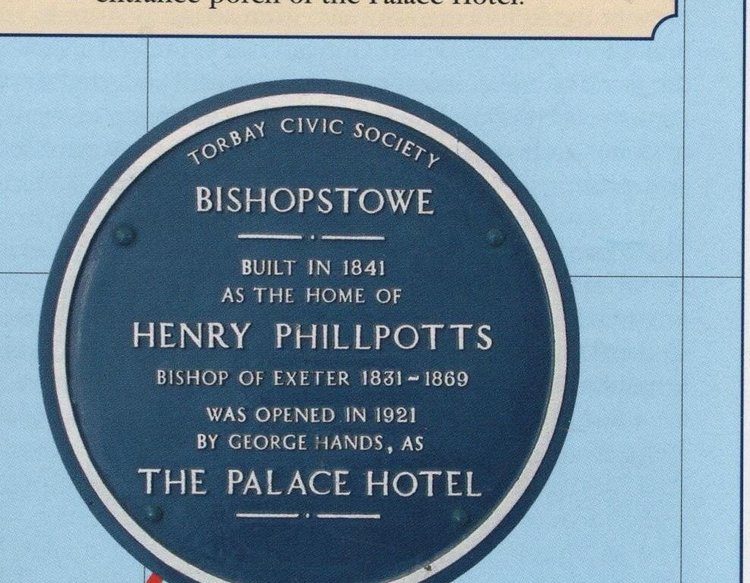
The Plaque
The plaque commemorating Bishop Phillpotts can be seen in the entrance porch of the Palace Hotel, Babbacombe Road, Torquay.
The Plaque Inscription
Torbay Civic Society. Bishopstowe. Built in 1841 as the home of Henry Phillpotts, Bishop of Exeter 1831–1869. Was opened in 1921 by George Hands, as the Palace Hotel.
Notes
Henry Phillpotts (1778–1869), Lord Bishop of Exeter for thirty-eight years, built Bishopstowe at Babbacombe in 1841 as a home for his large family. A formidable and controversial churchman, he was nonetheless an efficient administrator and generous benefactor to Exeter Cathedral and to new parishes across the diocese. Bishopstowe was later extended to become Torquay's Palace Hotel.