
Torbay Civic Society
Sir Edwin Lutyens1869–1944, and The Drum Inn
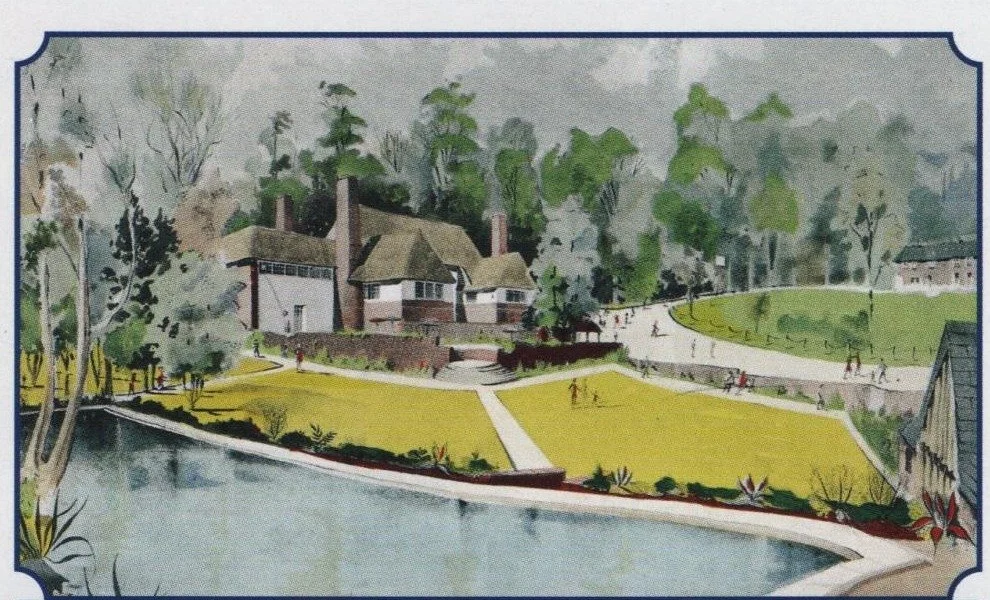
Edwin Landseer Lutyens, destined to design war memorials for an empire, was born on 29 March 1869, one child of fourteen of Captain Charles Henry Augustus Lutyens and Mary Gallwey. The innovative captain had contributed to the advancement of musketry and was a well-known painter of horses, and like his father, Edwin became an innovator and eventually an architect of great merit.
The great painter and sculptor of London's Trafalgar Square lions, Sir Edwin Landseer, had strangely offered to adopt the Lutyens' eleventh child, and although Mary had declined, she did consent to the child bearing his names. Edwin, educated at home, would later in life regret not experiencing a public school education, believing the omission had accentuated a natural shyness. Nevertheless, from the start he showed a tendency towards drawing and of "using his eyes," which would later help the elements of his building design.
At sixteen Edwin went to what is now the Royal College of Art in Kensington, and two years later entered the offices of Sir Ernest George. Residing at Thursley, Surrey, in 1888, he was allowed to undertake alterations to the village shop, which led him to a commission to design Crooksbury House at Farnham in 1889. This led to the setting up of his own practice at No. 6 Gray's Inn Square, London. He was not yet twenty.
He was to become acquainted with notables like Philip Webb and Miss Gertrude Jekyll, with whom he would collaborate on joint projects for more than thirty years. Always an admirer of older women, Edwin had met Gertrude in 1894 when he was only twenty-five, she fifty-two. Her admiration for his skill and her down-to-earth vision led to an enduring partnership, where she provided the planting plans for many of his gardens over the following years. His so-called "third-dimensional concepts" would at times see them clash, but her visionary outlook and connections always saw their differences overcome.
In 1897 Edwin married Lady Emily, third daughter of Lord Lytton, Viceroy of Delhi, despite opposition from her family. They were to have a son and four daughters, but it was a difficult marriage. Lady Emily, besotted with Mrs Besant and theosophy, "went native" by wearing Indian dress. Edwin, apparently inarticulate at times, had long before cultivated a sharp wit as a defensive mechanism. Architects of the English Renaissance inspired him, and preferring to memorise rather than sketch projects that interested him, he soon realised he would have to master classicism if he was to see his ambition of undertaking really "big work" achieved.
Gertrude's father, Sir Herbert Jekyll, commissioned Lutyens to design the British Pavilion for the Paris Exhibition in 1900, and a considerable number of country houses then followed, including Orchards at Godalming, Goddards at Abinger, Grey Walls at Gullane, Deanery Garden at Sonning and Marsh Court at Stockbridge. Edwin's obvious skills and innovation were also seen in his restoration of Lindisfarne Castle on Holy Island.
Limited essays between 1902 and 1904 preceded exercises in the style of the great "Wren," which led Edwin to adopt a simplified Queen Anne style, relying on dominant roofs and chimneys, fine proportions and mouldings, exemplified by his designs at Middlefield in Cambridgeshire in 1908.
His mastery of classical orders and work at Heathcote at Ilkley saw him established as an architect "able to restate first principles." His professional practice saw many pupils of distinction coming to the fore, two being Frederick Harrild and Oswald P. Milne. They were articled to Lutyens from 1907 to 1910, Harrild later being commissioned by Horace Pickersgill, son of a Leeds bookmaker, to create the magnificent gardens at Glengorse, now Castle Tor, on Torquay's Lincombe Hill, and then Little Tor in the Warberrys, now also Castle Tor. Oswald P. Milne, in 1924, created Coleton Fishacre for Rupert D'Oyly Carte, and with the famous Leonard Elmhirst hearing of this, he commissioned him to design the first school buildings and houses on the Dartington estate.
By 1911 Lutyens was travelling again, this time to Rome to design another British Pavilion, then to South Africa to create the Rand Memorial and the Johannesburg Art Gallery. Widely recognised for his innovative ideas, Lutyens created a number of buildings for the Viceroy of India, the major work being Viceroy House, a dream palace which took seventeen years to complete, opening in 1929.
Julius Charles Drewe, founder of the Home and Colonial Stores, set the scene for Lutyens's celebrated Castle Drogo at Drewsteignton. He brought Edwin to Devon to design his manor house in 1911, to be equipped with a fine collection of furniture, tapestries and china that can still be seen there. Drogo sits among 586 acres of land on the eastern flank of Dartmoor, and in spite of being the last castle to be built in England, its craftsmanship, stonework and interior are magnificent. Castle Drogo allowed Lutyens to experiment with his love of vistas and asymmetry. Built of granite, the castle occupies a spectacular site nine hundred feet above sea level through the wooded gorge where the Teign weaves its way eastward below Chagford. The castle, completed in 1924, now sports fine clipped yew hedges, beautiful gardens and walking areas. It was donated to the National Trust by the grandson of Julius, Anthony Drewe, and although the family still reside there it is open to visitors during the summer season.
In 1917 Lutyens was appointed to the Imperial, now Commonwealth, War Graves Commission and designed many memorials and a War Stone, one of two variants of which is common to almost all Commonwealth war cemeteries. Knighted for this work in 1918, other recognitions followed. In 1919 Lloyd George commissioned Sir Edwin to design a temporary "catafalque" in Whitehall, but he chose to design a permanent Cenotaph. Made of Portland stone, this national symbol of remembrance still stands in Whitehall.
Sir Edwin's work across many continents is too numerous to list, but between the years 1919 and 1930 he produced more work than any other architect of his time. He oversaw ninety designs in his practice, which included an amazing diversity of buildings: houses, villas, Liverpool Cathedral, started in 1933 and, with the Second World War intervening, not finished until 1943. So-called "palaces of finance," banks, were designed and built for the Midland and the Britannic. The personal commitment to work was astonishing: memorial structures, embassies, pavilions, houses and even apartments, Grosvenor House flats in Park Lane.
In 1924, following the completion of Castle Drogo, Sir Edwin was awarded a gold medal by the American Institute of Architects, and became a member of the Royal Fine Art Commission. He received an honorary degree from the University of Liverpool in 1928, and was appointed an Officer of the Legion of Honour in 1932, adding a D.C.L. from Oxford University in 1934.
Nearing the end of his career, Sir Edwin came to Torquay to design The Drum Inn, previously the Forge Inn, at Cockington, plus nearby housing on the estate which the Mallock family had sold to the Cockington Trust in 1932: with 223 acres leased to Torquay Council for 999 years, permission was given for the building of a "new village around a village green," which was not built. Only the inn and gardens, complete with the Lutyens trademark curved steps, were finished by 1936. The inn's design and furnishings were by Sir Edwin, the Drum Inn sign by British artist Dame Laura Knight, and in the saloon bar is an engraved window by Laurence Whistler, the well-known poet and sculptor.
Sir Edwin's commitment to a neo-Georgian style had been seen as a bit "old hat" by the 1930s, but nevertheless he refused to allow material consideration to coarsen, still less control, his conceptions. Throughout his life he insisted that art, not science, should have the last word, and a contemporary, A. S. G. Butler, claimed that Lutyens was "one of the greatest masters of visible proportion and perhaps the greatest artist in building who has practised architecture."
Having lived and worked continuously at Bloomsbury between 1897 and 1913, he finally moved to Mansfield Street, London, where he lived until his death from bronchial sarcoma on 1 January 1944. His principal legacy seems to have been in "applying mathematical ratios to functional designs."
The Torbay Civic Society installed a commemorative blue plaque to honour Sir Edwin Lutyens at The Drum Inn on 11 December 2002.
Written by Ian L. Handford, Torbay Civic Society Chairman, and M. Thompson, Torquay Natural History Society President, November 2002
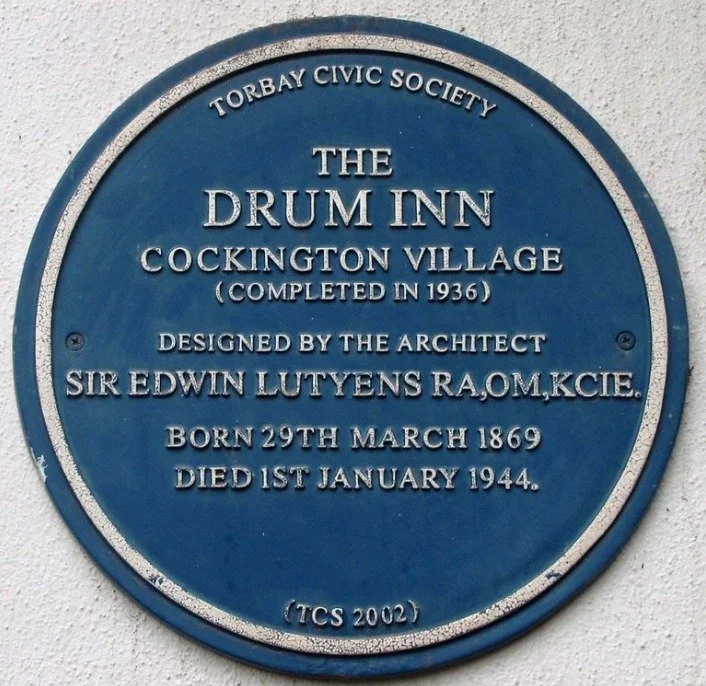
The Plaque
The plaque commemorating Sir Edwin Lutyens is situated at The Drum Inn, just beyond the main crossroads at the centre of Cockington Village.
The Plaque Inscription
Torbay Civic Society. The Drum Inn, Cockington Village. Completed in 1936. Designed by the architect Sir Edwin Lutyens R.A., O.M., K.C.I.E. Born 29th March 1869, died 1st January 1944.
Notes
Sir Edwin Lutyens (1869–1944) was one of the twentieth century's greatest architects, celebrated for country houses, the Cenotaph in Whitehall, and Viceroy's House in New Delhi. Near the end of his career he designed The Drum Inn at Cockington, complete with his trademark curved steps, its sign painted by Dame Laura Knight and its saloon bar window engraved by Laurence Whistler.