
Torbay Civic Society
Father John MacEneryand the Ancestry of Man
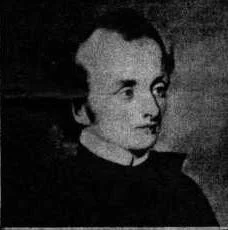
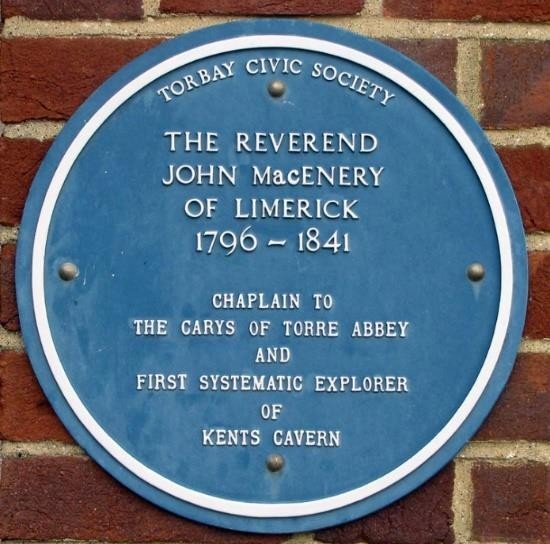
Father John McEnery was a cleric who, having excavated the caves of Devon, unearthed artifacts that changed human thinking on the ancestry of man.
John MacEnery was born at Limerick on 27 November 1797; he was the fourth son of Mathew MacEnery of Limerick. As a young man he saw his parents emigrate to America, a trip he could not take being committed to religious study. John’s studies continued at St Munchin’s Seminary Limerick until at age twenty-three he took holy orders and was ordained a priest. Naturally, he accepted the teachings of the Church, not knowing that within a decade he would be the instrument that helped to change the world’s thinking on the development of man.
With the French Revolution raging, John was unable to study in the Irish Colleges of France, the Netherlands or Italy so he had to continue studying under the eye of Irish clerics. It was to be this oddity that led to his greater interest in geology and palaeontology where questions concerning the ancestry of man arose.
He was viewed as a quasi-political, yet religious academic, yet when the Holy See became aware of MacEnery and his followers, his Holiness then appointed John as new Guardian to the Franciscan Convent in Cork.
Yet Father John MacEnery was not to stay long at Cork. He was about to take up his first appointment on the mainland and in March 1822 came to Torquay to fulfil the role of chaplain to our Cary family at Torre Abbey on an annual income of £120. Now allowed to travel widely, this greatly heightened McEnery’s interest in geology, visiting and even excavating caves here and abroad before a manuscript finally confirmed, “Nowhere except in the Alps have I seen paralleled the contortion in the strata which Mr De la Beche at the time engaged - in Torbay”.
Kent’s Hole as it was originally named had been discovered in the 16th century but it was not until the novelist Richardson in 1778 wrote, “In the parish of Tor is a very remarkable place called Kent’s Hole, not mentioned as I can find by the writers of that county”. Meanwhile, MacEnery having examined stratus of Lauterbrunnen and others at Lake Lucerne near Fluellen, would eventually compare these to Kent’s Hole. With more doubts on human ancestry arising, MacEnery now developed a passion for geology which led to new friendships with scientists and academics.
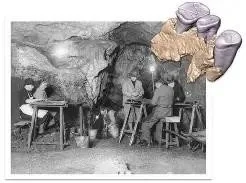
He met De la Beche and Professor Buckland, then the leading palaeontologist, before joining the first official exploration of Kents Hole in 1825, led by a Mr Northmore, a man seriously in pursuit of Druidal and Roman antiquities. Access to the cave was poor, only one person at a time could clamber in holding a single candle. Yet MacEnery found he was able to disturb the red-brownish earth with his free hand (later described as “unctuous to the touch”) until eventually he found his first enamel object, a fossilised tooth. More in awe than joyous, he immediately realised the enormity of this find to academia and religious belief.
During 1826 a Mrs Cazalet and MacEnery became the most frequent explorers at Kent’s Hole, and during a period of six months they documented 1000 significant finds, including some of the earliest flints ever honed by human hand. In addition, animal fossils rarely seen in this country were in abundance, which even today amazes geologists. On December 6th 1826 Dr Beeke of Torquay noted, “Mr MacEnery has arranged his Kent’s Hole collection very neatly and has added a fine skull of an Hyaena somewhat larger than the one which Scharf has engraved, the upper part more perfect”. Mrs Cazalet and MacEnery were already deemed authorities on our local geology and fortunately for us both were efficient at recording their specimens.
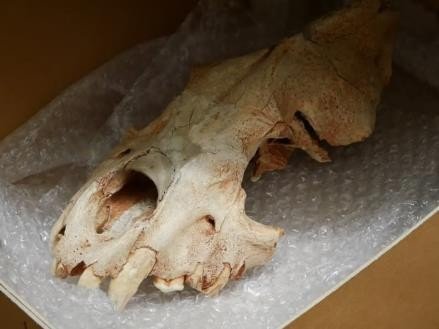
The Hyaena skull is today at Torquay Museum, not too far distant from where the creature died. By 1829 MacEnery was excavating at Berry Head caves yet continuing to work at Kents Caves where now he experienced a near fatal accident when falling several feet through a hole in the encrusted floor. Seemingly he had pierced the floor with his hand tool but in landing safely found a highly significant lower floor. He walked this for about a hundred paces before his candle flame went out. Later it was learned there had been insufficient air to sustain a candle or man and although unconscious he was fortunate indeed; friends were able to drag him out alive.
Darwin’s theories meanwhile were seeing most of the world’s churchmen stepping aside to watch from the safety of the cloisters as events unfolded. Father MacEnery was aware of the role he had played in the mounting controversy. He never said or published anything but like Darwin was branded a charlatan and a heretic. Although he had found important artifacts and human art on the walls of Kents Caves he now chose to retire and spend his remaining years in Torquay, with no more exploring.
For six years from 1834 Father MacEnery was said to be officially “on leave” although this may again have been by intervention of the Holy See. Whatever the truth, by late 1840 he was unwell and soon it would be his friend Canon George Oliver that reported, “on Thursday evening 18th February 1841 the Rev MacEnery died, sitting quietly in his chair at the Abbey aged just forty-five”.
It would take until 1846 for Torquay Natural History Society to produce a report to the Geological Society in London which included “everything documented and unearthed by John MacEnery was a truthful record”. For over two decades visitors were allowed access to Kent’s Hole until in 1848 the owner Sir Lawrence Palk finally closed all access by placing a locked door at the entrance. It would take 150 years before Torbay Civic Society erected a Blue Plaque to honour Father John MacEnery at Kents Cavern in May 1998.
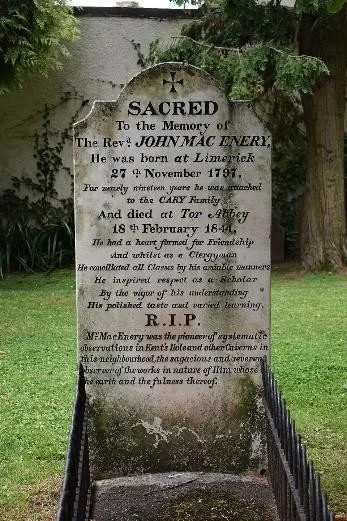
McEnery’s headstone can be found at the Greek Orthodox Church of Saint Andrew in Lucius Street, Torquay. It was recently restored by Les Filles De La Croix (the sisters at Stoodley Knowle).
This is one of a series commemorating notable people, buildings and events in the history of Torbay, prepared by the Torbay Civic Society. The plaque honouring Father John MacEnery was erected at Kents Cavern in May 1998.