
Torbay Civic Society
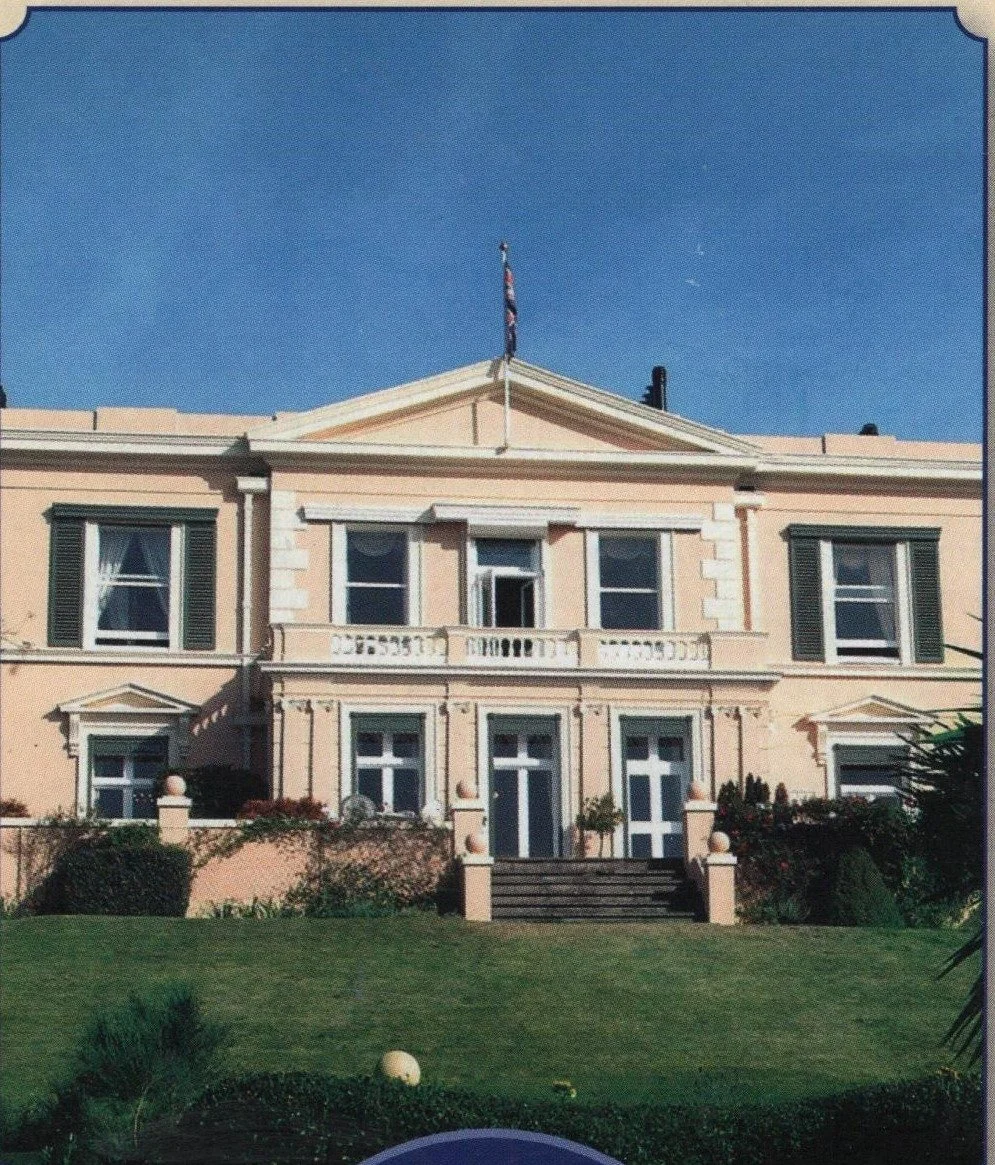
NormountBuilt 1844, and Bishops Court Hotel
Tor Key had been a small fishing cove with a village and little else from 1401, and it was not until the eighteenth century that the Napoleonic wars gave the coastal hamlet the impetus to grow when, between 1793 and 1815, it became the chief rendezvous of England's Channel Fleet.
From 1815 until 1871 the most amazing construction programme was undertaken, due largely to local land agent William Kitson, who, having been given the responsibility to lease enormous amounts of the Palk family land, was arranging hundreds of individual villa sites to be made available. As a leading solicitor, banker and figure of the town, Torquay was fortunate that Mr Kitson ensured strict covenants were placed on all purchasers, which ensured only the highest standard of building was allowed.
Hundreds of sites for houses and villas were sold, as well as land made available to public areas and churches. In the hills of the Lincombes, Warberries and around the town centre, there was rapid growth in the resident population. By 1841 the resident population was increasing by 5,000 each decade, and with summer and winter visitors, Torquay was second to Brighton as the most successful of the south coastal resorts.
Tor had come from "tor" as in hill, and of course quay was where the fish were landed. Naval officers stationed here encouraged their wives and families to stay in the elegant Regency terraces being built around the town. Many of these had replaced fishermen's cottages, although many were newly constructed in the Tor valley and its surrounding hills. The population also increased when the rich and powerful of the day, who through successive wars had been deprived of travelling on the continent, also chose to enjoy the new spas and so-called "garden cities" like Tor Quay.
With its milder winter climate, Tor Quay became an extremely popular wintering retreat as well as a summer venue, and many of its larger properties were built specifically for letting. Leases of purchased buildings were often assigned for a minimum of three months, and high society, including the British and Russian royal families, were some of the earliest to take advantage of the new arrangements.
Elegant villas established in the Warberries and Lincombes by Victorians soon ensured that Tor Quay was an accepted garden town and spa, and by 1850 was starting to be known as "Queen of the Watering Places." A good description of this developing style was included in an article entitled "Italy in England" by local architectural historian and Civic Society member John Wilson, who said: "The majority of the villas were built between 1830 and 1850, then let to visiting gentry for the season, complete with servants. The quality of the landscaping often surpassed that of the building, whose design was founded on European classical tastes of the period. In most cases a long winding drive leisurely climbed through the grounds and terminated at the portico of the villa, usually on the west side."
The development of the Warberries included a tramway established on the Babbacombe Road, and this ensured that Ilsham Road became referred to as "the village," with its own local hostelry and individual shops. Wellswood village was one of the first commercial shopping areas established, and came before the valley of the Flete (Fleet Street) started to be accepted as the natural centre of Torquay.
With land to the east of the town being developed at an incredible speed, amazing change was to be seen in and around Braddons Hill, Vane Hill, Park Hill, the Lincombes, and of course the Warberries, where Normount, now Bishops Court Hotel, was to be established. In the words of those times, "Hotels were built for people of distinction, and guest houses for genteel families." Just a hundred yards from Normount, Wellswood Hall was built in 1840 for Mr March Phillips, and through his inspiration thirty acres of trees were planted in and around the near hills.
Normount, being an Italianate style villa, was one of the most magnificent of all its counterparts. Completed in 1844, it comprised forty-two rooms and was set in 2.24 acres of highly cultivated ground. Its neo-classical style makes it still one of the finest remaining examples of the period.
Early owners of Normount were those who were wealthy enough to employ a vast number of servants, sufficient to enable their employers to entertain in lavish style. In 1848 Captain Charles and the Miss Fordyces were known to have been two of the earliest occupants, and the 1851 National Census confirms that in fact the Miss Fordyces, their cook, servant and footman were all listed as residents. By 1861 the Reverend Lawson was the owner, but by 1875 the premises were sold by "public competition" (auction). Various owners followed until, in 1905, a Miss Chadwick arrived to employ a huge staff, which included a parlour maid, head housemaid, second housemaid and kitchen maid, and outdoors a head gardener, coachman and groom (later renamed chauffeur when the motor car replaced carriages) and two under-gardeners. A quote of the time tells us that "this lady, the mistress, like other maiden ladies, also had a companion," highlighting that some in society, although being "gentlewomen in reduced circumstances," perhaps flaunted their position, whereas in reality they were often little more than servants themselves.
By 1938/39 the villa was the property of Captain and Mrs Nelson Clover, who remained longer than any other owners, just under thirty-eight years. Captain Nelson Clover had served in the Royal Navy during his early years and was a member of the Liverpool shipbuilding family "Clover." His wife Gertrude was a daughter of Sir Sydney Kidman, a wealthy South Australian owner of large cattle stations and substantial land around Adelaide and Eastern Australia, covering an area three-fifths the size of England.
When Mrs Clover died on 6 September 1973, it was to be only two years before her husband was to sell Normount. He later died in 1978. It was hoped the property might be used as a boarding school or residential college, but when these failed to materialise, the idea of a museum, art gallery, public hall or convalescent or children's home were suggested; these ideas similarly came to nothing.
Normount was eventually bought in 1975 by Lady Price, the widow of the man who had founded "The Fifty Shilling Tailors," later to become "Burtons." Lady Price was to change the name to Normount Court and, having brought in large quantities of acid soil, established camellias, rhododendrons and azaleas. But by 1977 the property was up for sale again, this time purchased by a dentist who constructed a surgery in what had been Captain Nelson Clover's study. A large mortgage and high rates saw him disposing of the property in 1979. Mr and Mrs Rhodes of Ipplepen then purchased Normount, but Mr Rhodes, having given up a farm, found the villa too claustrophobic, and in 1979 he died at the property. His wife and daughters remained at Normount for a time, but in 1982 they sold it to Mr Pascoe, a specialist concerned with the stock market.
Three years later the villa was sold again, this time to a newly formed company, Bishops Holdings. They demolished the greenhouses and the kitchen garden to expand the complex to incorporate holiday apartments. Finally, in December 2001, the current owners, Mr and Mrs Raymond Marks, purchased the property.
Normount, over the years, has welcomed a great number of famous visitors, including Agatha Christie, a friend of Miss Chadwick, Princess Marie Louise, granddaughter of Queen Victoria, Mrs Ella Rowcroft of the Wills tobacco family, and the famous jockey Sir Gordon Richards.
This well-established modern hotel and conference centre now comprises two venues in one: the Mansion House Hotel, being the original villa, and a modern Garden Hotel with comprehensive leisure centre facilities on-site. Bishops Court still enjoys the magnificent location chosen by the Victorians, which affords it superb sea-facing views of Torbay that have stood the test of time and are enjoyed by all who visit.
The Normount plaque was installed and unveiled by the Torbay Civic Society on 27 February 2003.
Written by I. L. Handford, Torbay Civic Society Chairman, from notes and help given by Mr and Mrs Michael and Joan Nott, January 2003
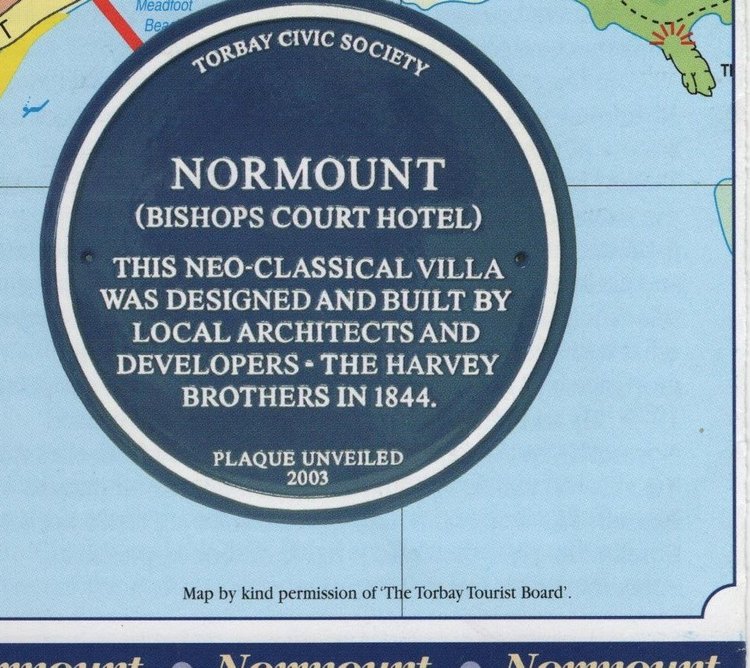
The Plaque
The plaque commemorating Normount can be seen at Bishops Court Hotel, Lower Warberry Road, Torquay, approximately 500 yards on the right hand side off Babbacombe Road.
The Plaque Inscription
Torbay Civic Society. Normount (Bishops Court Hotel). This neo-classical villa was designed and built by local architects and developers, the Harvey Brothers, in 1844. Plaque unveiled 2003.
Notes
Normount, an Italianate villa of forty-two rooms completed in 1844, stands among the grandest of Torquay's Warberry villas. Long known for its distinguished owners and visitors, including Agatha Christie and Princess Marie Louise, it survives today as the Mansion House Hotel at the heart of Bishops Court Hotel.