
Torbay Civic Society
Robert Graves1895–1985, and Vale House
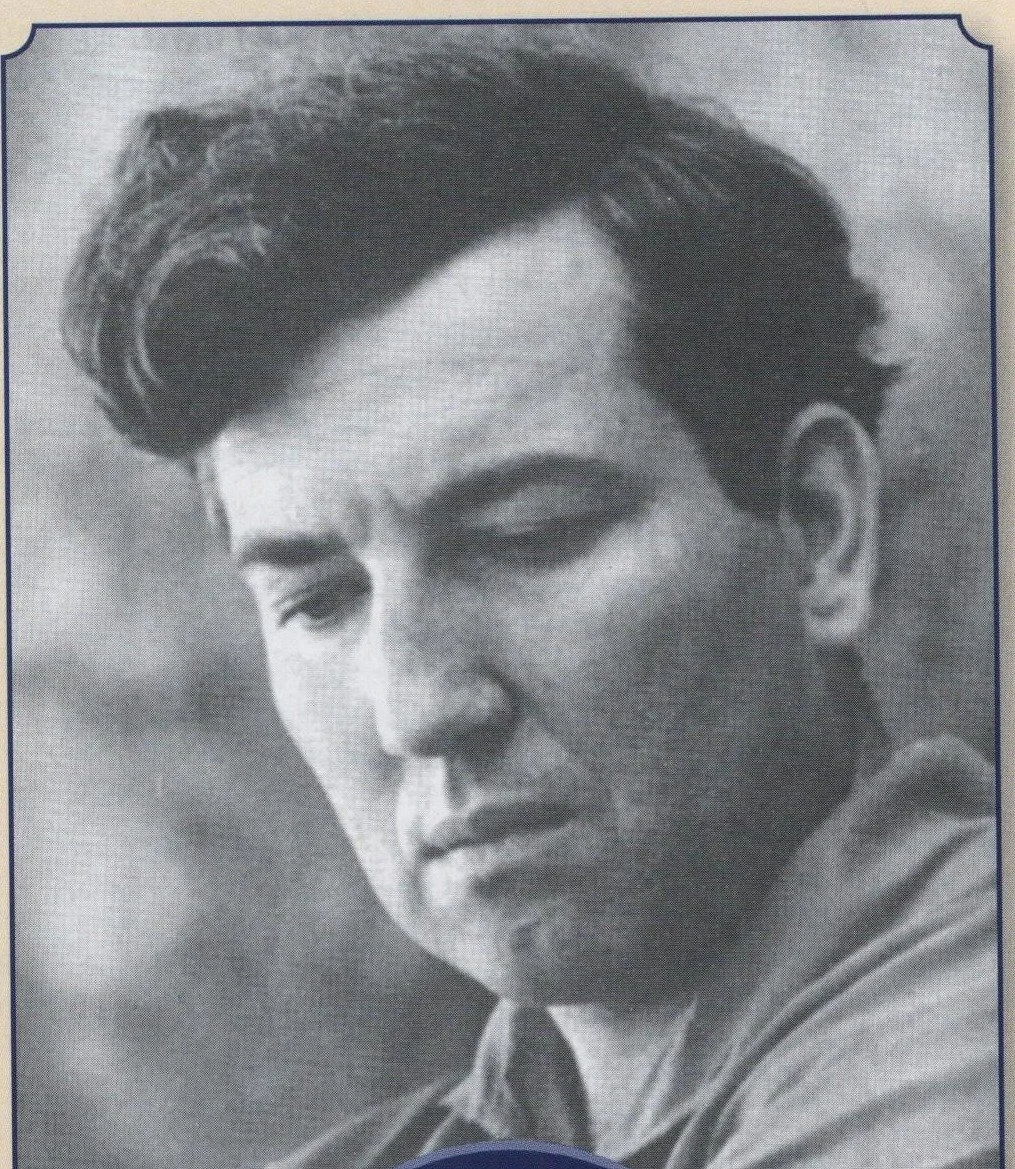
Robert Ranke Graves was born at Wimbledon on 24 July 1895, the eldest son of five children. His mother was Elizabeth Sophie (Amy) von Ranke, second wife to his father Alfred Percival Graves, an inspector of schools.
Robert's ancestry seems to have been littered with writers. His maternal great-uncle was the historian Leopold von Ranke, and an eighteenth-century Richard Graves wrote The Spiritual Quixote. Robert's father wrote poetry and collected folk songs, and even composed the Irish song "Father O'Flynn."
Having attended six preparatory schools, Robert eventually entered Charterhouse in 1914. Then, when he was about to enter St John's College, Oxford, the First World War broke out. Whilst residing at Harlech, someone told the young Robert it was possible to get an automatic commission rather than having to serve in the ranks. He therefore reported to the nearest recruiting depot at Wrexham to inform them he was in the Officer Training Corps at Charterhouse (in fact he had resigned), got a commission, and was soon serving in the same regiment as the great Siegfried Sassoon: the Royal Welch Fusiliers. His mother was to comment, "Our race has gone mad; he is already a hero!"
Indifferent to the whole idea of a career in the Army, Robert was sent to Lancaster and put in charge of new recruits and German prisoners. Next, posted as a second lieutenant to a platoon of forty at the front in France, one of his men, a sixty-three-year-old conscript who had also bent the rules, is recorded as commenting, "What is this ere arrangement," the arrangement being the safety catch on his rifle. The man had been too old to serve in the Boer War, let alone the First World War, and had not fired a rifle in thirty years. This brought the whole nightmare of war home to Robert, and he was to become an ardent critic of war, as his poems would later reflect.
Serving as a Captain in the Welch Fusiliers, he became appalled at the carnage he witnessed and yet served in some of the heaviest fighting. Twice mentioned in despatches, Robert was later wounded and returned to Oxford to convalesce. Immediately the war ended he married Annie Mary Pryde Nicholson (Nancy), and in wanting to complete his education they ran a small grocery shop and lived in a cottage in the garden of fellow poet John Masefield at Oxford, so that Robert could attend St John's College.
The business at Boars Hill was of little consequence, as Robert was by now convinced his career lay in being a Georgian poet. In May 1921 the business was sold and the family moved to "World's End," Islip. A year later Robert obtained his degree. With Nancy he now moved to Egypt to take up a post as Professor of English at the University of Cairo. A year later they returned, and by the end of that year they had separated. The last seven years had seen Nancy bear four children, but the mental stress of the war years, even after ten years, had left its mark. Robert now fled to Majorca, where he was to meet the American poet Laura Riding Gottschalk. They evolved a new theory of "pure, non-literary and integral" poetry, as his more romantic style had "boiled dry." Within two years of their arrival in Majorca, his most famous work, "Goodbye to All That," was published; it was 1929.
Having established a home with Miss Laura Riding at Deya, their affair was always destined to fail. Robert's sister Rosaleen Graves (later Dr Cooper), a medical practitioner at Bishopsteignton in Devon, confirmed in an interview some fifty years later that "my brother's stable relationships with women sometimes proved elusive; he was a very sensitive young poet, and the war shook him to his foundations, and he needed to write the horror out of himself for quite some time afterwards." This reflected what in fact happened when his first marriage failed.
With the world accepting him as a writing giant, Robert retorted, "I write poems for poets, and satires or grotesques for wits. For people in general I write prose, and am content that they should be unaware that I do anything else." The anything else was, of course, to be historical novels, plays, ordinary novels and fictional books. His historical work alone includes Claudius the God, Count Belisarius, Sergeant Lamb of the Ninth, King Jesus, and of course "I, Claudius," for which he received the James Tait Black Memorial Prize and the Hawthornden Prize in 1934.
The famed book "Goodbye to All That" was providing sufficient income for Laura and Robert to collaborate on many books, and these were published through their own business, Seizin Press. The "wild love affair" ended when the Spanish Civil War uprooted them from their island home. Having fled to London in 1936 and then France in 1938, Laura finally left Robert for another man.
On returning to England, Robert next became friendly with Beryl Hodge, daughter of solicitor Sir Harry Pritchard and wife of fellow poet and friend Alan Hodge. With the Second World War on the horizon, this was a truly productive time for Robert's written work, and in 1939 he won the Prix Femina-Vie Heureuse for his novel "Count Belisarius." In the autumn of that year Beryl was to leave her husband and Great Bardfield forever, to live with Robert. They soon visited Devon and Rosaleen at Bishopsteignton, and from there discovered Galmpton.
Vale House, Greenway Road, Galmpton, was to be home from May 1940 until the end of the Second World War. Strangely, it was Robert who invited the estranged husband to Devon, only to discover that Alan was happier as a friend to Beryl than he had been as a husband. The first child of Robert and Beryl was William, born at Paignton hospital on 21 July 1940, three days after Robert's forty-fifth birthday.
Meanwhile Laura, besotted with one Schuyler Jackson, was desperate to conclude the Deya business partnerships, and although this complex matter took a long time to resolve, she eventually conceded the island property to Robert. Desperate to return to Majorca, but with the war raging and there being no opportunity, Robert lectured Beryl on how island life would eventually make an idyllic permanent home.
With his heart set on returning to Deya, "The Golden Fleece" and "The White Goddess" were meanwhile written at Vale House and are said to be among his finest works. There was also collaboration with Alan Hodge, which included "The Long Week-End" and "The Reader Over Your Shoulder." In 1942, four thousand copies of "Proceed, Sergeant Lamb" were destroyed in the Blitz, and, more curiously, "I, Claudius" became used as an illegal plotters' codebook in the 1944 plot against Hitler, in which Count von Stauffenberg, a distant relative of Robert Graves, was shot. Local friends in Devon included the military historian Basil Liddell Hart, and of course Agatha Christie, who eventually dedicated a novel to Robert Graves.
Having lost his first son David in Burma, Robert was by now desperate to return to Spain as the war came to an end. It took eight months of negotiation before currency and visa arrangements were completed and the family could plan and pack for the migration. A new impression of "The White Goddess" was published on 5 April 1946, selling an initial 7,500 copies. Robert and Beryl were at last able to return to Deya later that year, and it was there, in the village that had shaped so much of his finest writing, that Robert Graves continued to live and work for the rest of his long life, until his death on 7 December 1985 at the age of ninety.
Written by the Torbay Civic Society, from research supplied for the Society's records
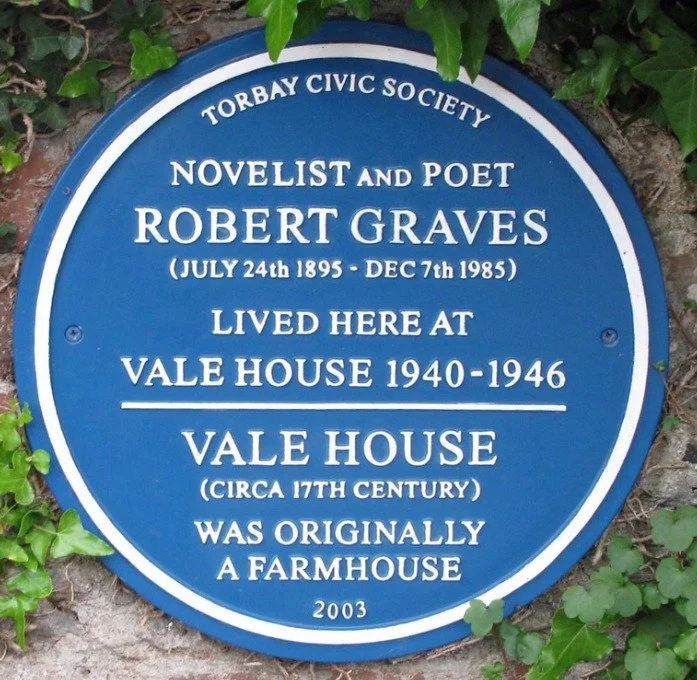
The Plaque
The plaque commemorating Robert Graves is situated at Vale House, on the left-hand side of Greenway Road, Galmpton, 100 yards after passing the Manor Inn on the right-hand side.
The Plaque Inscription
Torbay Civic Society. Novelist and poet Robert Graves (July 24th 1895–Dec 7th 1985). Lived here at Vale House 1940–1946. Vale House (circa 17th century) was originally a farmhouse. 2003.
Notes
Robert Graves (1895–1985), poet and novelist, lived at Vale House, Galmpton, from 1940 to 1946 with Beryl Hodge, having fled Majorca at the outbreak of the Spanish Civil War. There he wrote "The Golden Fleece" and "The White Goddess," among his finest works, before returning to Deya, Majorca, where he lived until his death.