
Torbay Civic Society
Rudyard Kipling1865–1936, and Rock House
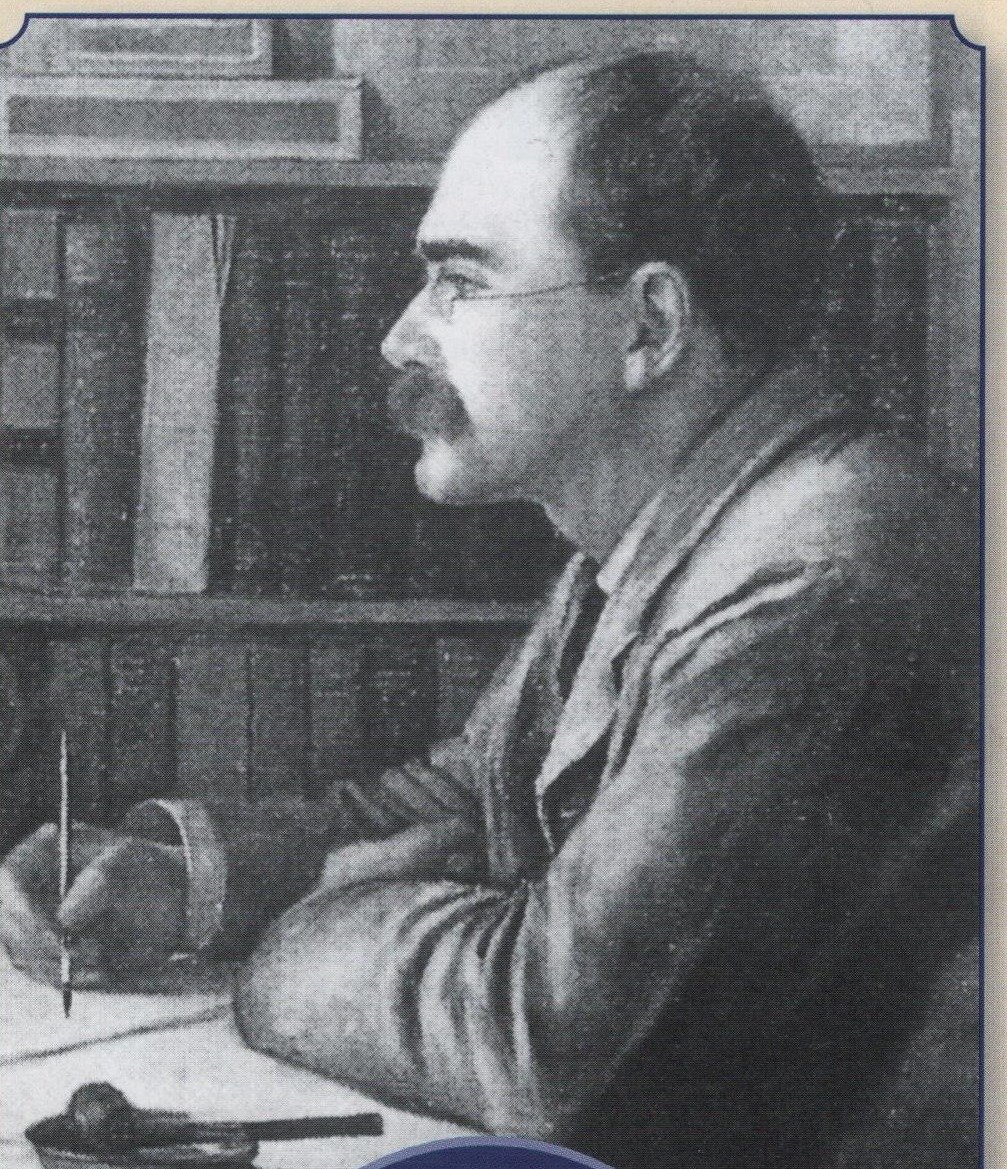
Rudyard (Joseph) Kipling was born in India on 30 December 1865, into a distinctive ancestry. Both his grandfathers were Methodist ministers, and his father, John Lockwood Kipling, a potter and designer of Staffordshire and a skilled mason, had made Alice Macdonald wait four years for his appointment as an architectural sculptor in 1865 before they married. After working at the Jeejeebhoy School of Art in Bombay for just two years, John was informed by six doctors that his son's frail health would be better served if he lived in England.
Writing his autobiography sixty-four years later, Rudyard recalled those first six years in India: "Early morning walks to the Bombay fruit market with my ayah and later my sister in her perambulator, with Meeta my Hindu bearer. There were Arab dhows on the pearly waters, and gaily dressed Parsees wading out to worship the sunset, and near the house were the Towers of Silence where their dead are exposed to the waiting vultures on the rim of the towers. I do not understand my mother's distress when she found a child's hand in our garden, and I want to ask questions about it."
Having arrived in England in 1871, Rudyard, together with his three-year-old sister Trix (Alice), became marooned in six dark years. Not having been told of their parents' intention to return to India, they were abandoned into the care of retired naval officer Captain Holloway and his wife Rose at Southsea. There they remained as boarders, entombed in a small terrace house smelling of "aridity and emptiness", in the care of a disagreeable and extremely pious family until then unknown to them.
At primary and junior school Rudyard showed few outstanding qualities except a passion for reading. The captain took the children for walks around the docks of Portsmouth and was generally kind to them, but after his death in 1875 his wife, "the Woman" (Auntie Rosa), an evangelical bigot, and her even more difficult son became their guardians. Rudyard, writing of the house, recalled it as a "House of Desolation". The woman taught them about hell, a concept they were unaware of until then, and Rudyard's life became a hell on earth of continual bullying, caning and, worst of all, humiliation, his only joy the precious books sent by his parents, avidly read as an escape.
Those six blissful years at Bombay in the care of his ayah were now totally overshadowed by the Southsea years with proxy parents. Years later the beatings and humiliation would resurface in his story "Baa Baa, Black Sheep". Six long years later, Alice, having received correspondence from a relative concerned about the children, returned to Southsea. She soon sent Rudyard to the United Services College at Westward Ho, Devon, where from 1878, with an extensive knowledge of English literature, he was to be happy.
Destined to be a man who worshipped and, surprisingly, respected all children and their imaginings, Rudyard throughout his life would happily leave grown-up company to join children and take part in their childish games. As one writer put it, "this perhaps gives a clue to his magic, a transformation of a small space into a whole world founded in the imaginings of a child". Many friendships cemented at Westward Ho were woven into the adventures of "Stalky and Friends", and this clear gift for transmuting the commonplace into full drama and a fairy-tale world saw his exuberance and real sense of fun surface in "Brugglesmith" (1891).
By 1880 Rudyard was back in India, and two years later he was asked to join the staff of the Lahore Civil and Military Gazette, putting him at last near his father. He was a good reporter but a much better storyteller and versifier, and today dozens of his phrases survive, "East is East and West is West" and "Never the twain shall meet", let alone his sketches, verses and satiric stories. His literary output was staggering. "A word should fall in its place like a bell in a full chime," he said, and yet he was rarely satisfied, being a hard taskmaster. Dozens of stories flowed, including "Departmental Ditties", "Plain Tales from the Hills", "Soldiers Three", "The Story of the Gadsbys" and "Wee Willie Winkie", containing seventy stories, all written between 1882 and 1890.
In 1887 the Lahore Gazette's sister newspaper, the great Punjab "Pioneer", poached him to Allahabad, and there he wrote for Hindu rather than Muslim readers. By 1889 this inveterate traveller was off again, this time to Japan, the United States and eventually London. A first novel in England, "The Light That Failed" (1890), was not unsuccessful, and by 1891 he set off again to the Cape, then Australia, New Zealand, Colombo and finally a last trip to Lahore.
Marrying Caroline Balestier in January 1892, she was later described as "a plain and somewhat bullying American who was possessive and rather jealous". But with the honeymoon over they settled at Brattleboro, Vermont, where during the next four years "The Jungle Book" and "Many Inventions" appeared, as did Josephine, their first child, born on 29 December 1892.
A publicity lawsuit brought them back to England in 1894, to Tisbury, Wiltshire, home of Rudyard's parents. On their return to America they knew they would eventually settle permanently in England. Published books, including "The Comforters", more of "The Jungle Books" (1894 and 1895), and a moving tribute to Hinduism, "The Miracle of Purun Bhagat", continually flowed from Rudyard's pen.
With Queen Victoria's Diamond Jubilee on the horizon, the Kiplings, now with two children, set off for a new life in England, arriving at Torquay in the autumn of 1896. In spite of its mild climate, the wetness of winter soon drew the writer's wrath. He wrote to a friend, "Bloody British is the only word for it, Torquay is such a place as I do desire acutely to upset by dancing through with nothing on but my spectacles." Even the newly discovered tandem bicycle tested his patience: "a tandem bicycle, whose double steering-bars made good dependence for continuous domestic quarrel," and after falling off he named the cycle "Hell Spider", walked home and never cycled again. A prolific writer yet desperately disliking Torquay, great work was produced at Rock House, Maidencombe, where ten of the "Stalky" stories, nine of which would later be published as "Stalky and Co.", were probably written.
By August the following year the family, now including a second daughter, Elsie, were resident at Rottingdean, Sussex, where their only son, John, was born. Here "The White Man's Burden", concerning the Americans' rule of the Philippine Islands, was written in 1899, its theme almost applying today. The death of Josephine, aged just six, from pneumonia while the family was visiting New York in 1899, devastated Rudyard, and echoes of that grief would surface in his later writing. The family settled permanently at Bateman's, a seventeenth-century house at Burwash in East Sussex, in 1902, and it was there that Rudyard wrote much of his finest later work, including the "Just So Stories" and "Puck of Pook's Hill". In 1907 he became the first writer in the English language to be awarded the Nobel Prize in Literature. Rudyard Kipling died on 18 January 1936, at the age of seventy.
Written by the Torbay Civic Society, from research supplied for the Society's records
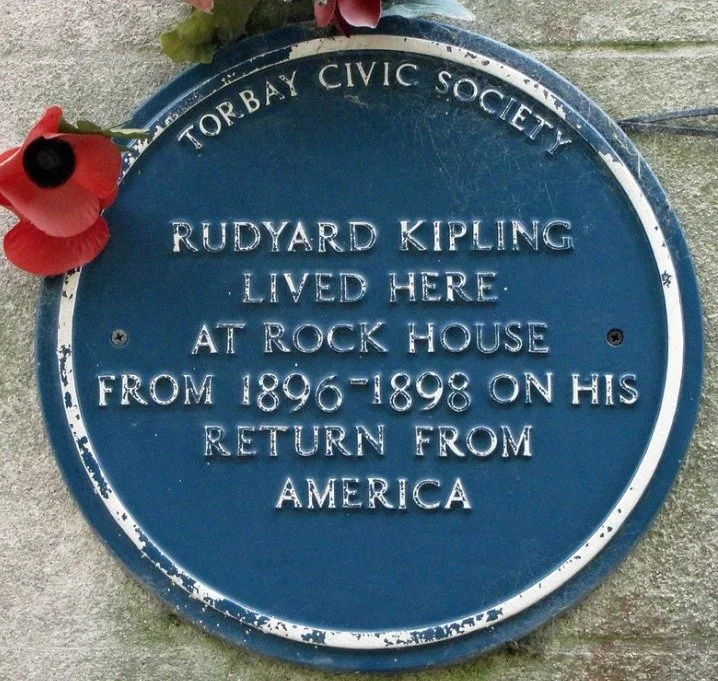
The Plaque
The plaque commemorating Rudyard Kipling is situated at Rock House, found two hundred yards down Rock House Lane after leaving the Teignmouth Road at Maidencombe.
The Plaque Inscription
Torbay Civic Society. Rudyard Kipling lived here at Rock House from 1896–1898 on his return from America.
Notes
Rudyard Kipling (1865–1936), writer and poet, lived at Rock House, Maidencombe, from 1896 to 1898, where he wrote much of the material later published as "Stalky and Co." He went on to settle at Bateman's in Burwash, East Sussex, and in 1907 became the first writer in the English language to be awarded the Nobel Prize in Literature.