
Torbay Civic Society
Isambard Kingdom Brunel1806–1859, and Bishops Place Surgery
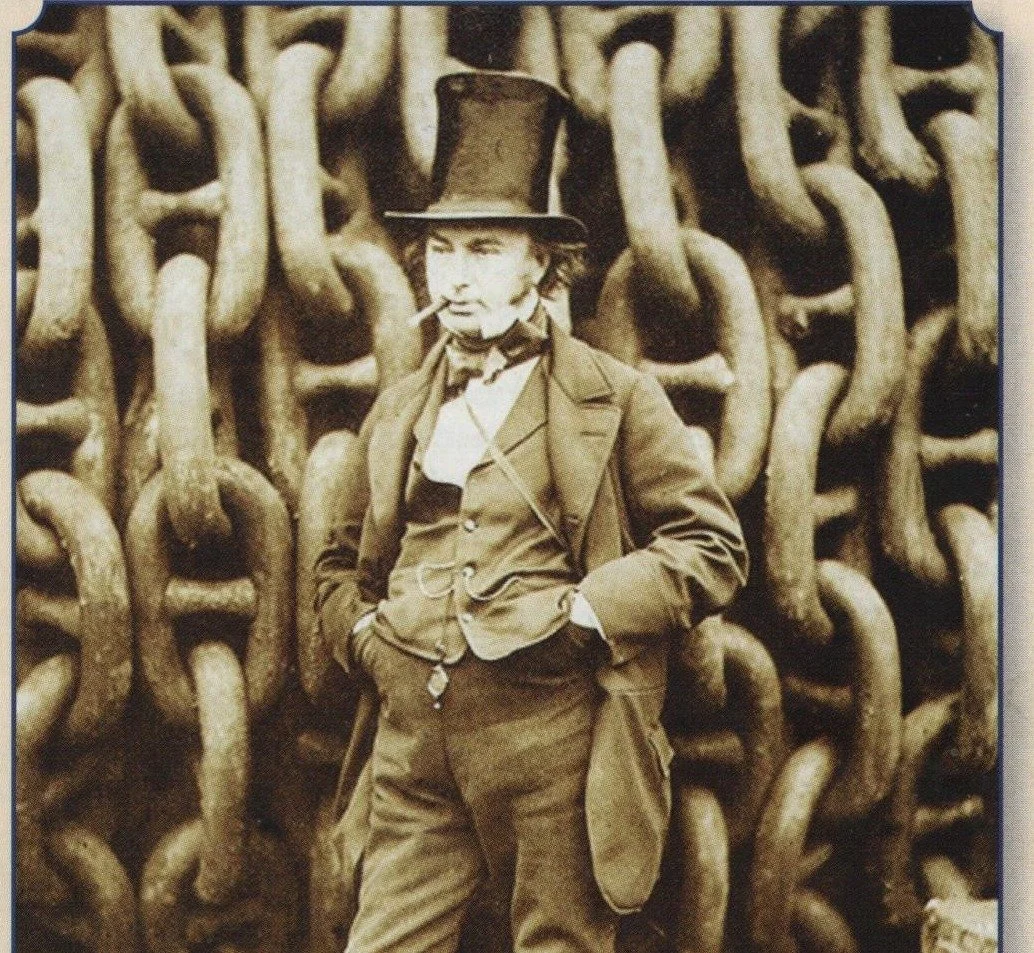
History records Isambard Kingdom Brunel as a brilliant engineer and inventor who built great ships and bridges as well as the Great Western Railway, constructing all the tunnels and viaducts on that line. He was a tough, single-minded negotiator who would let nothing and no one stand in his way.
His friends in Torbay, where he spent much of his time both at work and at leisure, knew him as a very different man: kind and considerate, particularly towards his employees no matter how lowly their station. When he died in 1859, aged only fifty-three, a fund was set up to commemorate the part he had played in the life of the community.
New evidence of Brunel the caring man was discovered during the refurbishment of four houses in Bishops Place, Paignton, next door to the ancient Coverdale Tower, known locally as Bishops Tower. Now a doctors' surgery, the houses were built by the engineer, when he brought the railway to Paignton, to make sure his senior staff worked in the very best environment.
They housed the four employees he prized most highly: his doctor, his architect, his chief engineer and the "chief procurer", the man who kept the railway builders supplied with everything they needed. The elegant rooms have high ceilings with delicate plaster decorations which show they were designed for important people to live in.
No 1 Bishops Place, home of the company doctor, has been in medical occupation since Brunel's ownership more than 150 years ago, in recent years serving as the base of a busy practice with over 3,500 patients. As space became increasingly cramped it was decided to extend into the adjoining premises at No 2, to provide new waiting rooms, consulting rooms, offices and other facilities.
An appeal for information about the history of the houses was answered by next-door neighbour Ken Rowe, who lives at No 3 Bishops Place and shares a keen interest in local history. His research revealed that Brunel bought the land from the nearby parish church "after much haggling", before building the houses for the senior staff he had taken on for his latest project, the extension of the railway from Torre to Kingswear.
Top of the list at No 1 was the company doctor, and a special agreement was made for him to have, at the rear, a stable and coachman so that he could make his calls. No 2 Bishops Place housed the architect and surveyor, who had a sealed building at the back used as a reservoir, fed by a spring. No 3 was allocated to the chief engineer and No 4 to the chief procurer. All had servants' quarters, but only the doctor had a stable and coachman.
Sadly, Isambard Brunel did not see the Bishops Place community flourish, for he died at the height of his powers. Nor did he live to enjoy the fine house at Watcombe, overlooking Babbacombe Bay, which he had planned for himself and his wife Mary. He died before it was completed, and it was left to his family to fulfil his dream. Brunel's journal, sold at auction by Sotheby's, records that he used to stop his carriage to admire the view while working on the railway, and decided he would set up his home there.
The caring Brunels had built houses for their workers in Torquay long before they planned one for themselves. Concerned that many were living in slum conditions, in attics and common lodging houses, they bought a field called Barn Close and planned ten semi-detached cottages in the shape of a crescent. Isambard's early death meant only two pairs were completed, but a century and a half later they still stand as testimony to his forethought.
Brunel's generosity was legendary. In 1851, the year of the Great Exhibition, he paid for all his estate workers to have a five-day holiday in London, with their wages paid as if they were at work. Two years later a local newspaper reported a lavish party for employees and their families, including seventy children from the school at Barton. Towards the end of his life he promised to build a new school, a pledge fulfilled by his sons Isambard and Henry sixteen years after his death.
Memories of Brunel are to be found all over South Devon. He stayed at several places in Newton Abbot, including both the Devon Arms and the Turks Head, while he and his architects wrestled with the problems of his ingenious "atmospheric railway", a project doomed by rodents and the Devon weather. By 1848 passengers could ride on it from Exeter to Newton Abbot, but the problems it suffered became so great that the whole enterprise was finally abandoned. The valve system of the vacuum tubes that housed the pulling pistons was made of leather and lubricated with grease, and rats took a great fancy to this grease, constantly eating the leather away. Rain storms washed away the lubricant and let air into the tubes, and sea spray along the coastal stretches had a similarly corrosive effect on the leather.
Brunel's sojourn in Paignton is now officially recognised at the new-look Bishops Place surgery, where great pains were taken during the refurbishment to preserve the large open fireplaces, tiled floors and other features that were part of his design. A conservatory built onto the main entrance has been restored, and a huge bougainvillea which had spread through its glass roof has been retained, albeit in a more manageable form.
The practice manager, Ingrid Marsh, has built up an historical record of all the doctors who have treated patients in the building over the 150 years since Isambard's own medical man was in residence, and patients have sent in their own memories of some interesting characters, including a well-loved doctor who always smoked a cigarette in a long holder during a consultation, handing it to the patient to hold while he examined them. Excavations in the medical centre car park have also revealed another piece of history: an ancient culvert, thought to have been part of a medieval sewer network serving the historic area around Paignton parish church, and now protected as a find of historic interest.
Written by the Torbay Civic Society, from research supplied for the Society's records
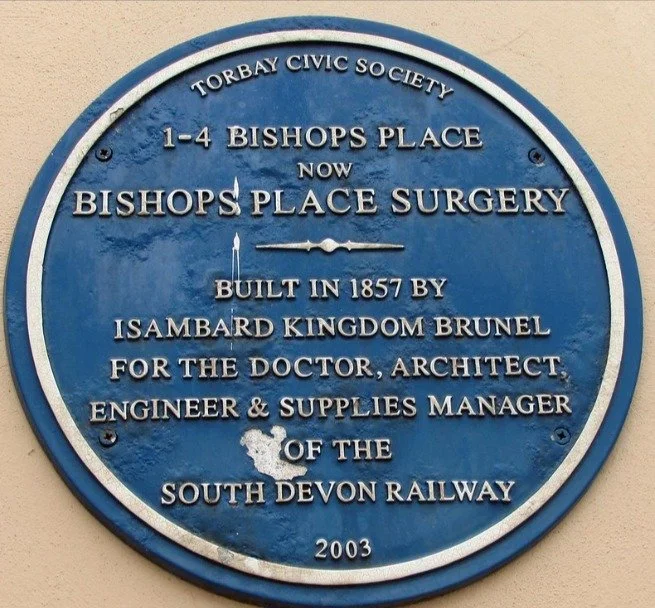
The Plaque
The plaque commemorating Isambard Kingdom Brunel is situated at Bishops Place Surgery, Bishops Place, Paignton, adjacent to the famous Bishops Tower.
The Plaque Inscription
Torbay Civic Society. 1–4 Bishops Place, now Bishops Place Surgery. Built in 1857 by Isambard Kingdom Brunel for the doctor, architect, engineer and supplies manager of the South Devon Railway.
Notes
Isambard Kingdom Brunel (1806–1859), engineer, built the four houses at Bishops Place, Paignton, in 1857 to house senior staff of the South Devon Railway. No 1 Bishops Place has remained in continuous medical use as a doctors' surgery for more than 150 years.