
Torbay Civic Society
Charles Darwinand Meadfoot House
Charles Darwin, who in later life would convalesce in Torquay, was one of five children of Robert and Susannah Darwin. Born at Shrewsbury on 12th February 1809, his mother died when he was eight, and although he was not particularly scholarly he attended Shrewsbury School before going on to the Edinburgh Medical School in 1825. Charles was always more interested in rocks, animals and plants than the pursuit of medicine, and nevertheless entered Cambridge to study for the priesthood.
In the eighteenth century his grandfather, Erasmus Darwin, had been a leading scientist with revolutionary ideas, and had written Zoonomia, a book concerning evolution, expressing far reaching ideas on air and sea travel and even considering the exploration of the oceans by submarine. Charles's father was a doctor of medicine, and his mother was a daughter of the entrepreneur Josiah Wedgwood, of pottery fame. He would later write of himself: "I believe I was considered by all my masters and by my father as a very ordinary boy, rather below common intelligence", a surprising admission from someone who followed in his grandfather's footsteps to become one of the world's greatest naturalists.
Having gained a Bachelor of Arts degree in 1831, Darwin questioned whether he really wanted to join the priesthood, and while in this predicament he endeavoured to organise a natural history expedition to the Canaries. But events were soon to overtake him when an opportunity arose to sail around the world with the Royal Navy. Captain Robert Fitzroy, Master of HMS Beagle, had advertised a berth for a scientist and gentleman who might wish to explore the world, and it took the intervention of Darwin's uncle, Josiah Wedgwood, to persuade Dr Darwin to fund his son's passage. Charles joined HMS Beagle at Plymouth and sailed out of Devonport on 27th December 1831.
The expedition would take five years, during which the twenty two year old, six foot tall student would experience dozens of adventures and amass an enormous collection of plants, rocks, fossils and animal specimens. On the Galapagos Islands Darwin became fascinated by the strange nature of all living things, since every island had its own species. He recorded thirteen species of Galapagos finch and could find no evidence that they existed anywhere else in the world. Beagle sailed via the Canary Islands across the Atlantic to Brazil, around Cape Horn to the Galapagos, across the Pacific to New Zealand and Australia, across the Indian Ocean to the Cape of Good Hope, and back across the Atlantic to Brazil, before finally returning to England.
After his return Darwin spent years cataloguing his thousands of specimens, initially assisted by his friend Sir Richard Owen, who later became an opponent of his theories on evolution. On marrying his cousin, Emma Wedgwood, in 1838, Darwin became much closer to his mother's family, and for the rest of his life they lived at Downe House, Bromley, in Kent. Emma bore him ten children, and during these years her husband wrote dozens of books while dedicating himself to the study of small seashore animals he named barnacles. His health was slowly deteriorating, though the precise nature of his suffering remains a mystery; it is likely it developed from the tropical Chagas disease, then often caught on long sea voyages.
The catalyst that determined the completion of his most famous book, On the Origin of Species by Means of Natural Selection, came in 1858 following a letter from Alfred Wallace, a rival naturalist. Wallace had just published his own theory of evolution, and Darwin realised that it succinctly described what he had been desperately trying to make others understand for over twenty years. Fellow scientists Lyell and Hooker implored Darwin to allow them to present his work to the Linnean Society in London, believing it imperative that he publish quickly. The presentation was made in July 1858, and in just a year On the Origin of Species was complete, and was published on 24th November 1859.
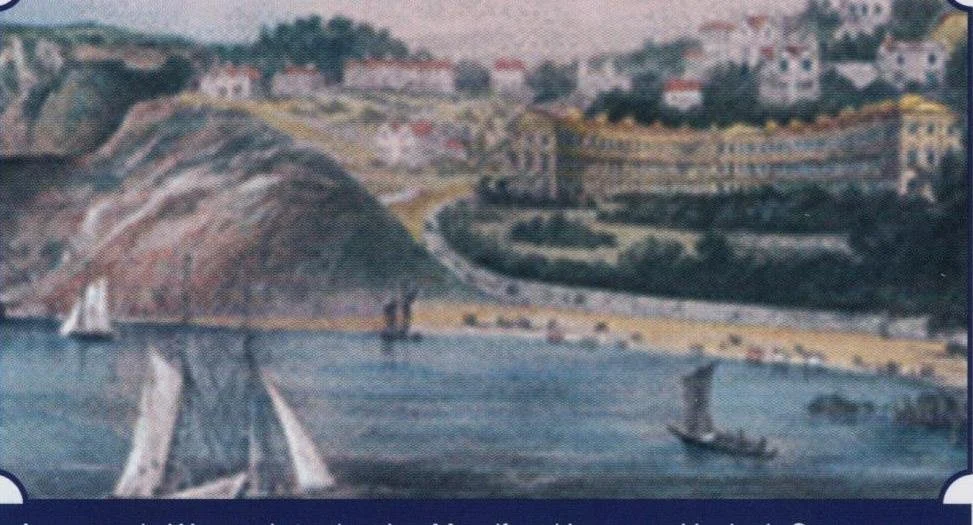
In poor health during the summer of 1861, Darwin came to Torquay to convalesce for six weeks. He lived at 2 Meadfoot House, Hesketh Crescent, where next door at No. 1 was Angela Burdett-Coutts, then the richest woman in England, later Baroness Coutts, and acknowledged as one of Torquay's, if not the nation's, outstanding philanthropists. Darwin continued to write while in Torquay, but is known to have worked only a few hours each day, much preferring to walk and, more often than not, carriage ride in order to visit the surrounding towns.
It would be a hundred and forty years before future generations of scientists, trying to understand the relationship between biodiversity and ecosystems, would rediscover Darwin's starting point. Two ecologists, Dr Andy Hector of Imperial College, London, and Dr Rowan Hooper of the National Institute for Environmental Studies, Japan, confirmed in the January 2002 edition of The Scientist that the missing link had been found in an incomplete but referenced manuscript for a book by Darwin entitled Natural Selection.
As late as April 1871 scientists and cartoonists were still mocking Darwin's theories and suggesting that his ideas made man a descendant of apes, but his book The Descent of Man, and Selection in Relation to Sex, proved so compelling that even the loudest voices were silenced, and he was eventually applauded and received a special degree from Cambridge. In later life Darwin concentrated on mould and earthworms, which he described as nature's first gardeners, and insect eating plants. He suffered a mild heart attack in December 1881 and died peacefully at Downe House on 19th April 1882, aged seventy three. He lies interred at Westminster Abbey, next to another British giant, Sir Isaac Newton.
Torbay Civic Society officially unveiled a blue plaque on 30th September 2004 to honour Charles Darwin's stay at 2 Hesketh Crescent.
Written for the Torbay Civic Society by Ian L Handford and Michael Thompson, June 2004
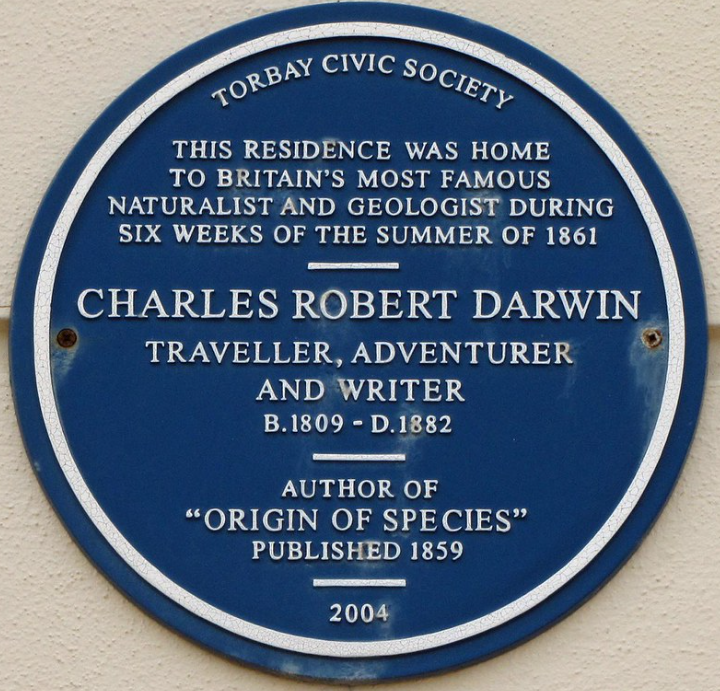
The Plaque
The plaque commemorating Charles Darwin is situated at Meadfoot House, Hesketh Crescent, Torquay.
The Plaque Inscription
Torbay Civic Society. This residence was home to Britain's most famous naturalist and geologist during six weeks of the summer of 1861. Charles Robert Darwin, traveller, adventurer and writer. B. 1809, D. 1882. Author of "Origin of Species", published 1859. 2004.
Notes
Charles Darwin stayed at 2 Meadfoot House, Hesketh Crescent, Torquay, for six weeks during the summer of 1861 to convalesce. He is best known as the author of On the Origin of Species, published in 1859.