
Torbay Civic Society
Primley Houseand Herbert Whitley (1886–1955)
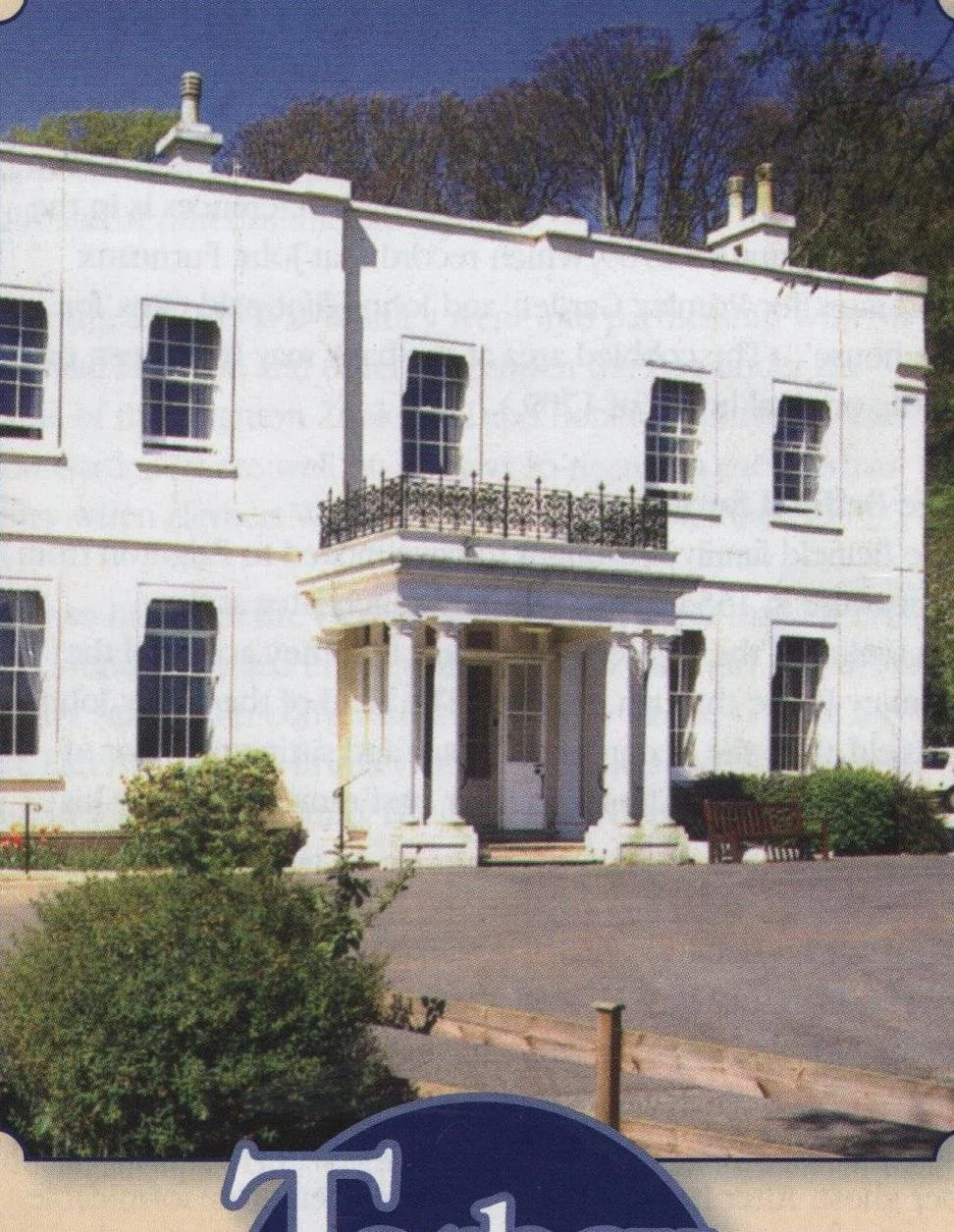
The Primley Estate dates back at least to Tudor times. For two centuries it was the seat of the Belfield family, who built the present house at the beginning of the nineteenth century. The Belfields and the people who occupied the house after them played a very important part in the life of the town. Little is known about the early history of the Estate; one of the earliest references is in the parish account for 1709, which records that John Furneaux paid rates "for Primley Garden" and John Elliot paid rates "for the house". The cobbled area at the back may have been part of the original house of 1709.
The Belfield family is thought to have moved to Paignton from Lancashire in 1554. It was not until much later, at the beginning of the eighteenth century, that they acquired the Primley Estate through marriage. The head of the family, John Belfield, then the Recorder of Exeter and sitting Member of Parliament for the City, is however best remembered for his children. Margaret, his daughter, married William Drake Gould of Steverton and Lew. Widowed at an early age, she became a formidable and forceful figure in her later years, and as Madame Gould of Lew Trenchard was known throughout the County. Her son Edward, a frequenter of the gambling tables, was charged with the brutal murder of a man who had won a large sum of money from him at cards, but did not go to the gallows thanks to the unscrupulous tactics of his lawyer.
It was a great-great-grandson of his who eventually restored the family name. By a curious irony of fate, Edward Gould the murderer was the kinsman of the man who wrote the famous hymn Onward Christian Soldiers, and who also rediscovered that most famous of all Devonshire folk songs, Widecombe Fair, which became almost the national anthem of the County. This was Sabine Baring Gould, the famous antiquary, hymn writer and novelist.
The other distinguished member of John Belfield's family was his son Samuel, Vicar of Paignton for sixty years from 1732 until 1792. As incumbent at Paignton he officiated in the parish church at the wedding of his own daughter. The bridegroom was Exeter born naval man Captain Thomas Louis, who within a few years was to become a Vice Admiral to Lord Nelson. Later, when Nelson was found to be badly injured in that most famous of battles and about to lose his life, he sent for Louis to thank him in person for his contribution to the famous victory. Louis was later Governor of Rome, the only Englishman ever to have held that historic post.
In 1870 the Belfield regime at Primley came to an abrupt end when Mr John Finney Belfield, a prominent figure in the public life of the town, woke one morning and decided he had had enough. He walked out with no known warning and went to live in Exeter, and it was generally believed that he never set foot in the town again.
In the early years of the twentieth century Primley was sold to the Whitley family, part owners of the brewery firm of Greenall Whitley & Co of Warrington. Shortly after the end of the First World War, Herbert Whitley, who was born on 2nd January 1886, started his collection of animals and plants, which he later opened free to the public under the name of the Primley Zoological and Botanical Gardens, unique as the only combined zoological and botanical gardens in Britain. Whitley soon found himself obliged to charge a nominal entrance fee to deter young hooligans from teasing the animals. On this fee the Inland Revenue demanded Entertainment Tax; Whitley rightly claimed that his exhibition was an education, not an entertainment, but when the tax claim was upheld he was so incensed that he closed the Gardens to the public and continued to develop them privately, amassing one of the finest private collections of birds in the world, along with notable collections of small mammals, reptiles, amphibians and tropical freshwater fish. After a while he acceded to popular demand and reopened the Gardens, continuing to develop them with a circus, featuring Samson the Strongest Man in the World, and tropical and sub-tropical houses, until the Second World War forced their closure.
Amongst his more amazing feats was the discovery of a unique parakeet from South America, named Whitley's Conure. This creature has never been found again, so it is now suspected that it may have been a chance natural hybrid. In his early days, with the help of his brother William, Herbert did much successful breeding of livestock, both for utility and show, and the brothers were a great help to local farmers in bringing in improved stock. In later years Herbert alone concentrated on birds, and with the help of the two Wilkinsons, father and son, he became almost unbeatable with many breeds of show poultry. His show and racing pigeons were also superb, and the homing pigeons were used for intelligence work carrying messages during the Second World War.
Whitley was a generous benefactor to Paignton. Amongst other things, he gave the town the Clennon Valley area, which has now been developed for sports of all sorts. He also supplied most of the plants that flourished in the Roundham Cliff and at other municipal gardens. After the 1939 to 1945 war, Whitley went into partnership with Mr Norman H Dixon and others to reopen the Zoo under the name of the Paignton Zoological and Botanical Gardens. The Zoo Gardens were well on the way to regaining their former glory when Herbert Whitley died on 15th September 1955.
Prior to his death the Herbert Whitley non-profit making Trust was founded. He left Primley Mansion to a land girl friend, Miss Gladys Salter, who converted it to Primley House, a home for the elderly. In 1956 Primley Housing Association was formed, and in 1967 a committee, The Friends of Primley, was established, its mission being to maintain the upkeep and needs of the house and to assist with the comfort and personal needs of its residents. After Miss Gladys Salter's death, and with the help of a loan from Help the Aged and a financial gift from Villa Rosa Trust of Torquay, Primley Housing Association purchased the freehold. Today the extended property is a registered residential care home which operates as a non-profit making organisation run by a management committee.
A Torbay Civic Society blue plaque was unveiled in 1986 at the entrance to the gates of the drive to Primley House, residential care home.
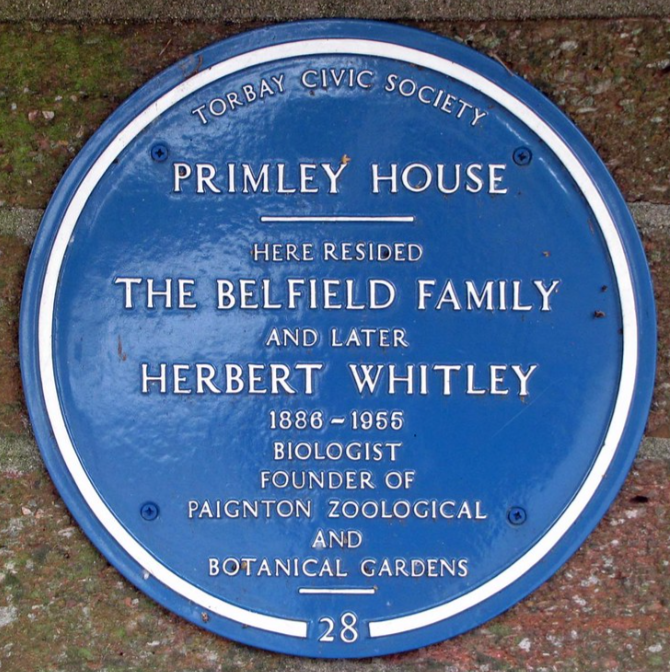
The Plaque
The plaque commemorating Primley House is situated at the entrance to the gates of the drive to Primley House, Paignton.
The Plaque Inscription
Torbay Civic Society. Primley House. Here resided the Belfield family and later Herbert Whitley, 1886 to 1955, biologist, founder of Paignton Zoological and Botanical Gardens.
Notes
Primley House, Paignton, dates back at least to Tudor times, and was for two centuries the seat of the Belfield family before being sold to the Whitley family in the early twentieth century. Herbert Whitley founded the Primley Zoological and Botanical Gardens, later known as Paignton Zoo. The house is today a registered residential care home.