
Torbay Civic Society
Hookhills Viaductand I.K. Brunel (Circa 1859)
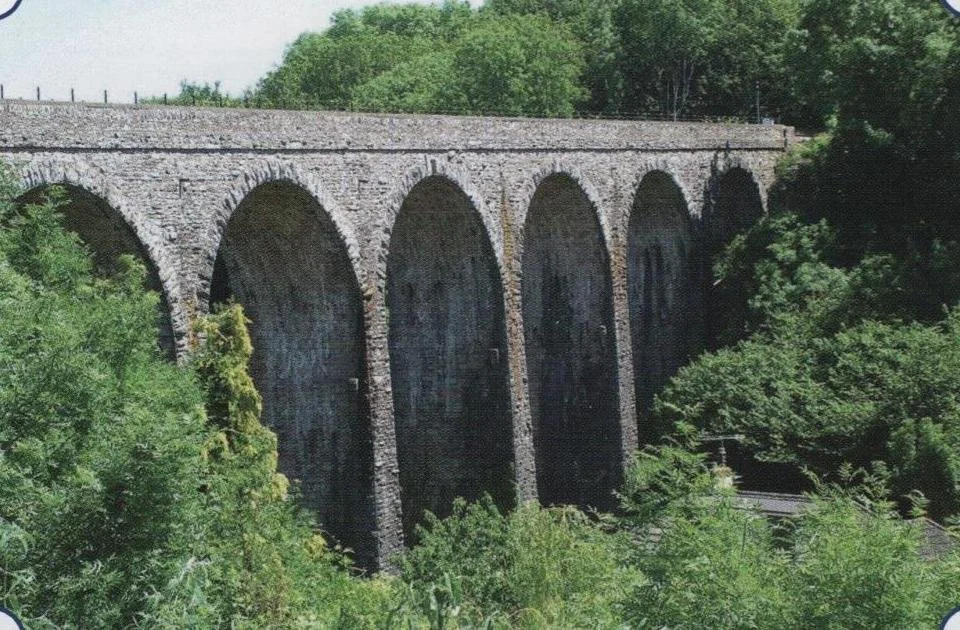
The coming of the railway to Torbay introduced a major technical, communication, transportation and social revolution to the area. Its effect on Victorian society is hard for us to comprehend in today's fast-changing world.
The South Devon Railway had arrived at the outskirts of Torquay in December 1848, its planning and construction overseen by Isambard Kingdom Brunel. It would be nearly ten years later when Brunel would commence the extension of that line under the title of The Dartmouth & Torbay Railway, the first sod being cut at Torre in January 1859.
With the encouragement and financial backing of such local dignitaries as Sir Lawrence Palk, Charles Seale Hayne and Lord Churston, the railway was to be built with three major objectives in mind: to assist in the development of Paignton as a successful seaside resort, to improve the speedy movement of Brixham fish to the country's major conurbations, and to encourage the development of the Port of Dartmouth as a major international sea port.
The building of the line was planned in three sections, the first from Torre to Paignton being completed and opened on 2nd August 1859 with considerable pomp and circumstance and the devouring of the famous Paignton Pudding. A month later Britain's greatest engineer died a premature death and so the responsibility for the completion of the line passed to Brunel's deputy, R.P. Brereton.
The second section to be constructed was a three mile stretch from Paignton to Churston, the completed station and terminus for three years, to be known as Brixham Road. This stretch of line is largely bounded by Torbay's coastline and therefore provided a number of structural and engineering barriers that had to be overcome. Before his death Brunel had already surveyed the route and produced his meticulous drawing of works and structures required. This three mile length required the excavation of four cuttings and the construction of three embankments, four bridges and two viaducts, one of them being Hookhills.
The contractors taken on to complete the work were Messrs Smith & Knight and they employed a workforce of 300 navvies. Hookhills Viaduct (148 yds. overall length), together with its smaller sister, Broadsands (72 yds. overall length), comprised the two major structures to be constructed. Originally, it had been envisaged that both would be built of timber but a late decision to build in stone, together with a wet winter over 59/60, caused a considerable delay in working progress. Over 16,000 cu yds of masonry was necessary for the building of bridges and viaducts and it seems that Lord Churston was a considerable benefactor of this requirement. High quality Devonian limestone was provided from his Brokenbury quarry at Churston. A tramway was constructed down to the sites to provide access for the stone. Limekilns were constructed within close proximity to the building sites in order to provide lime mortar.
Hookhills nine 40 ft semi-circular arches over 116 yds, giving the viaduct a maximum height of 85 ft, are impressive and a lasting epitaph to its designer and masons. The abutments that supported the semi-circular timber templates around which the masonry was positioned, remain for posterity and inspire the imagination to picture that moment when the final keystone was made good.
On the 9th March 1891, Board of Trade Inspector, Col. Yolland, passed this viaduct as "...well constructed and sufficiently strong...". After 110 years of continuous use, the majority spent in supporting a section of the 'permanent way' between the Port of Dartmouth and the Capital, it remains 'sufficiently strong'.
On the 14th March 1891 Brixham Road was officially opened by the arrival of a special train having left Paignton at 12.40 p.m., hauled by a 4–4–0 Saddle Tank Engine, Tiger, by name. The Brixham community, headed by Lord Churston, celebrated their first direct association with the railway age with a luncheon at Wintle's London Inn where Brixham turbot was consumed.
The third and final stage of the Dartmouth and Torbay Railway construction was now commenced but due to financial restraints, determined objections by Richard Harvey of Greenway and the cutting of a 490 yd tunnel, the line to the Port of Dartmouth was not to be completed until August 1864. Although the end of the line was at Kingswear, Dartmouth did get its railway station, but never would the two meet.
For a while Dartmouth became an international passenger seaport and Brixham gained a branchline in 1868 to provide a continuous transport link for its fish. Within that incredible chain that was to become the Great Western Railway, the Hookhills Viaduct provided one small but vital link.
The eleven miles that once was the Dartmouth & Torbay Railway and now provides the tourist attraction that is The Paignton & Dartmouth Steam Railway, along part of that same track, makes a magnificent living reminder to Isambard Kingdom Brunel. It reflects his genius as a designer, engineer and architect, a man dedicated to changing and improving people's lives. Today, we take his achievements for granted as we travel on his railway lines and cross his bridges. In and around Torbay we can see the fruits of his labours still, although not all successful. From his Atmospheric Pumping Station at Torre to his woodland garden at Watcombe, he remains with us, a man of vision.
Torbay Civic Society officially unveiled a plaque at Hookhills viaduct at a public ceremony on Monday September 25th 2006.
Written by John Risdon, 9th August 2006. Bibliography: The Newton Abbot to Kingswear Railway by C.R. Potts; Iron Horse to the Sea by John Pike.
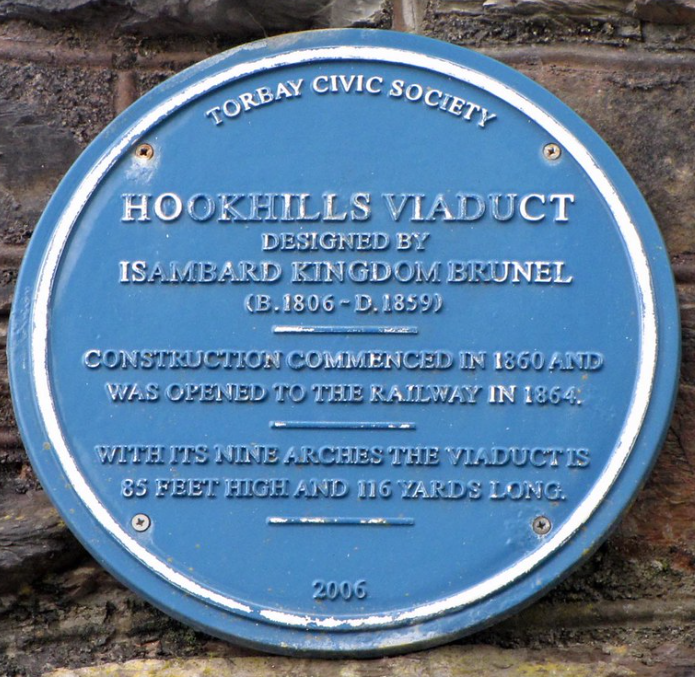
The Plaque
The plaque commemorating Hookhills Viaduct is situated where the viaduct straddles the lower end of Broadsands Road, adjacent to Brunel Road, Churston.
The Plaque Inscription
Torbay Civic Society. Hookhills Viaduct, designed by Isambard Kingdom Brunel (B. 1806, D. 1859). Construction commenced in 1860 and was opened to the railway in 1864. With its nine arches the viaduct is 85 feet high and 116 yards long. 2006.
Notes
Hookhills Viaduct carries the former Dartmouth & Torbay Railway, now the Paignton & Dartmouth Steam Railway, across Broadsands Road at Churston. Designed by Isambard Kingdom Brunel, its nine semi-circular arches were built in stone by Messrs Smith & Knight, and the line opened through Brixham Road in the 1860s.