
Torbay Civic Society
Babbacombe Cliffand Oscar Wilde (1892–1893)
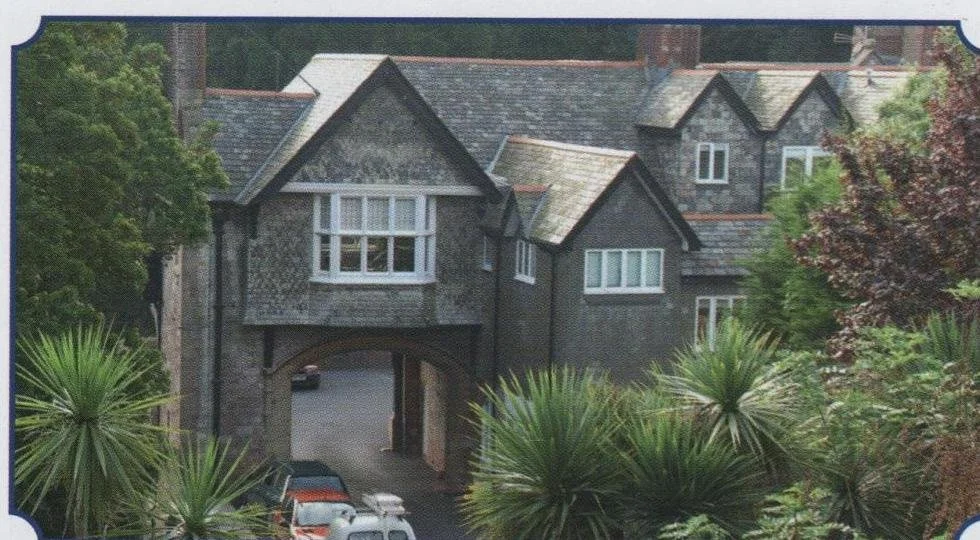
Babbacombe Cliff is an early nineteenth century house that was redesigned by William Eden Nesfield in 1877. During the 1890s Whiffen and Sons (builders) then added an extra wing and four elevations. When the "Wilde" family leased the house for the winter months of 1892/93 the owner, Lady Mount-Temple, was wintering abroad. During the twentieth century the house was used as a hotel and in the late twentieth century it was redeveloped again to form nine private apartments and three town houses.
Oscar Wilde was a self publicist, playwright, wit, aesthete, paradoxist and poet, yet in spite of these many earthly qualifications his "wilde" side saw him jailed, an experience that brought about an early death.
Born Oscar Fingal O'Flahertie Wills Wilde on October 16th 1854, the second son of William and Jane Wilde, at school Oscar was forever embarrassed by his names. At University he was more dismissive, writing "As one becomes famous, one sheds some of them, just as a balloonist, when rising higher sheds unnecessary ballast".
His parents, Sir William Wilde, surgeon, and Lady Jane, an Irish Nationalist poetess, had expected a girl, and some believed that having been disappointed they dressed Oscar as a girl, which later affected his sexuality. Dismissing this, others pointed out that most Victorians dressed both boys and girls in frocks or smocks. By age eight Oscar was like any boy of his age, as many pictures of him confirm.
His father sowed more than his share of "bachelor oats", siring three illegitimate children before an incident with a young woman of nineteen brought a court ruling and considerable financial hardship to the family in 1860. Thirty years later Oscar would mirror this when the court ruling in the "Queensbury" case made him bankrupt. As a boarder at Portora Royal School, Enniskillen, Oscar excelled at classics, taking top prizes in 1870 and 1871 to achieve a Royal Scholarship to Trinity College Dublin. His love of Greek, inspired by Trinity Dons John Pentland Mahaffy and Robert Tyrrell, later saw him proof reading Mahaffy's book "Social Life in Greece from Homer to Menander" with its controversial theme, Greek homosexuality.
At twenty, with a Trinity College Demyship (scholarship), Oscar entered Magdalen College Oxford where he excelled again, winning a double first. Later he recalled "the two great turning points of my life were when my father sent me to Oxford and society sent me to prison".
With a literal enthusiasm for life Oscar toyed with Catholicism, poetry, theory of art and aestheticism. His fascination for quasi-religious rituals and fancy dress led him into Freemasonry, and in February 1875 he was even admitted to the Apollo University Lodge, but by 1879, desperate for money, he jumped at the chance to tour America to satisfy their taste for "aesthetes".
In agreeing to fifty lectures he extended this to one hundred and forty in a 260 day tour of the East to West coasts and back. On his return to London he had £1200 in his pocket. On a second tour of Dublin in November 1883 he met Constance Lloyd and they eventually married on 29th May 1884. Constance, a romantic, was both beautiful and talented, and with her husband the toast of England and America she was the envy of the world. Having honeymooned in Paris and Dieppe, Oscar, a now so-called "professor of aesthetics", showed society what could be done to a house. His "house beautiful" took a year to complete, by which time Constance was three months pregnant with Cyril. One year later their second son Vyvyan was born.
Wilde was a self-professed "Lord of language" yet at thirty-two he still had no regular income and a family to support. Then, while reviewing work for the Pall Mall Gazette, he was approached by a new magazine already struggling to survive, The Lady's World. His suggestion that it ought to be more womanly than feminine, and be given the name "Woman's World", was a stroke of genius. It soon saw him and its publishers resolve their financial problems.
By 1888 Oscar was tiring of marriage but had published "The Happy Prince" and "Studies in the History of the Renaissance". Still to come was his so-called "heathenism" publication concerning Dorian Gray. In 1889 the poet, dramatist and later Catholic priest John Gray entered his life, although soon he was to be replaced by Oscar's nemesis (his own Dorian Gray) in the form of young Lord Alfred "Bosie" Douglas.
Suspecting him of having an affair, Constance sent Oscar and the children to Babbacombe Cliff, Beach Road, Torquay for the 1892/93 winter. A frequent visitor, she loved the house, owned by Lady Mount-Temple, her distant relative.
With Constance in Europe on tour, Oscar soon discovered he also adored Babbacombe Cliff, which certainly suited his muse. He completed his play "A Woman of No Importance" and virtually completed "A Florentine Tragedy", a drama in the vein of Salome. However, the suspected affair was not as Constance had thought, with an actress, but with Lord Douglas, third son of the Marquis of Queensbury, and in January 1893 Douglas ("Bosie") and his tutor Campbell Dodgson were invited by Oscar to join him in Torquay. His letter dated January 1893 was later actually used in evidence at his trial: "My Own Boy, Your sonnet is lovely....Why are you alone in London and when do you go to Salisbury?...come here whenever you like. It is a lovely place and lacks only you; but go to Salisbury first. Always with undying love, Yours OSCAR".
We can also deduce the situation from a note sent with the rent to her Ladyship: "Babbacombe Cliff is like a college, for Cyril studies French in the nursery, I write my plays in Wonderland, and in the drawing room Lord Alfred Douglas, one of Lady Queensbury's sons, studies Plato for his degree in June. He is staying with me for a few days, so I am not lonely in the evenings".
With hilarious goings on, it was a lovers' tiff that ensured "Bosie" left Torquay in a huff. The rest, as they say, is history. A card left by "Lord Queensbury" on a table at Wilde's London club, addressed "For Oscar Wilde sodomite(sic)", resulted in Wilde stupidly bringing a libel case which in May 1895 then saw him convicted of gross indecency and sentenced to two years hard labour.
Released in 1897 and re-united with Bosie in Italy, sadly it was all too late; the reunion was a disaster. When in 1898 Constance died, Wilde's final years were tortuous. Today homosexuality is not a criminal offence, and so perhaps Oscar Wilde was the only man ever to directly die as a martyr to the cause of Uranian love. His death came after a recurrent ear infection picked up in prison allowed meningitis to set in.
Destitute on death on the 30th November 1900, Wilde was given a pauper's burial in a leased grave outside of Paris. In 1909, after his friend Robbie Ross had paid off all Wilde's debts, he then purchased him a permanent resting place at Pere-Lachaise.
Torbay Civic Society officially unveiled a plaque at Babbacombe Cliff at a public ceremony on Monday October 16th 2006, to coincide with Oscar Wilde's birthdate 152 years ago.
Written by Ian L Handford for Torbay Civic Society, August 2006.
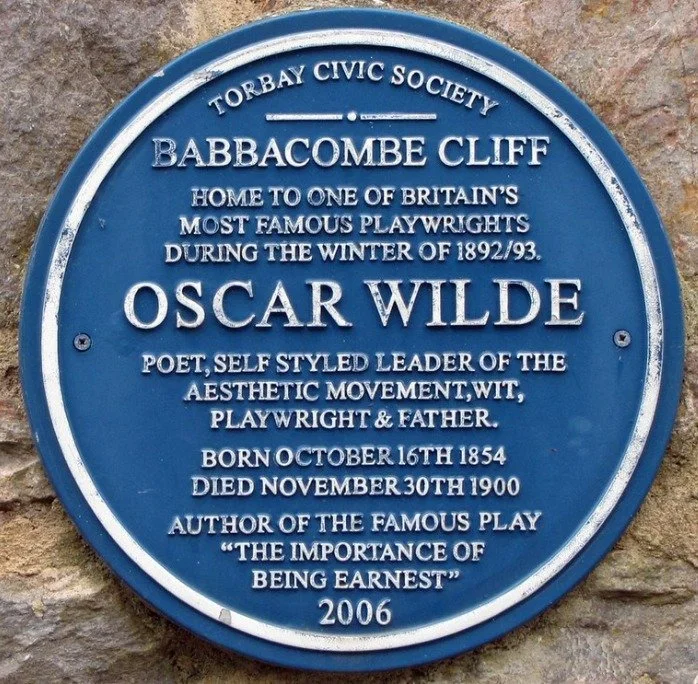
The Plaque
The plaque commemorating Oscar Wilde is situated at Babbacombe Cliff, Beach Road, Babbacombe, 50 yards from Babbacombe Theatre.
The Plaque Inscription
Torbay Civic Society. Babbacombe Cliff, home to one of Britain's most famous playwrights during the winter of 1892/93. Oscar Wilde. Poet, self styled leader of the aesthetic movement, wit, playwright & father. Born October 16th 1854, died November 30th 1900. Author of the famous play "The Importance of Being Ernest". 2006.
Notes
Oscar Wilde and his family leased Babbacombe Cliff for the winter of 1892/93, where he completed "A Woman of No Importance" and worked on "A Florentine Tragedy". The house, redesigned by William Eden Nesfield in 1877, was later used as a hotel and is today divided into private apartments and town houses.