
Torbay Civic Society
The Bishops TowerCoverdale Tower (circa 1050)
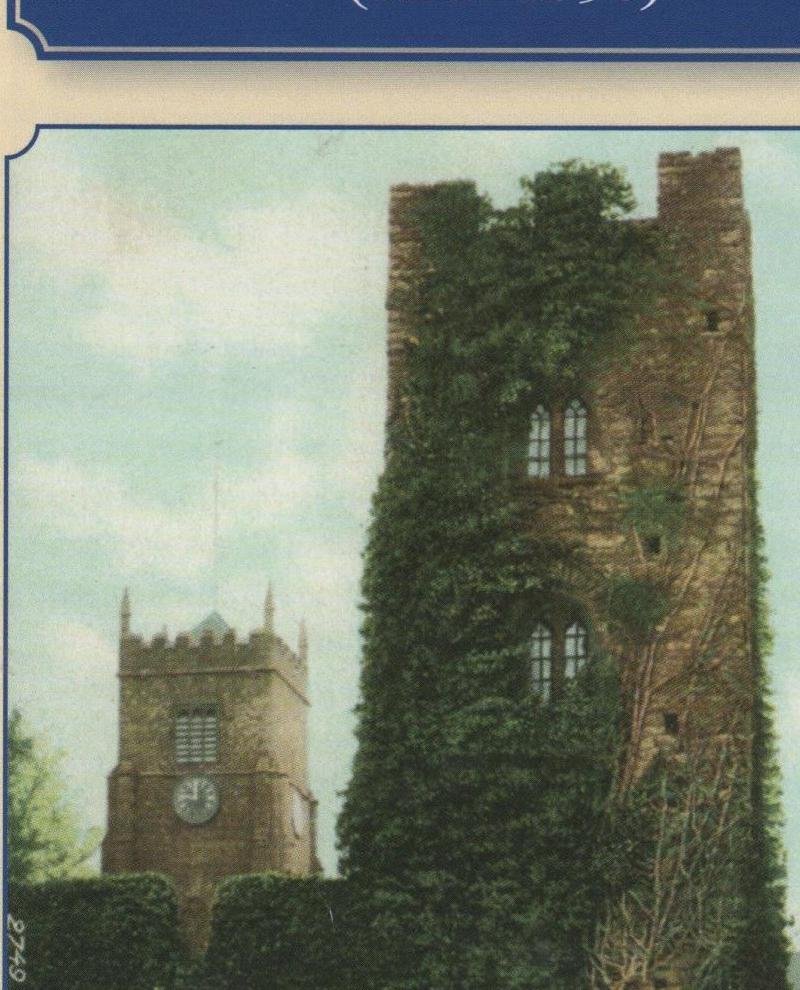
Without doubt Paignton's history goes back into ancient times, and before the Norman invasion it was a Saxon burg, or enclosure. The huge manor of Paignton came into the hands of the Bishops around 1048–9, and the first known record relating to the Manor of Peintona, as Paignton was then known, is in the Domesday Book of 1086, when it is thought the first Norman Bishop, Bishop Osbern (1072–1103), built an ecclesiastical palace. At this time the Danes were still eagerly seeking out fortified enclosed settlements as strongholds to settle into, and once in were impossible to remove, so like many owners of manors at this time, Bishop Osbern erected a watchtower.
The tower appears subsequently to have been rebuilt in two phases, the first in the fourteenth century and the second in the fifteenth. The battlements were added later, and the cast metal dogs set beneath the parapet probably date from the late nineteenth or early twentieth centuries. The various rebuilds and alterations are indicated mainly by the differences in the windows, although the refenestration seems to the modern eye to have been rather random. The fourteenth century windows have heads with a tall two centred arched form that corresponds to the form of the relieving arch, and each individual light has a cusped ogee head. The later windows have rectangular heads carved with depressed four centred arches that form the heads of the individual lights. Both styles of window can be seen on the east elevation. In 2007 the tower was refurbished by the Paignton Preservation and Local History Society, with funding from the Heritage Lottery Fund.
The Bishop's Palace appears to have been built for the purpose of administering the huge manor and as a base for conducting ecclesiastical business. It also provided residential accommodation where a bishop could stay overnight, or possibly for months at a time.
During the early Middle Ages the palace appears to have become an impressive establishment comprising a large Barn and a Great Stable, the former considerably larger than that of Torre Abbey. This period is a rather grey area in Paignton's history, but the palace was obviously designed to accommodate a great number of people. In 2003 the Paignton Preservation and Local History Society, with funding from the Heritage Lottery Fund, organised the preservation and recording of some ruins in Palace Place. These were then identified as a lodging block and garderobe tower, from the early part of the palace's history.
Myths and legends often contain an element of truth, but without documentation these events can never be proved. Paigntonians have long insisted that Miles Coverdale translated Tyndale's Bible in the Bishop's Tower, and this story is commemorated in the town's crest and the naming of Coverdale Road and the Coverdale Hotel. However, for some considerable time this has been dismissed as a myth thought up in the nineteenth century by the people of Paignton, because the Bible was translated and published in 1535, long before the 1551–1553 period when Coverdale was Bishop of Exeter. Coverdale spent a considerable part of his life abroad, to evade the problems of his connections with the new Protestant religion. Whilst abroad he worked on the translation into English of Calvin's treatise on the Eucharist.
But the mystery remains, because the Bible translation was completed in 1535, before Coverdale left Yorkshire and at a time when he was more often than not out of England. He did not come to Devon until 1551, sixteen years after his translation had been published and two years after the manor had passed out of the ownership of the Church. On ascending the throne in 1553, Queen Mary deprived Coverdale of his bishopric and had him imprisoned, possibly in the Tower of London. It was Coverdale's Calvinistic leanings and his marriage, unlawful according to the Catholic Church, that led Queen Mary to seriously consider having him executed.
Queen Mary would not have placed him under house arrest in the home of a nobleman, and as he was a man of the cloth, neither would she have placed him in a common prison. With public feeling in the West Country strongly Romanist, Coverdale was not popular with the ordinary people because he preached the Gospel in English. This might well have encouraged the Queen to consider the tower of the Bishop's Palace at Paignton as a safe place to incarcerate him. So if Coverdale was writing in the tower, as many have claimed, is it possible that one of the dates was mistakenly cited through the years as 1535 when in fact it was 1553? If so, Coverdale could well have been in the Bishop's Tower as a prisoner, not writing the translation of the Gospels but more likely doing further work on Calvin's treatise on the Eucharist. Eventually his wife's royal connections in Denmark pleaded on his behalf, and Coverdale and his family were finally granted free passage to Denmark.
The Palace and Manor had been in the hands of the Bishops for 501 years when Henry VIII entrusted Thomas Speke with the Manor in 1545. Coverdale was Bishop of Exeter for two years during Speke's tenure, during which he could have been invited to the old palace, even though it is said the building had been officially closed as an ecclesiastical palace six years earlier, in 1547. Speke held the manor until 1557, when Queen Mary bestowed it on William Herbert, first Earl of Pembroke, owner of Wilton House in Salisbury and brother-in-law to Catherine Parr, Henry VIII's last wife. William later commissioned a survey, wherein it was stated that "the Palace stable, the Great Stable, is laying in a state of decay," but interestingly there is no record of its being derelict. The Herberts were the first of a long line of absentee landlords who simply collected the rents but ignored the old palace, which became a quarry for building stone, with any artefacts found being disposed of regardless. By the late 1700s, what buildings remained were roofed with thatch and used as storage or cattle barns.
The absentee landlords following the Pembrokes were the Carys, the Kellands and the Templers, who also had little regard for the manor's heritage, thus ensuring the palace deteriorated still further. In 1909, after an interval of 350 years, the Church finally regained the palace grounds when the Diocese of Exeter purchased the title deeds. One year later, the present vicarage was built within the fortified walls. In 1959 the Templer family finally handed the title Lord of the Manor of Paignton to Paignton Urban District Council, which was probably the first council to hold such a title, and when the three towns were amalgamated into Torbay, the title passed to Torbay Council.
The Paignton Preservation and Local History Society grew out of a 1985 public protest group which was set up to save Primley Park from developers. The Society provides free tours of local heritage sites and buildings, including medieval Kirkham House, and has published four Paignton Town Trails: Medieval Paignton, Old Town, New Town and Oldway.
These notes were produced by Peggy Parnell to accompany the Blue Plaque officially unveiled at Bishop's Tower on 20th April 2007, when members of both Paignton Preservation and Local History Society and Torbay Civic Society were present.
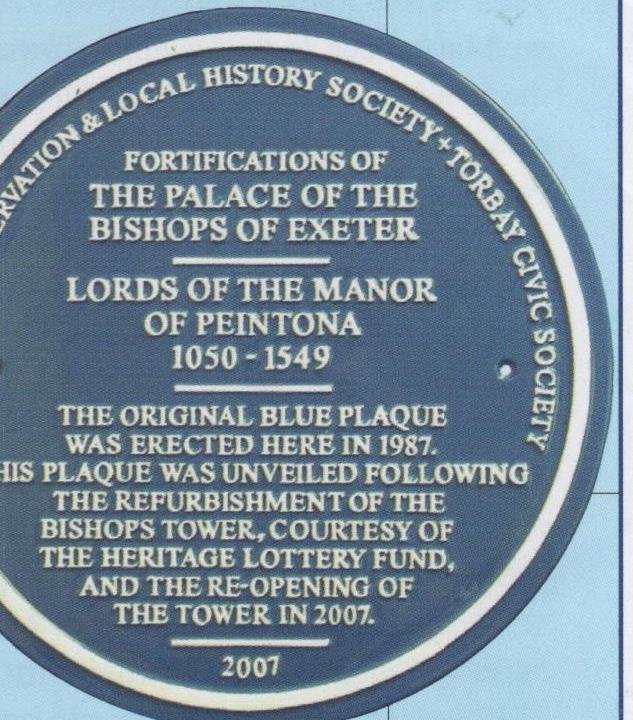
The Plaque
The Bishops Tower plaque can be found on the corner of Tower Road, adjacent to Coverdale Road, Paignton.
The Plaque Inscription
Paignton Preservation & Local History Society • Torbay Civic Society. Fortifications of the Palace of the Bishops of Exeter. Lords of the Manor of Peintona, 1050–1549. The original blue plaque was erected here in 1987. This plaque was unveiled following the refurbishment of the Bishops Tower, courtesy of the Heritage Lottery Fund, and the re-opening of the tower in 2007. 2007.
Notes
The Bishops Tower, also known as Coverdale Tower, is the surviving watchtower of the fortified palace built by the Bishops of Exeter, Lords of the Manor of Paignton from 1050 to 1549. Local tradition holds that Miles Coverdale translated part of the Bible here, though the dating of that tradition remains disputed. The tower was refurbished in 2007 by the Paignton Preservation and Local History Society with funding from the Heritage Lottery Fund.