
Torbay Civic Society
Eden PhillpottsEltham (1862–1960)
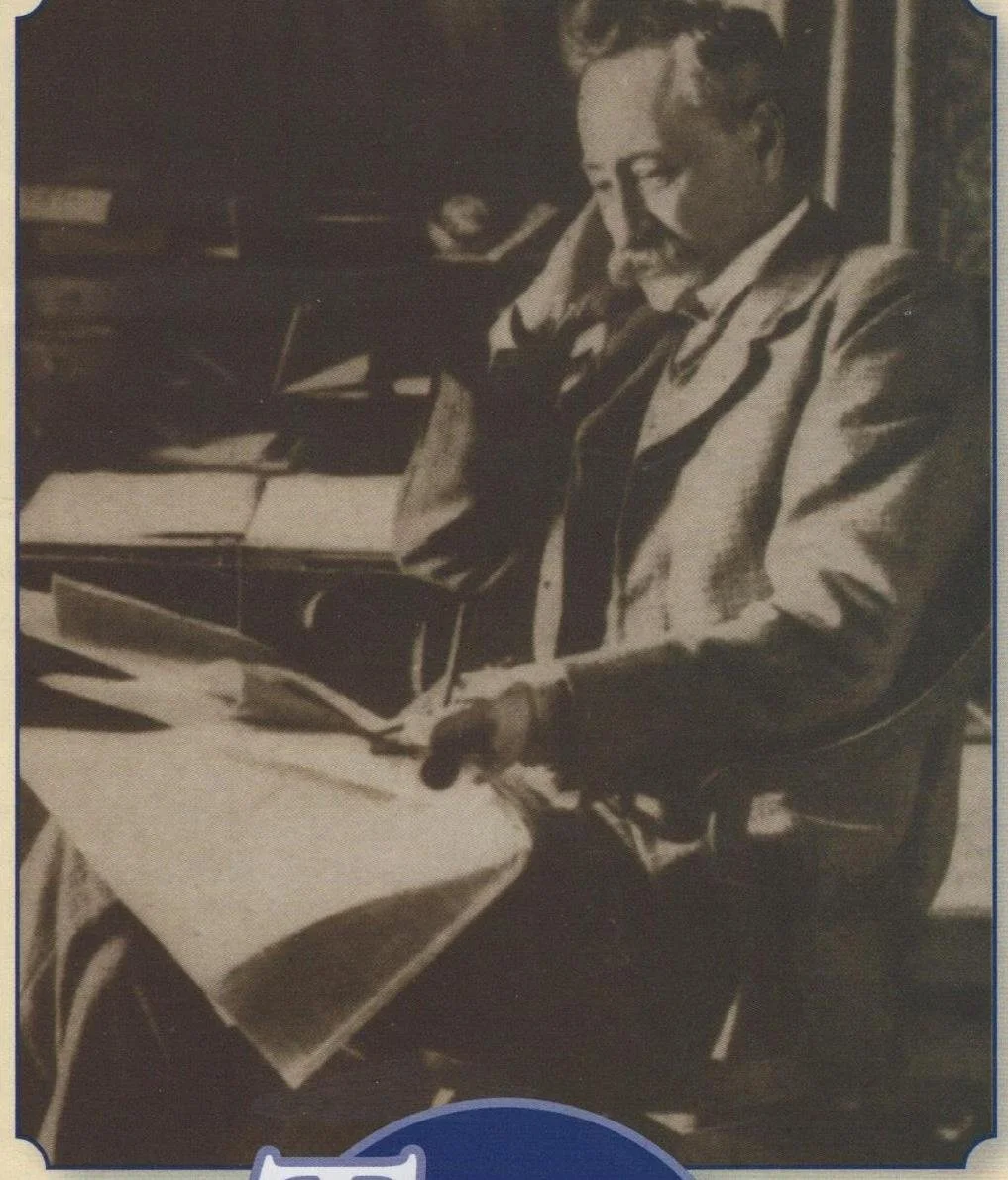
The eldest of the three sons of Captain Henry Eden Phillpotts, an officer and political agent in the Indian Army, Eden was born on 4th November 1862 at Rajputana, Mount Abu, so called the Hill of Wisdom. Together with his brothers Cecil and Herbert he was brought up among those who believed in Jainism, a creed that differs from Buddhism in placing much greater demands on its followers.
Following their father's death the widowed mother brought the boys to Britain, eventually settling at Dawlish in South Devon, not far from their famous uncle Bishop Phillpotts of Exeter. The family had relatives connected with the church based in Cornwall, while at Torquay a Commander Phillpotts sat as a Member of Parliament.
Eden was educated at Mannamead School, Plymouth, until at the age of seventeen he moved to London to be employed at the Sun Insurance Office, where as a clerk he dressed in the traditional long coat and top hat of the era. Through promotion he eventually earned a sum sufficient to allow him to pursue his true love, writing. During the next ten years he became a keen playgoer, toying with the idea of becoming an actor himself until discovering he had not got the talent; his aspirations for fame were satisfied not on the stage but eventually through his prolific writing.
During the early 1890s Eden travelled widely, visiting the West Indies and in time producing a number of travel books, before returning to his beloved Westcountry to capture in words its characters, lifestyles and scenes. During the late 1890s he came to live in Torquay, his initial residence Cosdonne in Wellswood, before, around the turn of the century, moving to Eltham House, Oakhill Road, Torquay. With its large grounds, Eltham, not too far distant from Ashfield, the home of Agatha Christie at Barton Road, would in time be demolished to make way for the South Devon College, which was itself demolished in 2006 to make way for today's Barratt Homes estate.
Eden's first novel was the thriller The End of a Life, published in 1891. It was his Lying Prophets, a tale of Cornish fisherfolk, that was his first real commercial success, following publication in 1897. His Children of the Mist, a story set in Chagford, produced in 1898, was followed by a succession of books highlighting the scenes and images of his beloved Dartmoor. The Secret Woman, a tale concerning adultery and murder, became his most successful story and was dramatised for the theatre in 1912. His own favourite was The Thief of Virtue. These two books were included among the eighteen novels of his series entitled The Dartmoor Cycle, which outline in detail the many geographical areas of Dartmoor that Eden walked with his friend William Crossing, author of Guide to Dartmoor.
Throughout his life Eden detested publicity and, although he lived to be ninety eight, he made only two public appearances, with the exception of his marriage to Emily Topham, which produced two children, Henry and Adelaide, the latter of whom would herself become an author. His first public appearance came in 1904, when at Exeter Cathedral he unveiled a memorial plaque to his fellow writer R D Blackmore, author of Lorna Doone. It was to be another fifty years before his public saw him on television, being interviewed alongside another contemporary who adored the Westcountry, Sir John Betjeman.
Eden was a philosopher, as witnessed by many of his poems, novels and plays, including The Prude's Progress and My Laughing Philosopher. With some of his work published in the Black and White journal, he was eventually appointed an assistant editor there. Being assistant editor ensured Eden had wide connections to the literary world, yet he rarely attended functions, and even when asked to attend the prestigious Westcountry Writers Association Conference of 1955 he declined; realising the delegates would likely toast his continued good health, he sent his wife Robina along to read out his message of thanks.
Eden lived at Eltham for twenty eight years, and in 1921 he was made a Freeman of Torquay. Having lost Emily in 1928, Torquay was now abandoned, and following his marriage the following year to his cousin Lucy Robina Webb, he went to live at Broadclyst near Exeter.
An interesting insight into Eden's personality occurred in 1912, when the British National censor refused to license one of his plays unless two particular sentences were removed from the script. Eden, by now more often referred to as EP, realised the offending words were actually immaterial to the story, but stubbornness took over and he refused to have his script changed by a censor. Writers rallied in support and castigated the censor: J M Barrie wrote, "Clearly the man has no mother, or he could not be so heedless; be that as it may: this puir Devonshire body has been roughly handled." Maurice Hewlett wrote, "As to the plot, a murrain on it. That's naught. The crux is this. Should men of genius, or approximately so, be censored by a Jack-in-office. There's the rub. Dramatic art's the lady; no wanton she." The matter was only resolved when Eden gave his public free admission to the theatre, a somewhat quirky but perfectly legal resolution.
Forever retaining his privacy, EP never attended a performance of his own plays. Although some of his written works were accepted as classics he dubbed himself "a rank and file writer", yet the quantity and diversity of his writing was extraordinary, encompassing travel books, detective stories, novels, poetry, short stories, essays and plays, as well as philosophical work. Late in life he confirmed how he managed to hasten sleep: "I often enumerate famous names and generally choose those eminent in the arts… tonight I might bring great painters to mind, tomorrow summon a regiment of composers, poets or novelists."
EP produced more than three hundred novels, most first editions of which are held in Torquay Library, and with an unknown number of other works completed, this author who said "Yea to life" survived until his ninety eighth year, departing this earth on 29th December 1960. It took more than four decades before a commemorative plaque, arranged by Torbay Civic Society, was unveiled at his garden wall at Eltham on 4th November 2007. The plaque came courtesy of Eden's friend Kenneth Day, and also of Ian Sampson, who recalled that the original inspiration for the recognition came from his friend the late Clive Gunnell of Westward Television, a Phillpotts enthusiast, whose 1980 television documentary entitled Eden Phillpotts – the Man who said 'Yea' to Life may still be remembered with pleasure. The plaque and publication were supported by numerous sponsors, including the Dartmoor Preservation Association, Dartmoor Society, Dartmoor Magazine and Barratt Homes, to all of which the Torbay Civic Society record their thanks.
This biography was written by Torbay Civic Society Chairman Ian L Handford with help from Mr Kenneth Day, who also lent three of the photographs. The Blue Plaque can be seen when visiting Oakhill Road, off Old Teignmouth Road, Torquay.
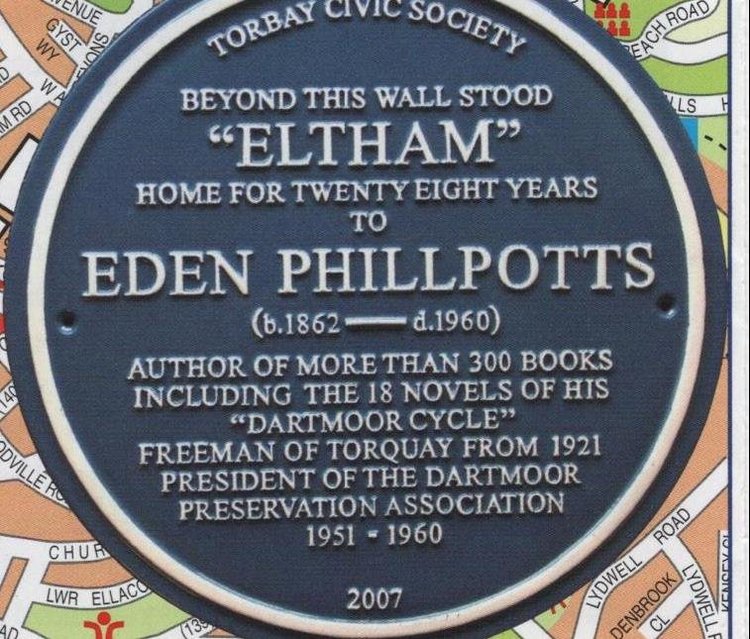
The Plaque
The Eden Phillpotts plaque can be found on Oakhill Road, after leaving the Old Teignmouth Road, Torquay.
The Plaque Inscription
Torbay Civic Society. Beyond this wall stood "Eltham", home for twenty eight years to Eden Phillpotts (b.1862—d.1960). Author of more than 300 books including the 18 novels of his "Dartmoor Cycle". Freeman of Torquay from 1921. President of the Dartmoor Preservation Association 1951–1960. 2007.
Notes
Eden Phillpotts lived at Eltham House, Oakhill Road, Torquay, for twenty eight years, and it was here that he wrote much of his Dartmoor Cycle of eighteen novels. A prolific author across almost every literary form, he was made a Freeman of Torquay in 1921 and later served as President of the Dartmoor Preservation Association. The blue plaque was unveiled at his former garden wall on 4th November 2007.