
Torbay Civic Society
The Royal Air Force in TorbayDuring World War Two
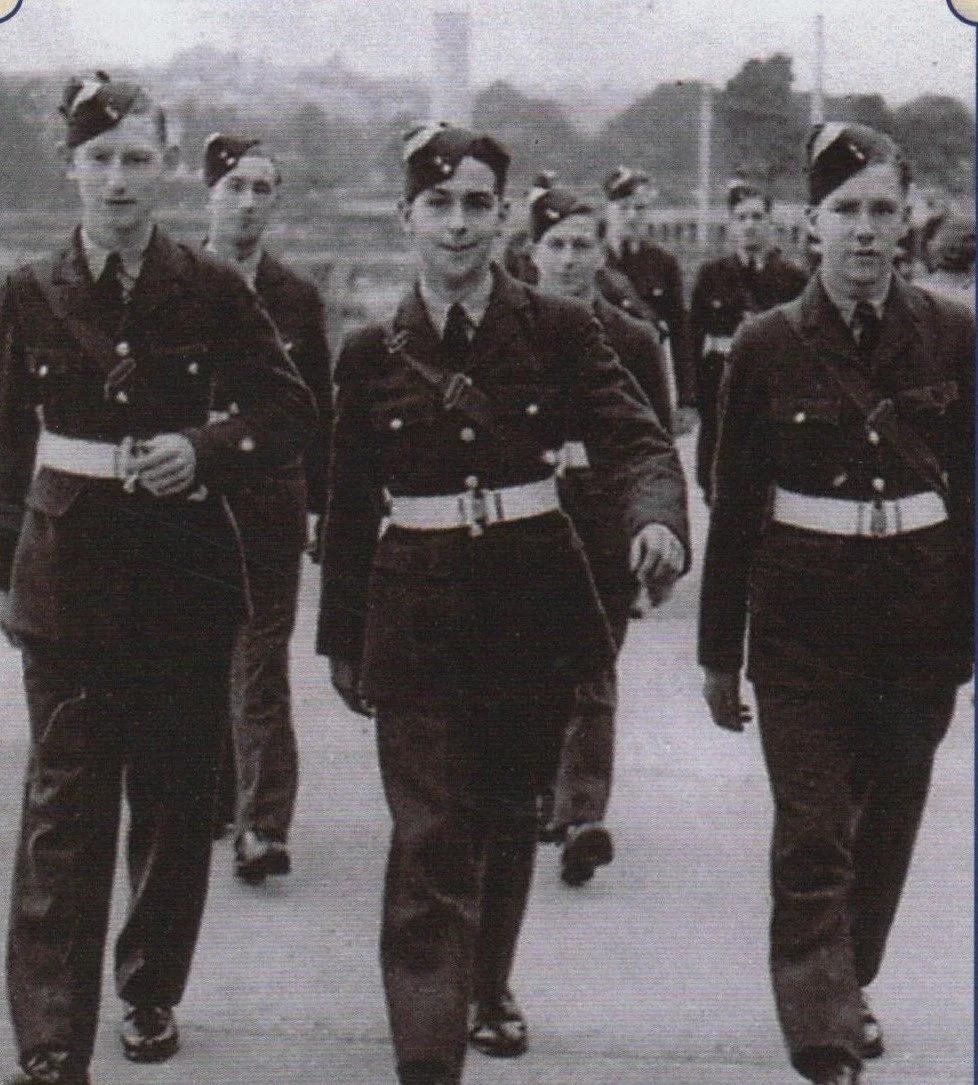
To fly with the Royal Air Force during World War Two one had to volunteer, to be of reasonable academic standard and to be fighting fit. Prospective cadets then took an aptitude test to determine a flying trade and were called to the colours around the age of eighteen. Many of those who were considered to have the aptitude of PNB (Pilot-Navigator-Bomb Aimer) came to Torbay. So, why was a seaside area without an airfield chosen to commence the training of the aircrew cadets?
At the outbreak of the War, Great Britain went all out to gain air superiority over Germany. To this end the Royal Air Force training programme was rapidly accelerated to provide aircrews. Part of the plan was the re-introduction of Initial Training Wings. This training system had been used during the First World War. It was then found that once prospective aircrew were in the air, they were not keen to tackle ground training. The main requirements for an ITW were accommodation and classrooms for lessons. Also, open spaces were needed for drill and physical training. What better than a holiday resort? Hotels and boarding houses were requisitioned and the ITWs quickly got underway.
Prospective flyers became members of the RAF Volunteer Reserve. Kitted out at an Aircrew Receiving Centre they were inoculated, vaccinated and taught basic drill. With a distinctive white flash in their forage caps, volunteer Pilots, Navigators, Flight Engineers and Bomb Aimers came to Torbay to finish preparatory training.
The Course lasted for 12 weeks. Subjects included were Aircraft Recognition, Anti-gas procedures, Armament, Airframes, Aircraft Engines, Hygiene, Air Force Law, Meteorology, Navigation, Parachute procedure, Principles of Flight, Signals, both Morse and Light, and Physical Training. All aircrew had to be able to swim 25 yards in heavy flying clothing and then climb into an inflated dingy. A small jetty was erected between the Grand Hotel and the Harbour. Often, during the depths of winter that swimming test was carried out in the sea. Cadets were assessed throughout each course. If they reached the end they were given a written examination. A pass mark of 70% was required. If they failed marginally they were re-coursed. Some failed completely. They were given the option of re-mustering to a ground trade or transferring to the Army.
Some remained with the RAF and spent their War in Torbay. They may have been unhappy that they did not qualify. Perhaps they were the lucky ones. So many came to train at Torbay and could never return. Others fell in love with Devonshire and Devon lasses. If they survived, they had good reason to return.
On graduation cadets were promoted. Then, for a short period of flying assessment, pilots were drafted to elementary flying schools. By 1941 nearly all further flying training was carried out in schools in the U.S.A., Canada, Rhodesia or South Africa. Pilots’ wings and other flying half wings were awarded at the end of those courses.
The Torbay Initial Training Wings
The Initial Training Wing consisted of 4 Squadrons with 4 Flights, each some 50 men strong. Local hotels were used for headquarter units and for accommodation. Additional buildings were requisitioned for equipment, recreation, lectures, instructional films and swimming. The latter included the Marine Spa, Oldway Mansion, Babbacombe Theatre, Babbacombe Garage, Torquay’s Gas Showrooms and Paignton’s Palace Theatre.
No 1 ITW (Babbacombe). At the outbreak of War this Unit was formed at Cambridge as No. 1 Receiving Wing. It was moved to Babbacombe on 17th June 1940 and was then re-titled No 1 ITW. Headquarters were at the Northcliffe Hotel. Cadets had accommodation at the following hotels: Sefton, Oswalds, Trecarn, Foxlands and the Palermo. Over 27,000 cadets passed through this ITW.
No 3 ITW (Torquay). Formed at St Leonards on Sea six days after the outbreak of war, No. 3 moved to Torquay on 24th June 1940. The HQ was at St James Hotel (now Harbour Point). Accommodation was at the Park Hall, Regina, Dorchester and the Devonshire Hotels. St Vincent’s Hotel was also used until 1943, and then handed over to the Women’s Auxiliary Air Force. Over 8,000 aircrew were trained at No 3. In 1944, while this unit was closing, small units remained at Torre Abbey and the Cavendish Hotel.
No 4 ITW (Paignton). This unit was formed just after the outbreak of war at Bexhill on Sea. Shortly after that it was moved to Paignton. It used the Hydro (now the Esplanade) and the Palace Hotel for accommodation. Oldway Mansion and Oldway Rotunda were used for classes. It closed in February 1944. Some 5,000 cadets commenced training here.
No 5 ITW (Torquay). This unit was formed at Hastings. It moved to Torquay on 24th June 1940. The HQ of No. 5 was in Castle Chambers, with messing centralised at Torquay Town Hall. The Templestowe, Majestic, Stanbury and Metropole Hotels were used for accommodation. 10,000 cadets completed initial training here.
No 13 ITW (Torquay). This unit was formed on 5th June 1941. Wing HQ was located at the Grand Hotel. No 13 specialised in the ground training of Pilots, Observers and Navigators, principally from Commonwealth and Allied Air Forces. The latter were mostly Poles and Turks. Hotels used were the Rosetor (now the Riviera International Conference Centre), the Belgrave and the Livermead Cliff. Shortly before D-Day the Rosetor was handed over to U.S. Forces. The Americans were then temporarily fed by the R.A.F. prior to closure; the HQ was moved to Torre Abbey. These were smaller courses although over 3,000 aircrew cadets passed through.
No 21 ITW (Torquay). Formed on 28th May 1943, No 21 was concerned solely with the initial training of Flight Engineers. The facilities of No 3 ITW were used. 1,100 engineer cadets were trained in the short existence of this unit.
The total strength of RAF Aircrew on the 1st May 1945 was 193,313. Gunners and Signallers did not come to Torbay and they would have numbered around 50,000. The fact that close to 55,000 Pilots, Navigators, Bomb Aimers and Flight Engineers came to the Bay should never be forgotten. It was a great contribution to the war effort.
This text was written for Torbay Civic Society by members of the Aircrew Association, Torbay and District Branch, and Torbay and South Devon Air Gunners. In commemoration of Torbay’s role in the Initial Training of Royal Air Force Aircrew during WW2, sponsorship of the Blue Plaque and the associated publication was by Torbay Civic Society in partnership with Turning Point Heritage Trust, the Torbay and District Branch of the Aircrew Association, Torbay and South Devon Air Gunners, the Torquay Branch of the Royal Air Forces Association, the Rotary Club of Torquay, the 205 Group Association of the Royal Air Force and the 148 Squadron Association, supported by donations in memory of 10, 35, 40, 57, 59, 148 and 355 Squadrons and aircrew from 492 Squadron (Solihull) Air Training Corps.
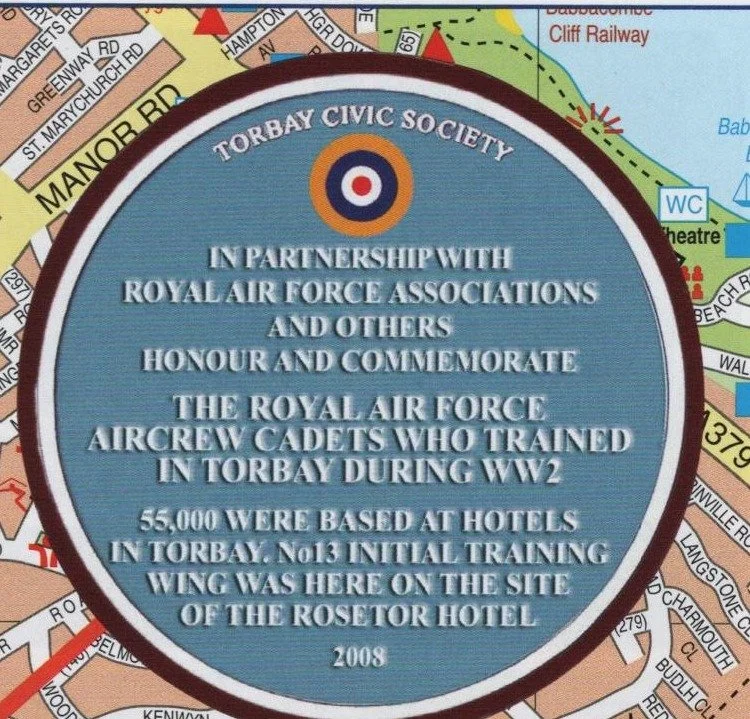
The Plaque
The Blue Plaque can be found at the site of the old Rosetor Hotel, now the Riviera International Conference Centre, Chestnut Avenue, Torquay.
The Plaque Inscription
Torbay Civic Society. In partnership with Royal Air Force Associations and others, honour and commemorate the Royal Air Force aircrew cadets who trained in Torbay during WW2. 55,000 were based at hotels in Torbay. No 13 Initial Training Wing was here on the site of the Rosetor Hotel. 2008.
Notes
Between 1940 and 1944, thousands of hotels and requisitioned buildings across Torquay, Paignton and Babbacombe housed the Royal Air Force’s Initial Training Wings, where close to 55,000 aircrew cadets completed twelve weeks of ground training before moving on to flying schools in Britain and overseas. The plaque was erected at the Riviera International Conference Centre, formerly the Rosetor Hotel and headquarters of No 13 ITW.