
Torbay Civic Society
Callaghan of CardiffLord Leonard James Callaghan (1912–2005)
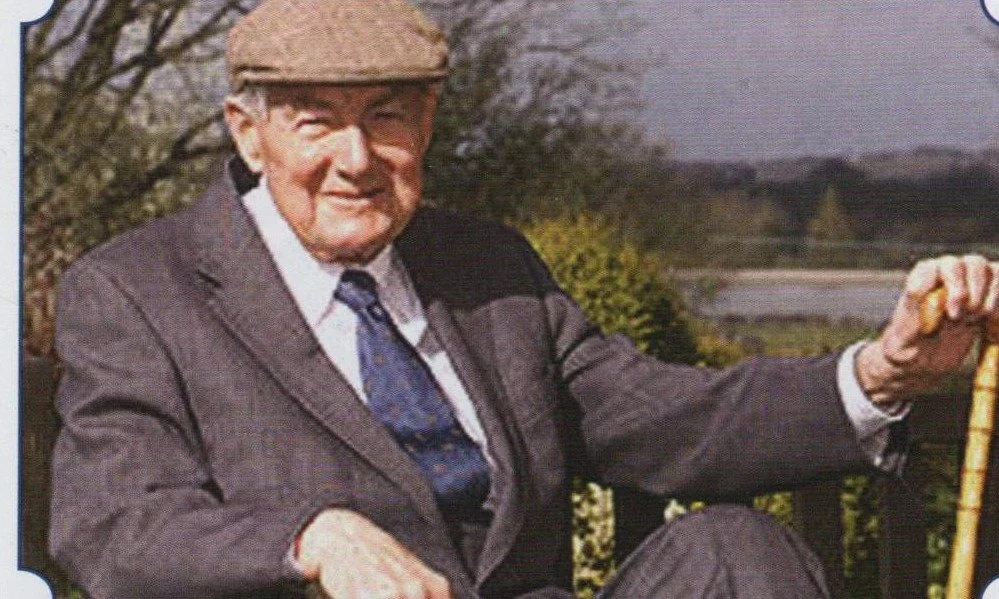
Lord Leonard James Callaghan was born in Portsmouth, Hampshire, on 27th March 1912. His father was James Callaghan, a Chief Naval Petty Officer RN on His Majesty’s Royal Yacht until retiring in 1914. He then moved the family to Brixham where, having taken up a post of coastguard, they were to reside in one of the agency’s cottages on Berry Head Road.
Having moved to Brixham when aged just two, Leonard later attended Furzeham Elementary, the first FREE school in the town, until he was nine years old. The school thought attendance and order most important and it was not until 1920 that a H.M. Inspection report would record the school as putting more emphasis on physical activity and sports, still sadly of little interest to an academic like Leonard. He was even noted as “not being an outstanding pupil” although he won a prize for his Biblical Knowledge during 1921, the same year his father died while working as a coastguard. Today James lies buried in St Mary’s Churchyard, Brixham.
The loss of James saw the family vacating the tied cottage and for a time residing in virtual poverty at Ranscombe Road, Brixham. Two years later they moved back to Portsmouth where young Leonard attended a secondary school before winning a scholarship to Portsmouth Grammar.
It might well have been the granting of an extra ten shillings per week (50p) to the family by Labour in 1924 that initially fired Leonard’s interest in socialism. Certainly by age fourteen he had left Portsmouth Northern and soon after, having had an examination success, he was working at the Inland Revenue. By 1929 he had been appointed a junior Tax Officer and over the following years was an ardent agitator for change before finally, in 1936, being appointed Assistant Secretary to the Inland Revenue Staff Federation (IRSF), a role he retained until 1947.
Jim had joined the Labour Party at the early age of 19 and soon after was to recognise the impending danger from German militarism. In wanting to join the Navy as early as 1938 he then married Audrey Elizabeth Moulton, and with the IRSF refusing him permission to enlist, his job being seen as far more important, he left Somerset House, London, when transferred to the Inland Revenue in North Wales.
Enlistment eventually came in 1943 and he saw active service in Ceylon and Iceland. Joining up late destined him to remain in the ranks, where his fellow ratings gave him numerous names including Stoker Jim and Young James before finally accepting just Jim. Decades later the national media would re-nickname him again, this time Sunny Jim. During the Second World War Jim was commissioned a Naval lieutenant and even played a minor role in military intelligence. The war years saw him acquiring a tattoo, an act that forever destined him to wear a suitable shirt in order to hide what later he regarded as an abomination.
As Member of Parliament for Cardiff South his maiden speech to the House of Commons was given on 20th August 1945. He retained the seat until 1950 before being re-elected by Cardiff SE, which he held for thirty-three years. An early interest in demobilisation saw him appointed Chairman of the Labour Party Defence Committee in 1946 and although the Prime Minister then wanted him at the War Office, due to Jim’s absence abroad Frank Pakenham (later Lord Longford) got the job in 1946. Jim made quite sure he was in the right place at the right time a year later when, as one of 23 rebels opposing the Bretton-Woods Agreement (to establish an International Monetary Fund), he was later rewarded when given the role of Junior Minister of Transport.
Appointed Parliamentary Secretary to the Admiralty in the autumn of 1950, he and the Labour Party lost power with the election of a Conservative Government that year. Nevertheless, during thirteen long years in opposition he kept in close contact with a number of high-ranking politicos on the world stage. He even involved himself with major issues of the day including the Common Market and Africa. Finally, in 1960, he backed Hugh Gaitskell against Harold Wilson’s call for unilateralism and, having stood unsuccessfully against George Brown as Deputy Leader of the Labour Party, Gaitskell appointed him Shadow Chancellor.
After Gaitskell’s death in 1963 Callaghan stood as Prospective Labour Leader against Harold Wilson and George Brown but again lost. Wilson nevertheless re-appointed him Shadow Chancellor. Now it was to be the Profumo scandal, the resignation of Macmillan and a shaky Premiership under the unpopular Sir Alec Douglas-Home that in 1964 brought Conservative rule to an end.
Labour was elected with a small majority of four and Jim Callaghan was Chancellor of the Exchequer. But having inherited an economy in crisis, his first major decision, a refusal to devalue the pound, became a disaster when, with inflation unchecked and the public and city investors losing confidence, he panicked and introduced counter-productive import taxes and the penal Selective Employment Tax (SET). At a stroke he effectively killed off any hope of job creation under Labour for years thereafter.
The Labour landslide of 1966 saw Callaghan return as Chancellor of the Exchequer but once again a devaluation crisis was on the horizon. In being forced to tighten the economic screws he once again got his timing wrong and soon after a much humiliated Government was forced to devalue in 1967. Although the media had a field day concerning the devaluation, they actually liked Callaghan and, in spite of his poor decisions, eventually nicknamed him “Sunny Jim”. But with the Conservatives in uproar, the still unbowed 6’1” Sunny Jim was forced to resign from his beloved job at the Treasury to be sent to the Home Office.
In spite of the many ups and downs in the political life of Sunny Jim, he was voted in as Prime Minister in April 1976, having beaten his rival Michael Foot in a ballot of Labour MPs. He remained PM for just over three years and during this period that most famous retort came just as he was leaving for a G7 summit, when he remarked “crisis, what crisis”, before months later union militancy and a so-called winter of discontent brought a Labour defeat in the May 1979 election.
During his latter years Mr Callaghan visited Brixham and Furzeham School on numerous occasions and as late as 2004 even supported a campaign for the repair of Shoalstone pool, not many yards from his childhood home. Having held all three of the great offices of State and become Father of the House, Her Majesty finally made him a Knight of the Garter and a Life Peer in 1987.
In retirement Lord Callaghan completed his memoirs, “Time and Chance”, but then, having lost his beloved Audrey on 15th March 2005, it was to be just eleven days later, on the eve of his 93rd birthday, that he also died.
In partnership with Brixham Town Council, the Society installed a Blue Plaque at Lord Callaghan’s former home, 26 Berry Head Road, Brixham, on 22nd September 2008, exactly twenty-one years to the day after his last visit to the area.
This pamphlet was written for the Torbay Civic Society by its Chairman Ian L Handford.
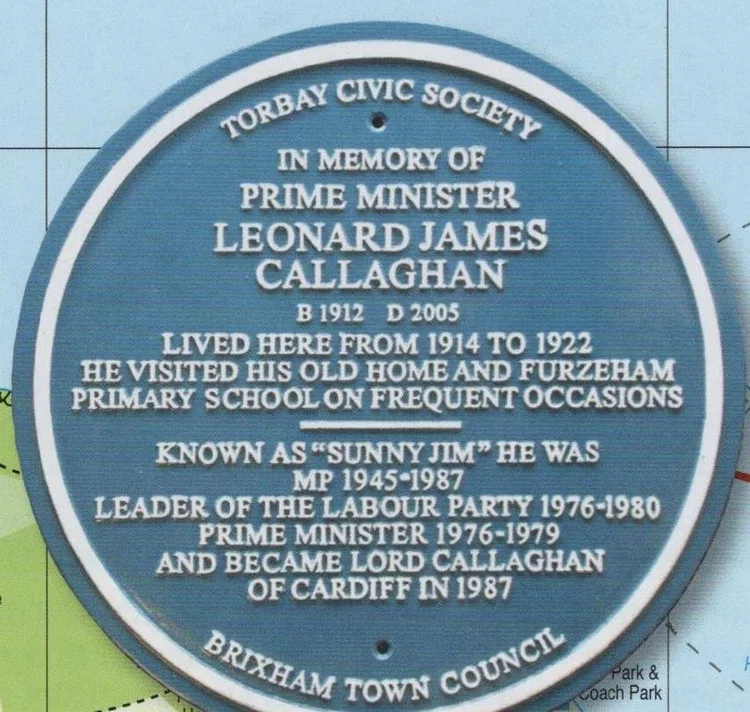
The Plaque
The Blue Plaque commemorating Lord Callaghan can be found at 26 Berry Head Road, Brixham, Devon.
The Plaque Inscription
Torbay Civic Society. In memory of Prime Minister Leonard James Callaghan. B 1912, D 2005. Lived here from 1914 to 1922. He visited his old home and Furzeham Primary School on frequent occasions. Known as “Sunny Jim” he was MP 1945–1987. Leader of the Labour Party 1976–1980. Prime Minister 1976–1979. And became Lord Callaghan of Cardiff in 1987. Brixham Town Council.
Notes
James Callaghan spent his boyhood years at Berry Head Road, Brixham, following his father’s appointment as a coastguard, and attended Furzeham Elementary School until the family’s move back to Portsmouth in 1921. He went on to serve as Chancellor of the Exchequer, Home Secretary, Foreign Secretary and Prime Minister, the only person to have held all four of the great offices of state. The plaque was unveiled in partnership with Brixham Town Council in September 2008.