
Torbay Civic Society
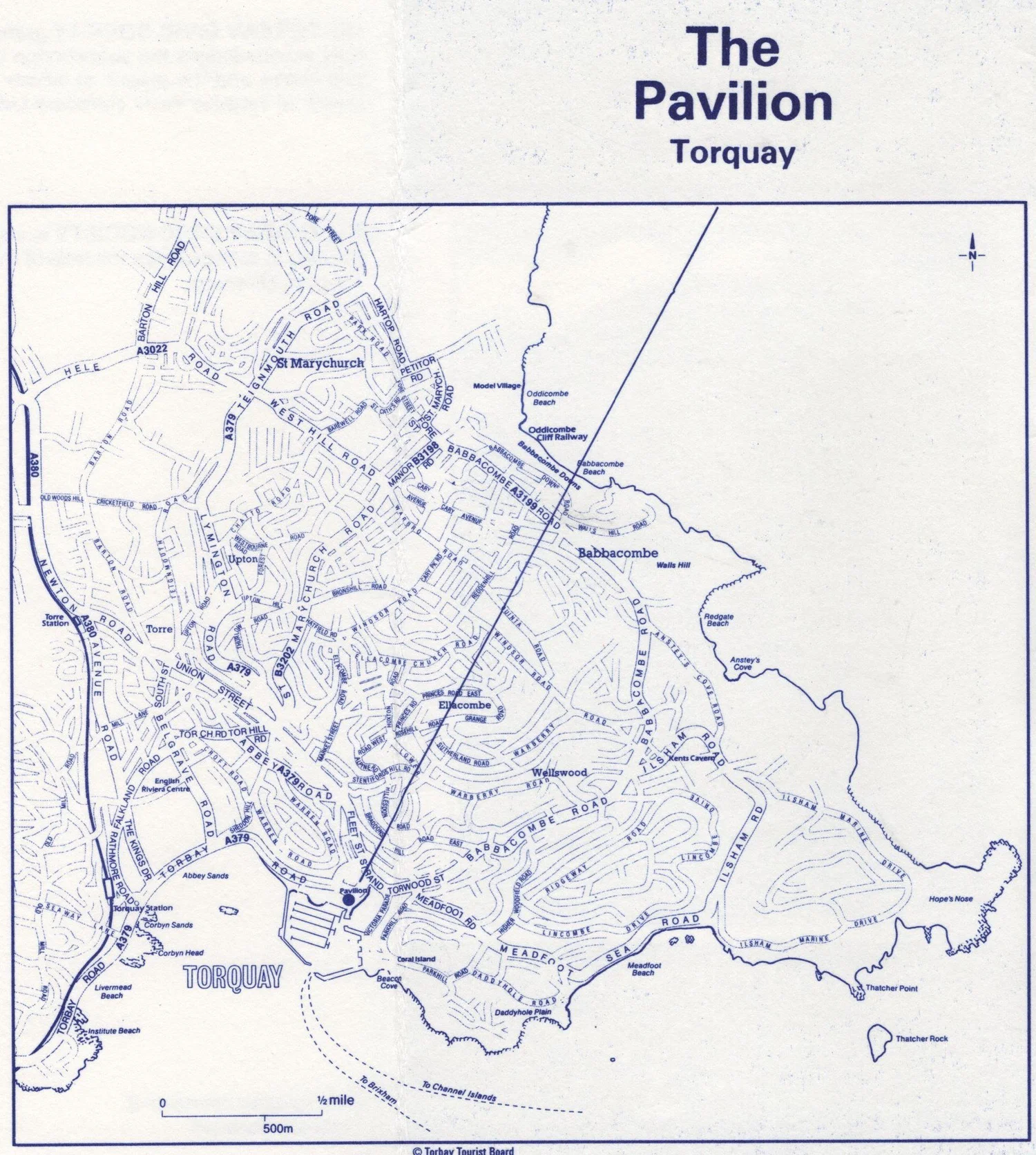
The PavilionTorquay
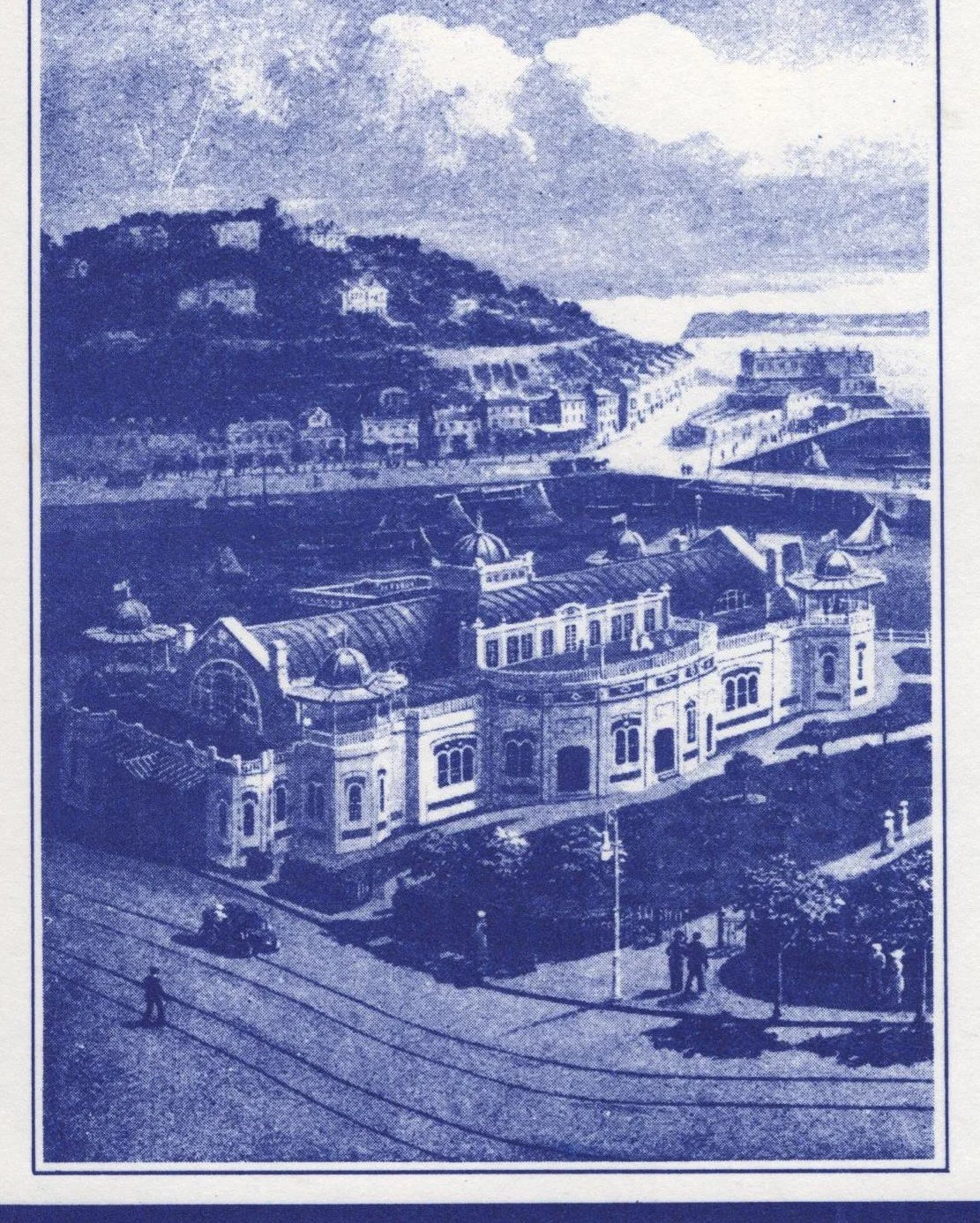
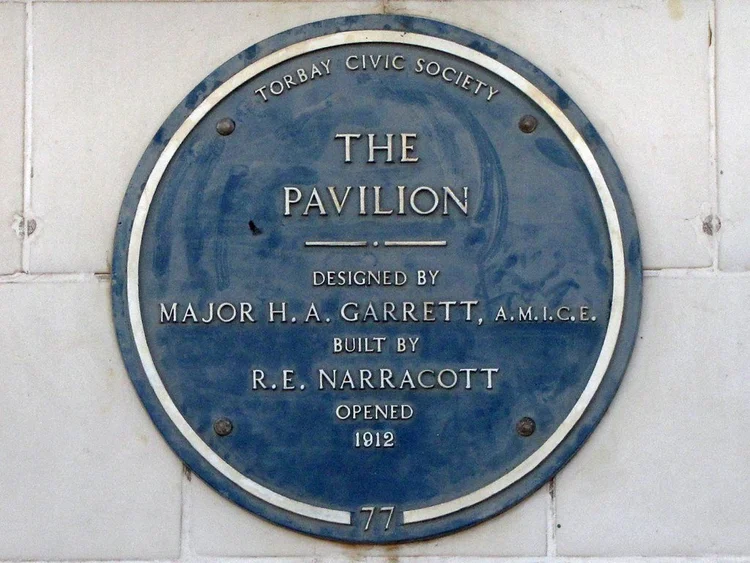
The Pavilion at Torquay is an excellent example of English seaside architecture, built when the English seaside was in its heyday, and because it was built at the edge of the sea and not at the end of a pier, it is exciting as a building and solidly constructed, and one of the few of its kind to have survived from 70 years ago.
Here was a place specially designed for our summer visitors to listen to music, to meet friends over tea or lunch, to clamber aboard the Skylark for a sail across the Bay, or simply to sit and enjoy the view.
Although it is arguably the most appropriate, most cherished and the most interesting building in the town, it took 18 years of argument and struggle before the opening ceremony took place.
In 1903, 11 years after that event, the Mayor of Torquay called a meeting, at the prompting of the Chamber of Commerce, to hear proposals for the building of a Pavilion. “It is absolutely necessary”, said a speaker, “that steps be taken to provide adequate musical and other attractions for visitors... Torquay gets duller and duller by year, and high-class property is depreciating.”
In 1896, seven years before that, a committee of the Council had wanted to build a pier complete with bandstand, shelters, landing places and pavilion. The Institute of British Architects offered a prize of £50 for the best design. Mr. Edward Richards was the winner. He may have got his money but he never got his building. Many public meetings were called, many resolutions passed, many polls demanded and many deferments decided upon. In the end they built a pier but no pavilion.
But now the Mayor had taken a personal interest and as the meeting came to a close many thought there was just a chance the town might at last get what it so obviously needed. Especially as the idea was to do it at no expense to the ratepayer. Two private companies were to be formed. They would quickly raise the necessary £7,000 and building could then go ahead in the capable hands of private enterprise.
But neither of the two companies could raise the money!
Six more years went by and the town was getting desperate. People were flocking in great numbers to Eastbourne, to Bournemouth and other places too painful to mention. Progress could be held back no longer. The Council decided to undertake the building of a Pavilion at a cost of £15,000. The contract went to a local builder, R.E. Narracott, whose price was £16,942 4s. 4d. The architect was the Borough Engineer, H.A. Garrett, who admittedly based his plans on those of Edward Richards. What was perhaps supported as an economy turned out to be a very good decision indeed.
When the Pavilion was opened on 17th August 1912, it was the culminating event in a series of major improvements to the town. Major Garrett had also been responsible for the laying out of the Princess Gardens and the terrace walk, which like the Pavilion itself were built on land reclaimed from the sea. Torquay now felt it was in a position to offer the sophisticated holidaymaker everything he could possibly want.
How different things were in those far off days! To meet one’s friends in a smart cafe for morning coffee or afternoon tea, to walk through gardens where the scent of the flowers mixed with the ozone off the sea, to buy a deckchair and listen to the band, all to the sound of the waves and within walking distance of the shops. Then to stroll along the pier and admire the view, carrying a silver-headed cane and wearing a boater and a blazer and humming a tune from The Maid of the Mountain.
Without a care in the world, except for the weather, which always created problems. Should one book tickets for the evening concert, hoping the day would turn out sunny? Or should one be a pessimist and buy tickets for the afternoon. But then suppose one was just sitting down to enjoy the music when the sun came shining through the windows and the Pride of the Bay was setting off for Brixham.
The Pavilion, described enthusiastically in the national press as “Torquay’s Palace of Pleasure”, was admirably fitted to be the centrepiece of the old time holiday scene. It was built rather in the manner of Art Nouveau. A distinctive feature was the octagonal cupolas standing like miniature bandstands at the corners, and the finely cast ironwork on the steps leading up to them. The graceful curving walls were enlivened with swags of flowers, urns topped with pineapples, scrolls, ferns and here and there the smiling features of a cherub. There is nothing official or monumental or work-a-day anywhere in evidence. It is all pure Betjeman, a place for fun and relaxation and enjoyment.
And it was the same inside. Potted palms stood beside the oak panelling of the lounges and the cafe, and the visitors promenaded past stained glass windows and skilfully moulded plasterwork.
It glittered white in the sun, thanks to its facing tiles of Doulton’s Carrara Enamelled Stoneware. In the centre it had a dome, and this was surmounted by a full-size figure of Britannia presented by the Mayor, Councillor C.T. Towell, J.P.
More than that. The dome itself was splendidly covered in copper. The Council had a brave after thought and by 19 votes to 9 decided to be devils and go the whole hog and lash out another £800. This sum presumably covered also the two copper figures on the smaller domes, representing Mercury, the messenger of the gods.
While the Pavilion was under construction the Council, with a degree of foresight that takes one’s breath away, appointed a conductor and set him to work to form an orchestra. They were rehearsing even before the building was ready, in the Pengelly Hall of the Museum. At last the town could boast its own Municipal Orchestra, which had now become the sine-qua-non of the fashionable seaside resort.
No expense was to be spared, at least as far as the salary of the conductor was concerned. They paid him £500 a year. More than the Town Clerk. It was not so much because of his age, he was only 28, but he was the up-and-coming young man and what’s more he had a German name. (What could an Englishman in those days possibly know about music?) Two years later this caused a little difficulty when the Kaiser marched into Belgium. But Hindenberg had an English mother and was quite ready to oblige. “Hello young man”, Sir Thomas Beecham called out to him one day on the steps of the Albert Hall, “and under what name are you conducting now?” “Basil Cameron” came the reply.
There were other problems. A critic at one of the first concerts wrote: “It makes one’s musical heart ache to see the anxious faces of the conductor watching for an interval to get a start between the cups and the saucers, and also to see a fair songstress suppressed by a steam siren at the jetty.”
The heyday of the Pavilion came between the wars, when the Torquay Municpal Orchestra played under a local conductor, Ernest Goss. During the Christmas of 1932 listeners to the radio, or the wireless as it was called in those days, first heard an announcement which was to become familiar throughout the country for many many years. “This concert is coming to you direct from the Pavilion in Torquay.”
The Pavilion was the focus for the annual Torquay Musical Festivals which became a feature of the musical life of the country. Almost every important name in music appeared on the platform of the Torquay Pavilion, including Sir Henry Wood, Sir Edward Elgar, Sir Adrian Boult, Fritz Kreisler, Mark Hambourg, Dame Nellie Melba, Dame Edith Smythe and many others.
After the second world war the days of the seaside orchestra were finished. The Torquay Municipal Orchestra struggled manfully on, still under the well-loved Ernest Goss, until it was finally disbanded in the early fifties, almost the last in the country.
But with the orchestra gone nobody could think of any suitable use for the building. All kinds of ventures were tried but without any real success. It went into decline and became shabbier and shabbier. By the early seventies it was scheduled for demolition and might have disappeared for good but for the initiative of Mrs. Sheila Hardaway, who formed the Friends of the Pavilion, which was the forerunner of the Torbay Civic Society.
In 1973 the Pavilion was listed by the Department of the Environment as a Class II Building of Special Architectural or Historic Interest. Its future is now assured and its character preserved in its new role as a part of the Torquay Marina. It will no doubt continue for many years to suggest the idea of enjoyment by the sea.
Research: Elaine Hunt
About this series
This leaflet, and the plaque, is one of a series commemorating notable people, buildings and events in the history of Torbay, prepared by the Torbay Civic Society. The Society gratefully acknowledges the sponsorship of this leaflet and the plaque to which it refers, of Torquay Yacht Harbours Ltd, and the help of the Torquay Museum.
Series edited by Frank Cawson. Produced by Denis Walton. Photographs courtesy of Torquay Museum.