
Torbay Civic Society
Flora ThompsonWriter of Lark Rise to Candleford (1876–1947)
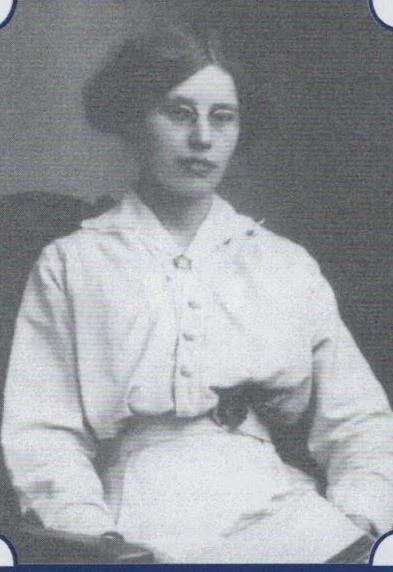
The acclaimed dramatisation of Lark Rise to Candleford, televised by the BBC in 2008, was adapted from a trilogy of novels written in South Devon by author Flora Thompson. In this semi-autobiographical classic of Victorian village life, there is a scene where a post office assistant, Laura, obligingly writes a letter for an illiterate gypsy woman, who by way of thanks, then tells the young girl’s fortune and prophesises, ‘You’re going to be loved, loved by people you’ve never seen and never will see’. These words were to prove uncannily true, for the character of Laura was modelled on the real-life experiences of Flora whose literary genius would flourish too late in life for her to fully appreciate the enduring popularity her books would attract after her death.
Flora Jane Timms was born on 5 December 1876, in the hamlet of Juniper Hill, near Bicester, North Oxfordshire, being the eldest of ten children whose impoverished upbringing gave her the inspiration for her books, which also provide a valuable social record of rural life in a bygone age. Flora’s father was a stonemason, whose increasing dependence on drink eventually reduced him to taking work as a bricklayer. However, there was always food for the table as the family grew vegetables and kept livestock on a smallholding. Flora learned to read before she started school and having developed a flair for writing this saved her from a life in service. At the age of fourteen, her mother found a more suitable situation for her daughter with the postmistress in the nearby village of Fringford, this a significant step up the social ladder for a girl from such a humble background. Furthermore, as post offices were the hub of village life this provided the budding author with plenty of interesting characters to observe. Soon, she took the opportunity to act as holiday relief in places further a-field before being transferred to Grayshott, Hampshire, an area fashionable with authors and poets where she came into contact with famous literary figures, when selling stamps or sending telegrams for such luminaries as George Bernard Shaw and Arthur Conan Doyle.
In 1903, at the age of twenty-six, Flora married sorting clerk and telegraphist John Thompson (1874–1948) and they settled in Bournemouth. Marriage restricted her strong urge to write, as her husband strongly disapproved and condemned such inclinations as a waste of time. Nevertheless, she raised a family and made a private study of literature by making good use of the recently established free library system. Writing for her own amusement, she never seriously considered having her work published until 1911 when she entered and won a women’s magazine essay competition on the works of Jane Austen. This success encouraged her to submit two articles to the same magazine, both accepted for publication.
The Titanic disaster of 1912 prompted poet Ronald Campbell Macfie to write an ode that was published in the Literary Monthly and readers were invited to review the poem. Flora won first prize and with her creative gift greatly admired by physician Dr Macfie he was to continue to encourage the literary aspirant during a life-long friendship.
Being paid for what she loved to do best enabled Flora to overcome her husband’s prejudice as she felt she had finally ‘earned the right to use my scanty leisure as I wished’. Although not fulfilling, the income received from newspapers and magazines provided her three children with a private education as she concentrated on writing ‘small sugared love stories’ and even accepted a commission to ‘ghost’ the memoirs of a big game hunter. Much more personally satisfying were her nature essays, which, for twenty years appeared in The Catholic Fireside. After John was appointed sub-postmaster of Liphook, Hampshire in 1916, Flora produced a volume of poems entitled Bog, Myrtle and Peat, which failed commercially when published in 1921. From 1925 to the outbreak of the Second World War, Flora also ran a postal writers’ circle entitled the Peverel Society.
Being restless John Thompson applied for promotion and accepted the position of postmaster of Dartmouth in 1928. Now the family moved to a secluded cottage The Outlook, in Above Town, where Flora began writing sketches about her country childhood. In 1937, The Lady published the first of these, Old Queenie, a remembrance of the beekeeper and lace maker of Juniper Hill. Her birthplace was renamed Lark Rise when a collection of similar essays formed the basis of her first novel published by Oxford University Press in 1939, followed two years later by Over to Candleford. In 1940 John retired from the Post Office and he and Flora then moved to Brixham. The onset of war had dampened the author’s hard earned success, but she continued to write, even during the air raids, cooped up in a Morrison shelter in the cellar of her home at their house Lauriston, New Road. Candleford Green was published in 1943 and, two years later, there were advance orders of 5,000 for the three novels published as the celebrated trilogy Lark Rise to Candleford. Her last book Still Glides the Stream was completed in August 1946 but due to a paper shortage the publication was delayed until 1948.
The works completed by Flora Thompson in Brixham were written under great strain as she was grieving for the loss of her youngest child, Peter, lost at sea when his merchant vessel was torpedoed in 1940.
She never recovered from this blow and as her health slowly deteriorated the garden became a retreat as angina prevented her from enjoying walks in the country. Fatigue and a failing heart gradually took its toll before on 21 May 1947, aged seventy, Flora died alone in her room at Lauriston. Her passing did not even warrant a mention in the Torbay press, although her literary achievements were proudly recognised by her husband, once her fiercest critic, who finally arranged for a headstone in the shape of an open book to mark his wife’s resting place at Longcross Cemetery, Dartmouth.
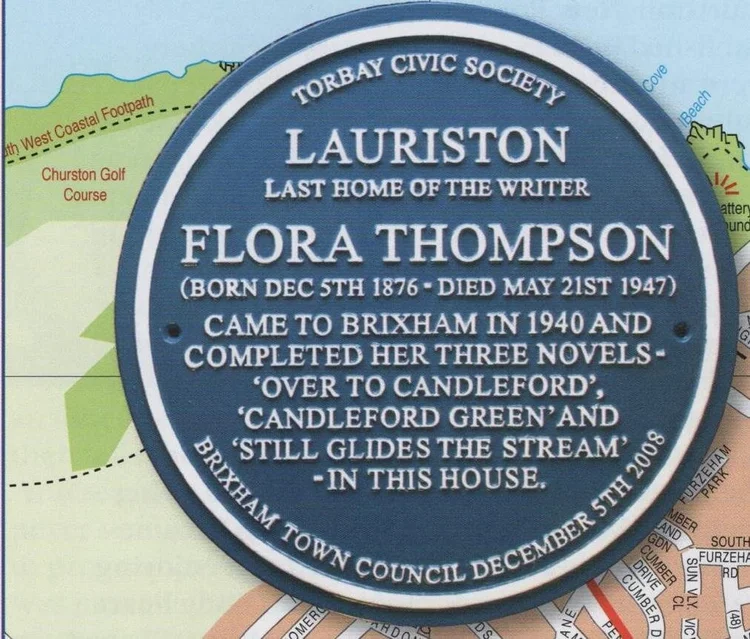
In partnership with Brixham Town Council, Torbay Civic Society unveiled a Blue Plaque at Lauriston House on New Road, on the anniversary of Flora’s birthdate, 5 December 2008.
Thanks are given for the history and text of this pamphlet, which were provided by author and local historian Mike Holgate.
The Plaque
The Blue Plaque commemorating Flora Thompson can be found on the end wall of Lauriston House, New Road, Brixham, Devon.
The Plaque Inscription
Torbay Civic Society. Lauriston. Last home of the writer Flora Thompson (born Dec 5th 1876, died May 21st 1947). Came to Brixham in 1940 and completed her three novels – ‘Over to Candleford’, ‘Candleford Green’ and ‘Still Glides the Stream’ – in this house. Brixham Town Council, December 5th 2008.
Notes
Flora Thompson moved to Brixham with her husband John in 1940, where she completed the celebrated trilogy Lark Rise to Candleford, later dramatised by the BBC. She died at Lauriston in 1947 and is buried at Longcross Cemetery, Dartmouth. The plaque was unveiled in partnership with Brixham Town Council on the anniversary of her birthdate in December 2008.