
Torbay Civic Society
The Spanish BarnTorquay
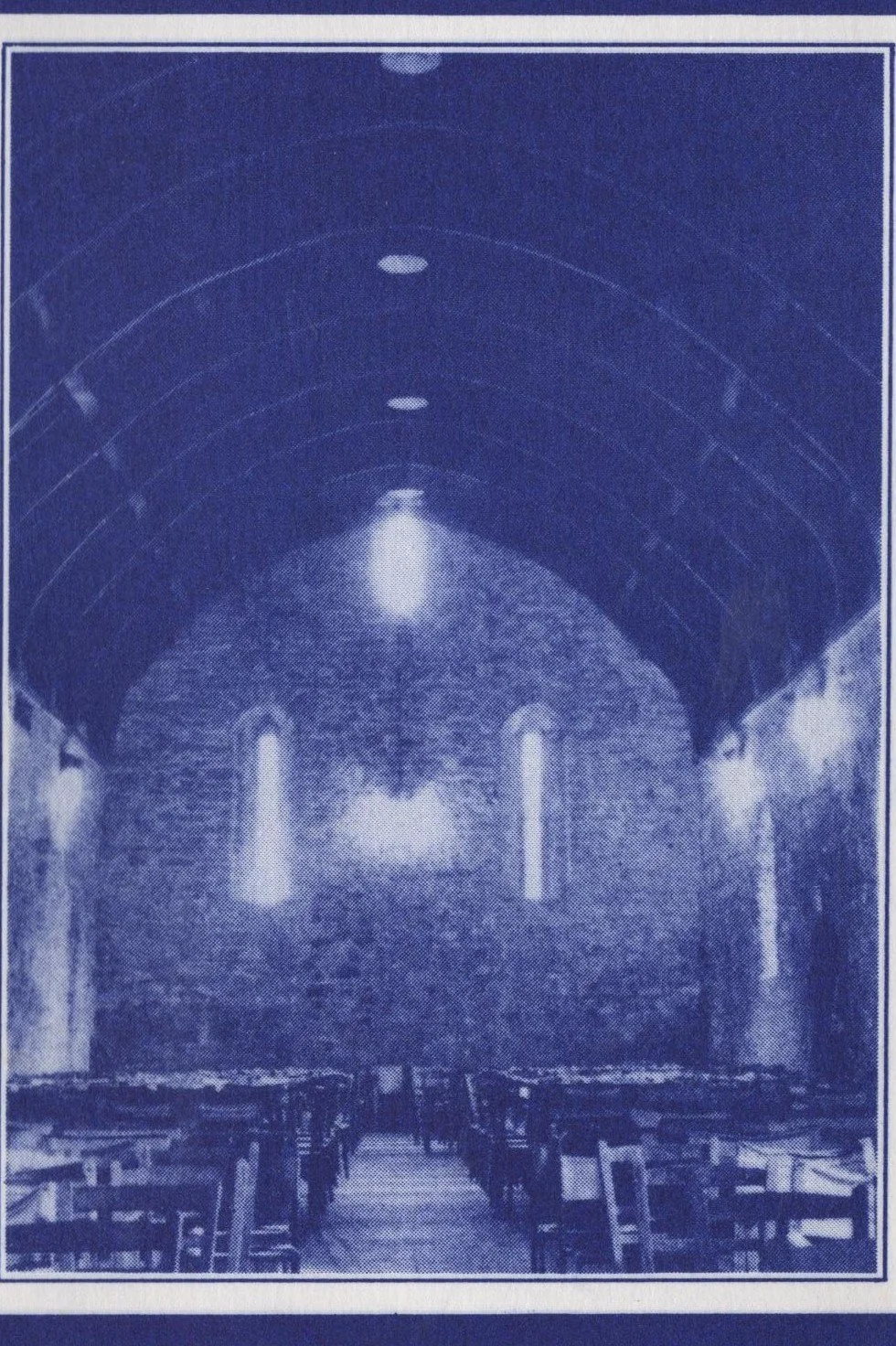
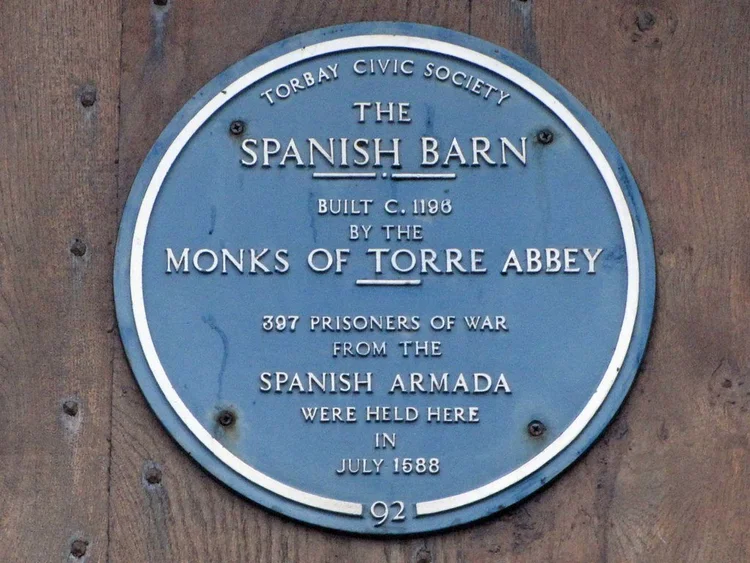
The Spanish Barn was built over 700 years ago as the tithe barn of Torre Abbey. It is one of the largest and oldest and most stoutly constructed buildings of its kind in Britain — a building with a curious history and a special place in the affection of the town.
The Manor of Torre had been given to William Usher as a reward for his part in helping the Normans to conquer the English. From him it passed to William de Brewer, who was responsible for the setting up of the Abbey.
On the 25th March 1196, at his invitation, a first party of monks set foot on the sands of Tor Bay. They had travelled from Welbeck Abbey, and were members of a French Order, the Premonstratensians, who took their name from the town of Premontre, some 80 miles outside Paris.
They were warmly received, at least by William de Brewer. He gave them some of the best land in his possession and they started on the building of Torre Abbey, which soon became the richest Premonstratensian Abbey in the country. The tithe barn, or the Spanish Barn as it is now called, was completed in the late twelfth or early thirteenth century, and gives some indication of the wealth of the Abbey and the extent of its local possessions.
The function of a tithe barn was to store the crops collected as rent from the farmers on their estates. The word, which is of Anglo Saxon origin, means a ‘tenth’, and reflects the fact that the peasant farmer had to surrender one tenth of what he produced as a tax to the Church.
The Spanish Barn measures 119 feet by 28 feet — large enough to accommodate a single tennis court. It has ten buttresses at each side and three at each end and the massive doorways allowed fully laden haywains to be taken inside for unloading.
It still has its original walls, of sturdy local sandstone and limestone. But if we go inside the building and look upwards we can see that the present roof is a later addition. There are twelve recesses on each side, which were clearly to receive the beam ends of the twelve supporting ribs. This contrasts with the seventeen ribs of the present roof, the only other roof the building has had in almost 800 years. It probably dates from the seventeenth century.
In 1539 Henry VIII took Torre Abbey, along with all the other monasteries of the country, into the ownership of the Crown. For a long time the buildings were unoccupied, the lead was stripped from the roof, and everything fell into decay, with the single exception of the Spanish Barn, which alone was exempt from the general delapidation.
From one point of view this was extremely fortunate. In 1588 it was pressed into use for a purpose altogether different from any its early builders could have envisaged. In late July of that year the alarm beacons were lit on hilltops across the country. They were to warn the nation that the long dreaded Spanish Armada had at last been sighted in the Channel.
A running battle was fought between the English and Spanish fleets as they sailed up the Channel. But so limited were communications in those days that the people on land remained for a long time in utter ignorance of how the battle was going. This was true even for Sir John Gilbert and Sir George Cary, who were jointly in charge of the land defences of Torbay, and who must have found the suspense especially agonising.
Eventually a signal was received that the Armada had sailed past Torbay and was heading up the Channel. Torbay relaxed, but the excitement was not yet over. On the next morning a most surprising sight greeted the eyes of the populace who quickly gathered on cliff and headland. The Roebuck, a privateer owned by Sir Walter Raleigh, appeared over the horizon, with an enormous Spanish galleon in tow behind it. This was none other than the vast 1,100 ton Nuestra Senora Del Rosaio, one of the largest and fastest ships in the Armada and the flagship of the Andalusian squadron.
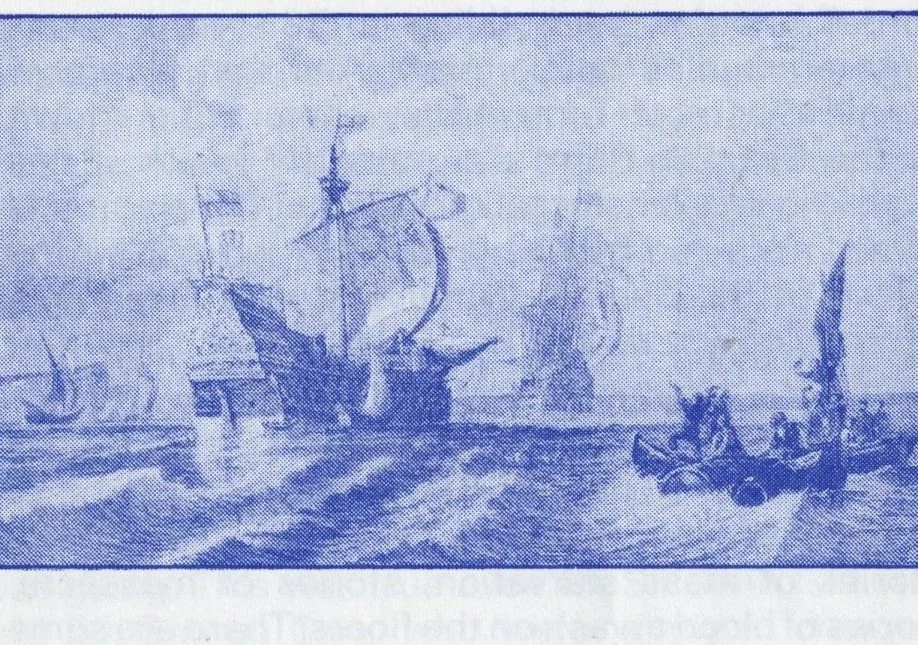
She had been in collision with another Spanish vessel the previous day and had lost her foremast. During the night she had fallen behind the rest of the fleet, and in the morning was picked up by Sir Francis Drake, who spotted her from the bridge of the Revenge in the early light of dawn.
Why her captain, Don Pedro de Valdez, in command of a vessel of such armament with her firepower still intact, should have surrendered her without offering any resistance remains one of the great mysteries of the Armada. Equally puzzling is the fact that no attempt had been made to repair the damaged foremast during the night.
Gilbert and Cary were now faced with the problem of what to do with the crew of the captured vessel, which was all the more difficult in view of the known hatred of the local population for the Spanish. Sir George Cary eventually arranged for them to be brought ashore under heavy guard and herded into the one building in the area that was large enough to house them. And that was how the tithe barn of Torre Abbey came to be known as the Spanish Barn, the name by which it has been known ever since. Lord Seymour, the nominal owner, received a consignment of wine from the cellars of Sir George. Whether it was a red or a white wine we do not know, but we can say that it was very unlikely to have been a Spanish vintage.
In the years that followed, all manner of lurid stories grew up around the enforced sojourn of the unfortunate prisoners in the Spanish Barn. Stories of mass starvation, stories of massacre, stories of blood awash on the floors! There are some who to this day believe the barn to echo at dead of night to the ghostly footsteps of a Spanish noblewoman who had contrived in secret to embark with her lover. These stories are more interesting as exercises in the romantic imagination than as examples of historic fact. Especially as in this instance the historic facts are rather disappointing. The prisoners were moved from the barn after less than two weeks. And not one of them seems to have been seriously the worse for his incarceration in Torquay.
It was a descendant of George Cary who gave the Spanish Barn a new and different function. Having bought Torre Abbey from the Ridgeway family, in the first half of the eighteenth century, he converted it into a fashionable Georgian residence and turned the Spanish Barn into a coach house. He put in a second floor to make a hay loft and built fireplaces and chimneys. Some of the original windows were enlarged, and the south transept doors were bricked up.
In 1930 the Abbey and its grounds were purchased by the local authority, who restored the medieval appearance of its exterior, while inside they removed the fireplaces and the hayloft, installed electric lighting and built a new flagged floor.
During the Second World War the Barn was used as a gymnasium by the R.A.F. who had taken over the Abbey as a training centre for officers. Since the war the Barn has been used as a theatre, a concert hall and an exhibition hall.
Research: Leslie Retallick
About this series
This leaflet, and the plaque, is one of a series commemorating notable people, buildings and events in the history of Torbay, prepared by the Torbay Civic Society.