
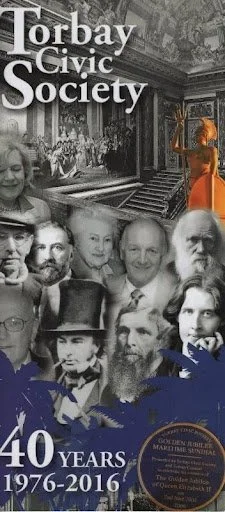
Torbay Civic Society -
40 years (1976 – 2016)
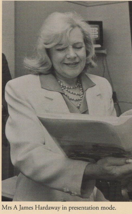
The earliest amenity protection group in the Torbay area was probably the Torquay Association for the Protection of Property started in 1928. However, the emergence of today's local resident associations and amenity groups really started in the 1960s and early 1970s. It was then that Mrs A James Hardaway (Sheila to her friends) became a formidable ally to those wishing to protect the area in which they lived. The Hardaway’s home was located in the Parish of Wellswood, Torquay and a year after founding an association she had named the Friends of the Pavilion in 1971, the Meadfoot and Wellswood Area Residents' Association would emerge. The volunteers were mainly those already associated with the Pavilion group but the first formal committee meeting of the Wellswood group was held on 8th April 1972 at the home of Mr & Mrs Hardaway.
The new group would initially decide that preservation and conservation should be their main interest with buildings and trees the main concern, although as time passed other topics were added including: transport, sewage, street lighting, walkways, local parks and roads etc., with the overarching interest always, "to protect the built heritage of the area''.
The group paved the way for other amenity groups to emerge in Torbay while they set out their early mission statement covering Wellswood and Torquay Harbour, "To protect and preserve the established character of the area''.
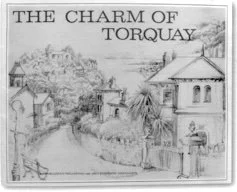
The public were already witnessing undesirable buildings and new facades appearing everywhere with much of the verdant and natural beauty of this local area being lost to overdevelopment and commercialism. This led to a very relevant booklet being published on the 15th August 1972 entitled "The Charm of Torquay" which set out in pictures and words why Torquay had been designed as a town and "place of visual delight" using photographs and engravings etc., from committee member John Wilson and a front-page montage by Trixie Smith. Today the booklet is a collector's item and is still seen as the earliest printed success of the association.
The association would regularly respond to all planning applications affecting their area and would often lodge objections or amendments if proposed changes were seen as inappropriate. It was not long before the Livermead and Cockington Area Residents' Association and the Galmpton Residents' Association offered to partner the Wellswood group so that a single more powerful organisation might emerge. This, in time, did lead to the founding of Torbay Civic Society just 40 years ago.
Evolution of a Civic Society
Prior to 1972, there had been a long history of local activists wanting to protect our built heritage. Then in 1972, government legislation ensured that planning proposals had to be publicly advertised locally, which greatly assisted those wishing to monitor all plans being put forward at a local level. It was during this era that the Livermead and Cockington group in partnership with the Meadfoot and Wellswood Association came together to further protect the Torquay Pavilion, which at chat time was threatened by a demolition order. It was from these early partnerships the first civic society evolved.
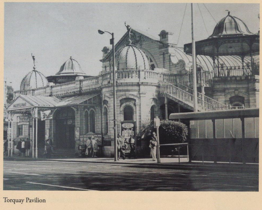
The Pavilion had come about from an idea by Edward Richards during the 1890s, and finally opened in 1912 after an eighteen year-long dispute at council level. The dispute had raised its head in 1896 following a council decision to build a pier complete with bandstand, shelters, a landing place and a pavilion. But then, having become involved with the National Institute of British Architects who had awarded a cash prize of £50 for the best design to Mr Richards, protracted council and public meetings were held and even a poll, before eventually the Torquay Pier Scheme was given the go-ahead but without a pavilion. With the Mayor fronting the battle and the private sector promising to help with the finance, a new contract was eventually awarded to local builder R E Narracott to construct a stand-alone pavilion for a sum of £16,942.4s.4d. As the dispute had lasted six long years, many regular visitors to Torbay had already switched their allegiance to places like Bournemouth and Eastbourne and other resorts too painful to mention.

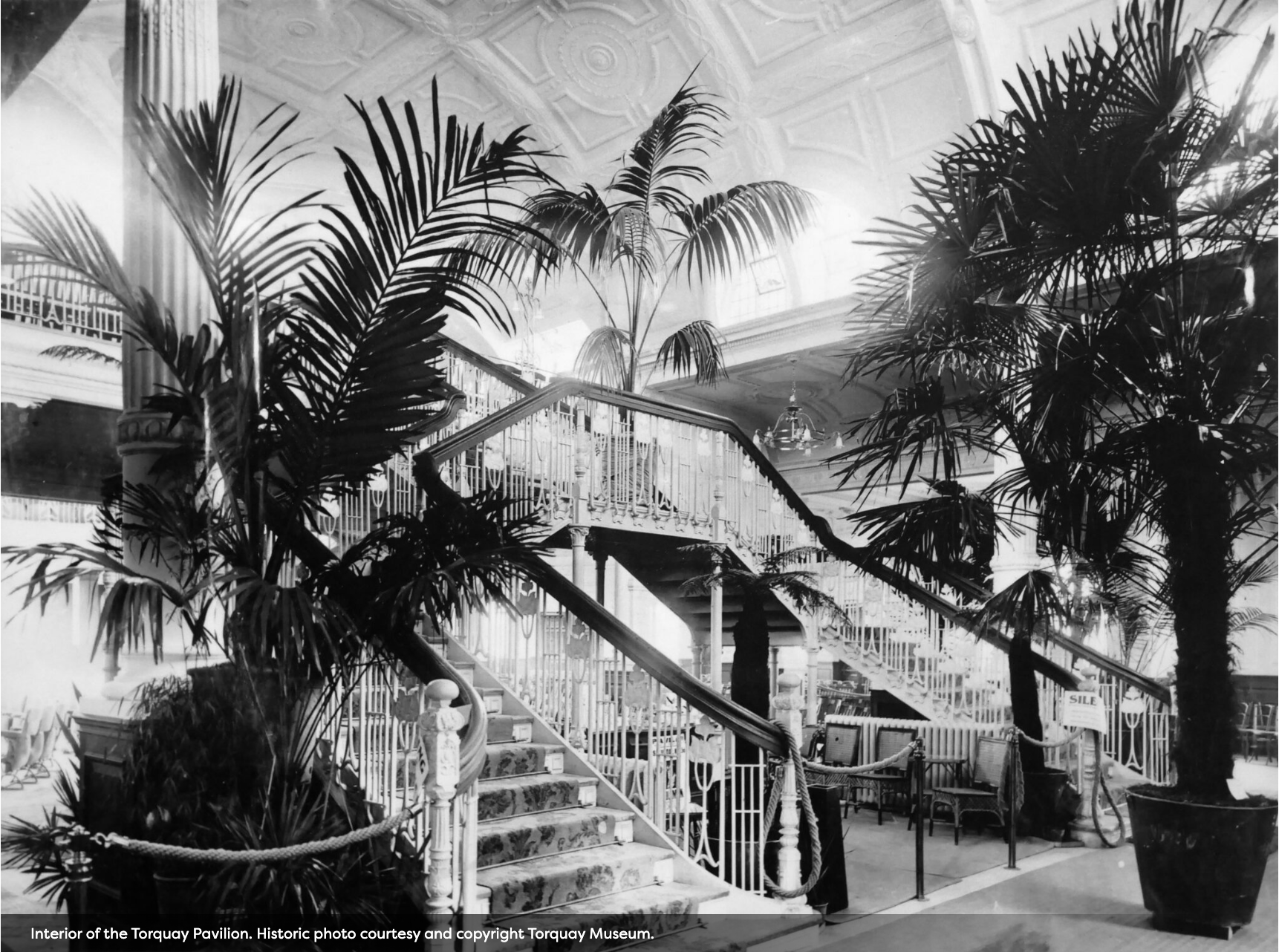
With the procrastination at an end, Borough Engineer Major H A Garrett was appointed architect. He then chose to base his plans on those put forward by Mr E Richards so many years previously. The Pavilion was to be built on reclaimed land and supported on a raft of concrete using expanded steel. With a facade of Daulton Patent Carraraware, together with art nouveau ironwork and with a copper domed roof carrying figures of Mercury and Britannia (on front page), the overall effect was of the East. The Pavilion opened its doors to the public on 17th August 1912 and during the next 100 years the doors would be closed to the public on three occasions, which of course includes the latest closure today.
Legal disputes are not new in Torbay. During the mid-1970s the public watched in disbelief as the Marine Spa complex, comprising the Assembly Rooms and Public Baths, was demolished. It all seemed to be a precursor to what might occur at the Pavilion, which, unlike the Marine Spa, commissioned by Sir Lawrence Palk in 1853, had never been a commercial success. Yet the Pavilion Theatre had remained one of the last public buildings in the town making a profit. Now, with the threat of demolition looming, Mrs Hardaway founded the Friends of the Pavilion group and, with a small group of activists, would save the beloved building on this first occasion.
The September 72 issue of the Meadfoot, Wellswood & Area Residents' Association newsletter named no less than sixteen properties as being under threat in just the Wellswood area alone. With a new planning group formed co monitor all new road orders, trees requiring protection and the built heritage, local activists were fast reaching a time when a more formidable group needed co emerge to cake on the lobbying role to "protect and preserve" the heritage of all of Torbay's three towns.
Meanwhile, during 1973, the council had decided to undertake a major survey of trees in order to create a Tree Preservation Order (TPO) list and so sought the help of the association. Later that year, the Livermead with Cockington Residents' group and the association would learn chat the council was actually encouraging demolition of older properties in favour of new blocks of residential flats, so Sheila, in her usual flamboyant style, penned, "demolition of existing properties, mainly Victorian, and their replacement with blocks of Rats, the bacillus concrecus ad infinitum would seem to be in full space". With planning appeals attended, soon the Secretary of State would confirm chat the Lincombes, the Warberries, and Torquay Harbour were co be designated conservation areas. Now new town plan proposals were 'order of the day' and with a new Torquay Harbour underpass, Torre village and a coastal highway being proposed, (until plucked out by the roots), these were viewed as early successes for the local activists.
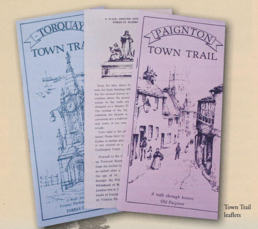
The first Town Trail leaflets were being established which enabled residents and visitors alike to enjoy walks in Torquay and Paignton. Then, as convenor of yet another steering committee, Mrs Hardaway proposed the possibility of establishing the first local civic society in Torbay, at a time when civic societies were becoming popular throughout the UK.
When in 1975, the Council of Europe declared a European Architectural Heritage Year, this ensured all historic buildings, public open spaces, notable trees and waterways achieved a higher profile. It was the first time the public would start co appreciate the importance of their heritage and their responsibility to future generations. They started to realise chat changes in lifestyle and where we live cannot always be purely progressive and that local activists had a serious role to play in monitoring change or development through lobbying. The association's annual report of 1975 confirmed the group had, "come a long way" since formation just four years before. The planning and tree brief and other topics were now supplemented by active social events and interestingly, that year, this included the first Gala Evening. But the constant round of meetings and voluntary work would continue to grow right through to 4th March 1976, when the inaugural meeting of the new Torbay Civic Society (TCS) was finally held and 100 local organisations invited.
Torbay Civic Society Evolves - The First Decade from 1976
In order to further champion the cause of amenity groups locally, Mrs Hardaway arranged for her committee and the TCS to become a member of the National Civic Trust. In deciding to encourage local amenity groups to come together into one major group under its banner, the TCS also led the way by bringing the membership of the Friends of the Pavilion into partnership with the TCS. The society was now heavily involved with the Victorian Society, the Georgian Group and aided the Men of the Trees and the Council for the Protection of Rural England at a national level. As if all this was not sufficient, Sheila had opened a dialogue with the Conservation Forum, the Devon Alliance of Amenity Societies, Devon Historic Buildings Trust and Dartington Hall and when questioned how she planned to save the Pavilion while getting her message heard across all these areas of heritage, she replied, "you fight fire with fire and paper" and on heritage, "with pictures - Torquay is a place of visual beauty".
Unfortunately, in the year the TCS evolved there was a drought, which saw members having to help others prepare for the expected water rationing. For a time, local community work and drought issues plus litter, hooliganism and drunkenness were more important matters and so matters of heritage and conservation lobbyists cook a back seat. However, once the drought crisis had passed, the activities of the new society through its enthusiastic volunteers, quickly ensured that matters of local, regional and even national importance were discussed. Now like many similar groups in the UK, the TCS obtained the scams of a registered charity, which gave even more credibility to its first Chairman, Mrs Hardaway who later became its first President. With her vibrant, unique tone and massive enthusiasm for our cause, Sheila was the natural leader co protect the living environment as she established it as a powerful voice on environmental issues concerning preservation, conservation and of course Torbay's built heritage.
By the second AGM the committee numbered eleven volunteers including: Chairman Mrs Hardaway; Vice Chairman Mr Charles Stone; Secretary Mrs J Richardson; Treasurer Mr F RB Lockwood; Librarian Miss A Crampton and committee members Mrs Austin Smith; Mr R Clotworthy; Mr I L Handford; Mr A J Hardaway; Mrs H W Mortimore; Mrs H Peddle and Architectural Adviser Mr J Wilson. It was the year the Meadfoot & Wellswood Residents Association was subsumed into Torbay Civic Society and now a plan of work emerged which would fully monitor all Torbay's planning applications and particularly those where a Listed Building or protected tree was involved. It was not long before the society extended this work into providing new publications following the success its Town Trail and Town Walk publications. Publications were seen as a marvellous way of raising the profile of the society as did open meetings where film or slide shows, talks or lectures were given. With tours of major historic buildings or private houses plus walking trips becoming a regular feature of the society's social activities, coach outings were even being arranged to visit historic places of interest such as manor houses, gardens, castles and palaces. Later, even coach holidays to Europe were arranged, although these would cease due to the high cost of insurance and health and safety issues.
The work of the society's planning group included the society asking the council to open the Torre Abbey kitchens to the public and to find a use for the Old Brewery Grade II Listed building at Paignton. Then came a very successful campaign against the proposed demolition of the Tithe Barn at Shiphay when an appeal was mounted to Devon County Council. At Brixham, its museum was threatened with bankruptcy and the TCS joined a delegation to find a way to save the building while at Torquay, public appeals were lodged against demolition of Woodfield in Lower Woodfield Road and The Rainbow off Avenue Road, a building that would later become the famous Rowcroft Hospice Torquay.
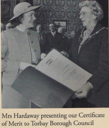
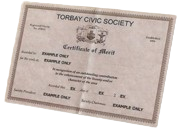
Formal partnership with the Friends of the Pavilion evolved in 1978, while at around the same time an association was formed with the Galmpton Residents' Association, proving yet again the growing influence of the TCS. Although only two years old, the Society created a plan for a new award, a Certificate of Merit, given to a developer who was deemed to have assisted in the society's printed aims as confirmed on the certificate, "In recognition of an outstanding contribution to the enhancement of the beauty and/or character of the area". By now the society was regularly attending meetings of the Devon Conservation Forum and the Devon Alliance of Amenity Societies, which ensured its activities and expertise were appreciated by a wider regional audience. It had a new logo, a three-shield emblem representing the three towns of Torbay. This included a sailing craft for Brixham; a Tower for Paignton; and The Victorian Fountain for Torquay. The three-town-shield logo is still used by the society today.
Saving the Pavilion was, of course, a milestone achievement for those who had fought so hard and long to protect it, battling against the wishes of the council. Sadly, today there are even fewer public buildings of historic interest left in Torbay and so each saved is a bonus. The loss of the Pavilion's theatre had been a disaster for theatregoers but when this was compounded by the closure of the Pavilion kitchens, the building stood empty for years. Eventually, refurbishment brought an ice rink and when this closed, a roller-skating rink before finally, full conversion created a shopping complex on the ground floor with a new restaurant above. The society may have achieved its goal in saving the building but it would have a chequered history for decades thereafter during which time the doors would be closed twice to the public. Today it lies closed again while negotiations proceed for the building to be restored as a concourse to a new hotel/apartment complex planned for the site.
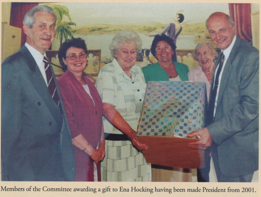
At the AGM on the 8th April 1980 members voted to elect Sheila, its first President and Mr F Clarke its Chairman. Sadly, due to ill health Mr Clarke had to resign within months and Vice Chairman Mr C Scone then stood in as Acting Chairman. But highlight of this year came when in December, Mrs Ena Hocking was elected Chairman, a role she would hold for twenty-one years. It was through Ena chat visits were arranged to new historic venues of interest and guided walks in Brixham and Old Paignton. Visits to Disraeli's (previously Mount Braddon) and to Loventor Manor (near Berry Pomeroy) and the Elizabethan Manor House now called Churston Court Inn were also arranged in the year of HRH Queen Elizabeth the Queen Mother's 80th birthday. To celebrate this, the society planted Scots Pines at Thatcher Corpse on the coastal road of Ilsham Marine Drive Torquay following which a letter was received from Clarence House thanking the society members for their imaginative planting of trees that, "Her Majesty felt sure had been planned and executed with great care".
1981, the "Year for the Disabled" saw the Chairman install a new scented garden of trees and shrubs at Lower Hollicombe with a special seat being placed nearby. By now it had launched its Certificates of Merit scheme and chis same year, certificates were awarded co Jurgen Etheridge for his refurbishment of the Pavilion and as a member of the Tree Committee and to his Worship the Mayor of Torbay Councillor L Blogg who, on behalf of the Borough Council, accepted one for the landscaping work at the Hollicombe Scented Garden.
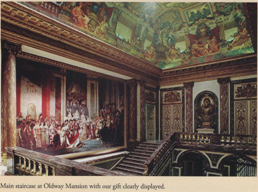
By the spring of 1984, Torbay Council agreed to allow the society to use part of the ground floor of Oldway Mansion to create a heritage space for a "Singer Museum" with items donated by the people of Paignton. The facility is still in place although Oldway Mansion today is closed, awaiting its fate. Under a separate project, proposals were afoot to replace the original painting of "Napolean Crowning Josephine at Notre Dame Cathedral" on the staircase of Oldway Mansion using a special photocopy of the original tapestry which had been returned to the French Government some years previously. Meanwhile, the society were delighted to learn chat Mrs Hocking had received an award for her services co the County of Cornwall and was created a Bard of the Cornish Gorsedh.
The Second Decade - 1986
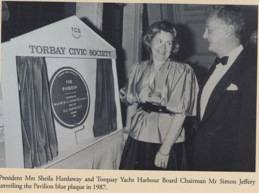
By now, the society had introduced their Blue Plaque Heritage Scheme, which would provide Blue Plaques honouring famous individuals or buildings or monuments throughout Torbay. Under the Chairmanship of Arthur Ebdon, a sub-committee comprising Secretary Denis Walton and Frank Cawson had organised the scheme which would install plaques across the three towns for residents and visitors co view. Cases would be underwritten by the society although generally the owner of the property paid for the Blue Plaque. The first plaques unveiled were: Beverley Nicholls (Torquay), the Rev. H Lyte (Brixham), Sc Marychurch Town Hall (sponsored by the Rotary Club) the Paignton Clink (sponsored by Torbay Council). By the end of 1988, a total of 24 plaques had been unveiled and this in spice of delays through the intervention of the Historic Buildings and Monuments Commission. Meanwhile in the annual report chat year the Chairman was able to confirm chat the Torquay Town Trail leaflet had reached second place in a nationwide competition of excellence, an award scheme sponsored by the National Wimpey Construction Company.
Now the society assisted the Brixham Residents' Association and in 1985 were updated on the proposals co extend the so-called Brixham Harbour ''Arm" which was likely to be subject to a public enquiry. The year also saw the local authority agreeing to donate a room at Torre Abbey to the society for it to furnish and create a permanent Agatha Christie memorial room. Sadly, this would later be removed when Torre Abbey was redeveloped with help of Heritage Lottery funding.
In responding to a request from Cllr Denis Reid to support the Civic Week of Pride, the society contributed a static display of its photographic memorabilia in all three towns. The exhibition went to the Scala Hall at Brixham, Clennon Valley at Paignton and the Riviera Centre in Torquay. Then came the removal of trees from Cary Parade to make way for the new Fleet Street and Cary Green redevelopment by Rosehaugh PLC. This saw the society agree to replace the trees while also constructing a special circular seat for public use on the so called "ziggurat walkway" of the pedestrian bridge into Fleet Walk.
At council level a Centenary Committee had been set up with members of the society involved. Meanwhile, Sheila Harding our founder, first Chairman and now first President would leave Torbay for a new future elsewhere. During the late 1990s another so-called "white elephant" was subject to demolition, when Coral Island built on the site of the council's Marine Spa was itself demolished to make way for the Paignton Zoo Living Coasts complex. Meanwhile, the society had launched its Tree Fund scheme, which turned out to be enormously successful. The society planted trees in their thousands, replacing any lose due to disease, storm damage or age.
The Mayor and Chief Executive Office of the council even attended the launch of the TCS Tree Fund when a special subscribers' book to record donations was produced. The Borough Conservation Officer Mike Chittenden produced an audio/visual presentation showing the trees across the whole of the three towns of Torbay. A generous financial donation by the Leech Trust, allowed the woodland walk between Torre Abbey and the new ERC building to be replanted with new shrubs and trees by the society which also endorsed the appointment of The Rr Hon. Viscount Falkland as Patron, an appropriate appointment as it linked us with the famous Cary family of Torre Abbey and Cockington, Torquay.
With the subscription fee rising from £1 to £2 in 1991, this was not seen as controversial until members heard of our reserves. In February 1991, a scheme to take 46 members by coach on a holiday to Brittany was arranged by Mr & Mrs Denis Walton. On their return this was hailed a huge success as everyone had enjoyed six days of heritage education of the standing stones of Brittany.
Meanwhile, John Law announced this year was his "swan song" owing to personal difficulties. His final planning report concerned the Warberry Corpse where the "tele-mast" issue had returned. The telecoms giant Orange Personal Communications wanted to remove the Water Reservoir Tower and erect a higher structure and mast leading to local residents and the society renewing their objections.
In 1993 English Heritage removed Paignton from its list of "Town Schemes at Risk'' believing the area was in good condition, which came as a shock to members at that time and indeed even today the town centre in Paignton needs renewal.
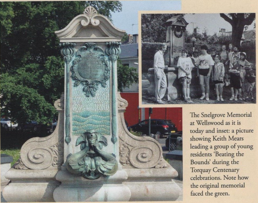
During the final years of this period, the Napoleon picture at Oldway, after massive fundraising under the watchful eye of the Treasurer Keith Mears (who had succeeded Jim Oliver), was officially unveiled while the Paignton Picture House was supported after a change of use threatened its future.
Finally, after a committee decision the TCS Blue Plaque scheme, ceased in 1998.
The Five Years to 2001
With the planning brief having been undertaken by Chairman Mrs Ena Hocking since 1993, this did not deter her from appearing on Westcountry Television to raise concerns about the future of Torre Abbey in 1998 as massive plans were being proposed for huge expansion and refurbishment with the help of the National Lottery.
During the last decade, new links with other local amenity groups and resident associations had included, in particular, the Paignton Preservation Society, being highly active in its area. The TCS was also involved with civic ceremonies and would support the council where possible while keeping their independence as far as any planning proposals were concerned.
Finally at the 1999 AGM proposals to dramatically increase the subscription were made and passed, while at the same time Chairman Ena made a plea for people to step forward and join the committee as she would soon be stepping down as Chairman. At the TCS 2000 AGM Ena announced her intention to step down within the year, a year that saw formal displays of our literature exhibited at Oldway Mansion and at Torre Abbey. The ongoing work of the committee would continue as ever, although now all thoughts were turning to finding a new Chairman for election at the 2001 AGM.
Having approached Ian Handford during 1999 to ask him to be Vice Chairman, Ena explained to members attending the 2001 AGM chat he had been a founder member of the Friends of the Pavilion and Meadfoot & Wellswood Area Residents Association, and was now about to end his term as National Chairman of the Federation of Small Businesses (FSB) after thirty years of lobbying government.
Although still in business in Torbay and a Magistrate on the South Devon Bench, at the AGM in April 2001 Ian was duly elected the new TCS Chairman and as we celebrate this 40th Anniversary in 2016, he is still our chairman.
Ian's initial wish after election was to ensure he retained the experience and knowledge of Ena and therefore lost no time in investing her into the role of President. He was aware that his first 100 days in office could be crucial in establishing credibility and therefore he immediately outlined a ten-point plan of activities while confirming he would personally take on the important role of monitoring all planning applications in Torbay.
Included in the first new activities were the renewal of the TCS Blue Plaque Scheme together with a new "collectors" publication; car stickers for promotional purposes and a label scheme for securing envelopes, plus the promise to create a monthly event involving the members. A "Member Get a member" scheme was commenced in memory of Harold Handford, his late father, who had also been a founder and active member of the TCS until his death in 1991. Ian funded this trophy which was to be presented each year to the member who enrolled the most new members in any year. With a long business background, Ian would now ensure that all new events were sponsored in order to become self-funding, and finally new regalia was created for the President.
The new monthly event, which is still popular today, the "Coffee Morning with a Difference" event, allows members and non-members to attend, which ensures everyone can be more proactive in creating a very different civic society. With the monthly event always held at the Redcliffe Hotel Paignton, and later many of its meetings and AGMs held there too, the committee would eventually place a small Blue Plaque at the entrance to signify that TCS meetings were held there.